
How Should an HRT Clinic Price Its Memberships? ($165 vs $400/Month Breakdown)
INTRO:
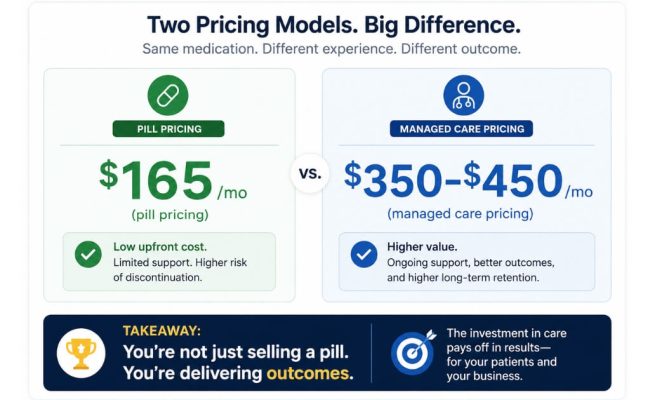
The biggest pricing mistake we see at cash-pay HRT clinics is pricing hormones like pills. A clinic that charges $115 for estradiol plus $30 for progesterone is collecting $165 a month and leaving $250 in managed-care value on the table — every single month, on every single patient, for years. The clinics actually growing in HRT charge $300–$450 a month. Here’s the FAQ on why, and how to restructure your pricing without losing the patients you have.
——————————————————————————
How should an HRT clinic price its monthly membership?
Between $300 and $450 a month for the base hormone protocol, with named add-ons priced as fixed monthly increments.
The benchmark is concrete. Eternity Health Partners in Santa Barbara prices their base hormone protocol for women at “350 to 450” a month and the same for men — add-ons (peptides, growth hormone secretagogues, additional labs) raise that another 50 to 100 dollars. Guard Wellness in Palm Beach charges $350 a month. Rewind Anti-Aging in Miami runs quarterly programs at “400 a month average for three months” — $1,200 a quarter, men and women.
A clinic charging $115 for estradiol and $30 for progesterone — total $165 a month — is, in our consultant’s words on a recent client call, “not even close, like half” of market rate. The pricing isn’t wrong because $165 is cheap; the pricing is wrong because the clinic is selling hormones when the patient is buying managed care. Patients pay $400 a month for the relationship — access to a provider, a clinical team that knows their history, quarterly labs, dose adjustments, follow-up. They don’t pay $400 a month for a bottle of pills, which is why a generic price comparison ($30 retail estradiol) doesn’t even occur to them.
What HRT pricing structure works best for a cash-pay clinic?
A round-number tiered model — one published monthly price for the base protocol, with named add-ons at fixed dollar increments. Stupidly simple, so the front desk and patient coordinator can quote it without consulting a chart.
The same logic that works for GLP-1 pricing works for HRT. NuLevel Wellness in Arizona — a cash-pay clinic running roughly $1.3M a month — prices its GLP-1 protocols at three clean starting tiers (semaglutide, tirzepatide, retatrutide) with a flat $50 step-up per dose. The clinic’s own explanation: “they did it like that just to keep it super simple for their team.” A patient coordinator who has to navigate a 14-tier spreadsheet will quote the wrong number, hesitate, or stall the close. A patient coordinator who can say “$400 a month, $50 more if you want progesterone, $100 more if you want peptides” closes consults.
The structure should look like this for an HRT clinic: a single base monthly price ($350–$450), named add-ons at flat increments ($30 progesterone, $75 peptides, $100 growth hormone secretagogues), and a clearly priced labs panel ($150–$250 at intake). Avoid quarterly billing unless you have a specific operational reason — monthly is what patients budget for, monthly is what your CRM bills, monthly is what your retention metrics track.
Should an HRT clinic offer a low-cost intro injection or trial?
No. Cheap front-end offers attract patients with zero lifetime value and never convert to membership.
Two of our clients ran this experiment at the same time. NuLevel Wellness tested “$99 skinny shots” as a paid-ad front-end. CardioMender MD ran a similar offer around $84. Both clinics’ results: “It has never converted. They’ve never been able to say that they kept somebody for longer than a month. Usually they go in like one, two, three injections, and that’s it. If they even book.” A $99 acquisition cost with one-month retention isn’t a marketing funnel — it’s an expensive way to disqualify your own brand.
The clinics that win in HRT and weight loss position the relationship as managed care from the first dollar. The patient pays for the consult. The patient pays the first month’s protocol. The patient is enrolled in a recurring billing relationship the day they say yes. The highest-performing TRT clinic marketing systems are built around attracting patients who are ready to commit to long-term care instead of one-time promotional offers. There is no $99 step. The lowest meaningful price point is the first month of the program — and that price point is structured to reward retention, not to grab attention.
——————————————————————————
Should we use compounded pharmacy or generic for HRT?
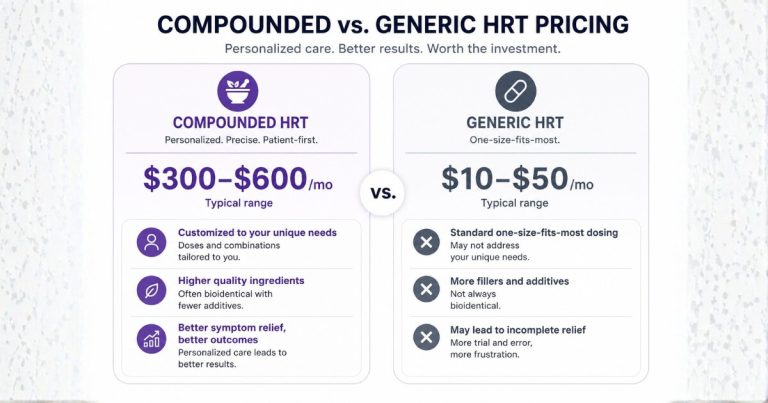
Compounded. Generic estradiol invites the patient to Google the retail price and discover the markup. Compounded prescriptions — branded vial, custom dose, the patient’s name, the pharmacy’s name — make the comparison impossible.
The math on the clinic side looks worse on paper. A generic estradiol pill costs the clinic about $5; a compounded Strive prescription adds roughly $30 to cost of goods sold. The clinic’s per-script COGS triples. But the premium the patient pays absorbs that easily, because the patient now perceives the prescription as a custom protocol rather than a commodity. Compounded scripts also limit retail comparability — “you can’t order from Strive unless you’re a provider,” removing the easy reference price.
Real ADvice’s founder has been an Eternity Health Partners patient for four to five years. Every script he gets comes labeled “Strive Compounding Pharmacy” with his name, dose, and instructions. The packaging is the felt premium. The clinics charging $400 a month aren’t selling hormones at a higher markup — they’re selling a managed protocol delivered through compounded medicine. Different product. Different price ceiling.
What’s the right margin to target on an HRT membership?
Don’t confuse product margin with business margin. A 50% gross margin on the script becomes a 15–20% net margin on the business after staff, provider, marketing, taxes, and owner draw.
The trap every clinic owner falls into is reasoning from the prescription out. “Estradiol costs me $5 and I’m charging $115, so I’m running a great margin.” That’s product margin. It ignores the patient coordinator who scheduled the consult, the front desk that took the call, the provider who reviewed the labs, the EHR subscription, the agency fee, the rent. Once those are subtracted, the realistic business margin is closer to 15–20% — and that’s only true if your acquisition cost is healthy and your retention holds.
The implication: you cannot run an HRT clinic profitably at $165 a month per patient unless you’re acquiring patients organically (no ad spend) and the doctor is doing every part of the job. As soon as you build a real team and run real marketing, $165 a month becomes a money-losing price. “An HRT clinic that scaled from $1M to $4M in revenue over four years did it on a $1,000/month membership for the upper tier — and 250 active members at that price now produce $1.7M a year in recurring revenue alone“. The price ceiling in HRT is much higher than most owners believe, and the floor most owners set is well below break-even.
——————————————————————————
How do I add a profitable maintenance tier to my HRT or weight-loss program?
Build the maintenance product before the patient hits their goal. Auto-route every successful weight-loss patient onto a half-dose maintenance plan, priced close to the starter dose, billed monthly without action required.
NuLevel Wellness does this with weight-loss patients: when a patient hits their goal, they’re moved onto a maintenance dose at roughly half the starting dose, priced close to the starter price. The clinic’s view internally: “it’s like their most profitable program because the lower the dose, the better the margins.” Same patient. Same monthly bill. Half the cost of goods.
The same approach works in HRT. Patients who have hit optimization don’t need monthly dose changes — they need a pre-filled shipment, a quarterly check-in, a yearly comprehensive lab panel. Charge them the same monthly price they paid in the optimization phase (or 80–90% of it), ship the maintenance dose on autopilot, and the relationship becomes the most profitable line in the business. “A medspa that added $6.7M in revenue in one year built that growth on retention loops like this — automated refill forms, free follow-up consults for under-performing patients, branded-merchandise giveaways for milestone hits — turning every successful weight-loss patient into a long-tail revenue stream rather than a one-time procedure“.
——————————————————————————
What’s the next step?
If you’re a cash-pay HRT, TRT, or hormone clinic owner and the patients are coming through the door but the monthly economics don’t justify the team you need to build — book a strategy call. In 60 minutes we’ll audit your current price points, your add-on structure, and your compounding pharmacy relationship, and map a 90-day path to the $300–$450/month membership pricing that comparable clinics are already running. If it’s a fit, we’ll fly to your clinic and rebuild the patient journey with your team.