
How Should a Direct Primary Care Clinic Price Family vs Individual Memberships?
A direct primary care clinic lives or dies on its membership pricing — set it wrong and you either scare off families or leave money on the table with individuals. The clinics that get it right use a clean structure: a flat monthly individual tier, a modest family premium on top of it, core primary care fully included, and high-value add-ons discounted to keep members buying through the practice. Here’s the FAQ on how to price family versus individual DPC memberships, built from a real practice’s pricing model.
How should a direct primary care clinic price family vs individual memberships?
Set a flat monthly individual rate that bundles core primary care, then offer a family tier at a modest premium over it — for example, individual DPC around $275/month and family DPC around $350/month — with labs, consults, and sick visits included in both.
The flat fee and the bundled inclusions are what make membership feel obviously worth it.
The whole point of direct primary care is predictability — for the patient and for the clinic.
A flat monthly fee that covers the core of primary care:
- Labs
- Initial consults
- Follow-up consults
- Sick visits
removes the per-visit friction that keeps people from getting care.
It also gives the clinic recurring, forecastable revenue.
The individual tier anchors the pricing.
The family tier extends the same value to a household for a modest step up, which is far more attractive to a parent than paying per person.
Getting this structure right is foundational to the kind of recurring-revenue model that lets a cash-pay practice scale.
It’s also a core piece of any modern medical practice marketing strategy built around memberships.
What’s the difference between the family and individual DPC tiers?
The individual tier covers one member.
The family tier covers the whole household for a modest premium — making the per-person cost of family coverage far lower.
The family tier is where lifetime value and stickiness come from.
In the real model:
- Individual DPC runs about $275/month
- Family DPC runs about $350/month
That $75/month difference covers an entire household instead of one person.
The family math becomes extremely compelling for a parent.
A couple with kids gets:
- Everyone’s primary care
- Labs
- Consults
- Sick visits
- Discounted kids’ sick visits
for barely more than a single membership.
The family tier is also the retention engine.
A family that relies on your clinic for everyone’s care is dramatically less likely to leave than a single member.
Pricing the family tier to be an easy “yes” pays off in years of recurring revenue, not just one signup.
What should be included in a DPC membership versus discounted?
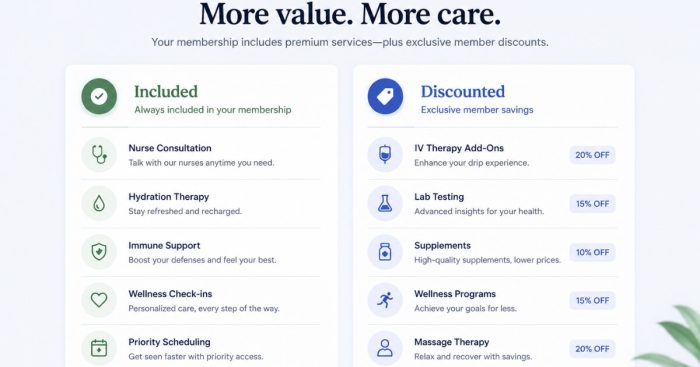
Include the core of primary care — labs, initial and follow-up consults, and sick visits — and discount the high-value add-ons like hormones, GLP-1, peptides, and supplements (for example, 15% off).
Inclusions drive the join.
Discounts drive the ongoing spend.
The line between “included” and “discounted” is the most important pricing decision a DPC clinic makes.
Everything a member uses routinely should be included:
- Labs
- Initial 60-minute consult
- Follow-up labs
- Follow-up consults
- Sick visits
- Kids’ sick visits at a low cash rate
Those inclusions are what make the flat fee feel like a bargain.
The optional, high-margin add-ons should be discounted:
- Hormones
- GLP-1
- Peptides
- Supplements
A flat 15% discount works cleanly.
That keeps the membership profitable while giving members a real reason to buy those services through you instead of sourcing them elsewhere.
Include what builds the value story.
Discount what captures the upside.
How do I price the membership so it clearly beats paying à la carte?
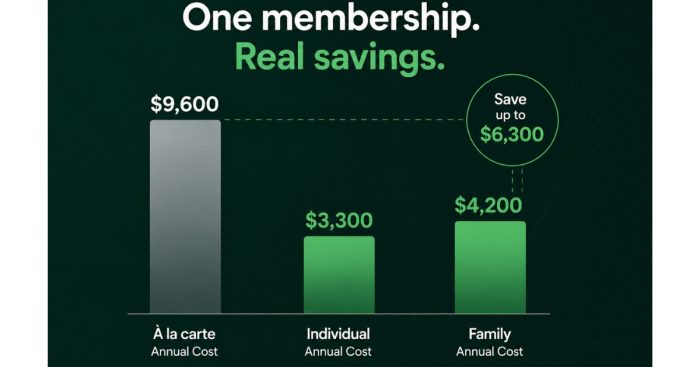
Total the annual à la carte cost of everything a typical member uses and show it next to the annual membership cost.
When à la carte runs roughly $9,600 a year and the membership runs $3,300–$4,200, the value is undeniable.
Members don’t join because the membership sounds nice.
They join because the math is obvious.
In the real model:
- À la carte services total about $9,600 per year
- Individual DPC costs about $3,300 per year
- Family DPC costs about $4,200 per year
Put those numbers side by side and the membership becomes self-justifying.
The patient:
- Saves thousands
- Gets predictable care
- Avoids per-visit friction
On the add-ons, spell out the monthly savings too.
Members save roughly:
- $60/month on GLP-1
- $45/month on peptides
- $30/month on supplements
when they use them.
The clinic’s job is simply to make the comparison visible.
The patient does the rest.
This is the same value-stacking discipline behind an HRT clinic we grew from $1M to $4M a year on 250 members paying $1,000 a month.
Should I add a separate hormone membership alongside DPC?
Yes.
A dedicated hormone membership captures the high-lifetime-value hormone patient who may not want full primary care, and it gives DPC members a natural upsell.
The hormone tier is often your most profitable.
Not every hormone patient wants a primary care relationship.
Not every DPC member wants hormones.
A standalone hormone membership (in the real model, around $400/month) lets you serve both without forcing one into the other.
It includes:
- Labs
- Consults
- The hormone protocol
along with discounts on:
- Peptides
- GLP-1
- Supplements
For the practice, hormones are the textbook recurring, high-margin service.
A clean hormone tier alongside the DPC tiers maximizes lifetime value.
A patient can:
- Join for hormones and later add family DPC
- Join for DPC and later add hormones
Offering both, priced clearly, captures more of the market than forcing everyone into a single membership.
How do I present DPC pricing so families choose the membership?
Show the tiers side by side, list exactly what’s included in each, and put the annual à la carte total next to the annual membership cost so the savings are impossible to miss.
Clarity converts.
The presentation matters as much as the numbers.
Lay out the tiers as columns:
- À la carte
- Individual DPC
- Family DPC
- Hormone membership
Use a clear “included” or “discounted” marker next to each service.
Then show the annual totals so a family can immediately see that membership costs a fraction of paying per visit.
Lead with family value:
- Everyone covered
- Predictable costs
- No surprise bills
because that’s the emotional driver for a parent.
When the page does the comparison for them, the membership stops looking like an expense and starts looking like the obviously smart choice.
That’s exactly how cash-pay memberships are meant to be sold.
FAQ’s About DPC Family and Individual Membership Pricing
How much should a direct primary care membership cost?
A flat monthly fee per tier works best.
For example:
- Around $275/month for an individual
- Around $350/month for a family
Core primary care should be included:
- Labs
- Consults
- Sick visits
The flat fee removes per-visit friction and gives the clinic predictable recurring revenue.
Why is the family DPC tier only slightly more than the individual tier?
Because the small premium (for example, $75/month) makes covering an entire household an easy “yes” for a parent and dramatically lowers the per-person cost.
The family tier is also far stickier.
A family that relies on your clinic for everyone’s care rarely leaves.
What should a DPC membership include versus discount?
Include the routine core:
- Labs
- Initial consults
- Follow-up consults
- Sick visits
Discount high-value add-ons:
- Hormones
- GLP-1
- Peptides
- Supplements
A flat 15% discount works well.
Inclusions drive sign-ups.
Discounts capture ongoing spend.
How do I prove the membership beats à la carte?
Show the annual à la carte total (around $9,600 in the real model) next to the annual membership cost:
- $3,300 individual
- $4,200 family
The side-by-side comparison makes the savings undeniable.
Should I offer a separate hormone membership?
Yes.
A dedicated hormone tier (around $400/month) captures high-lifetime-value hormone patients who don’t want full primary care and gives DPC members a natural upsell.
Hormones are typically the most profitable recurring service.
What’s the next step?
If your direct primary care pricing is guesswork — or if you’re forcing every patient into one membership — you’re either scaring off families or leaving recurring revenue on the table.
A clean structure:
- Individual DPC tier
- Family DPC tier
- Core care included
- Add-ons discounted
- Standalone hormone membership
priced clearly against à la carte fixes both.
If you want help modeling your DPC tiers and building the pricing page that converts families, that’s the conversation to book.
We’ll map your service menu into a membership structure built for your market and margins.