
How Do You Price Cash-Pay Services Based on Actual Cost (Margin-Safe Pricing)?
Most cash-pay clinics set prices by looking at what the practice down the street charges, adding a round number, and moving on. That is not pricing — it is guessing, and it is the single most common reason a busy clinic still runs thin.
Margin-safe pricing works the other direction: you find the true cost of delivering each service, decide the margin you need to keep, and back into the price from there.
This is the answer-first guide to building a cost-based price for every line on your menu so profit survives discounts, slow weeks, and rising input costs.
What counts as the actual cost of a cash-pay service?
Three layers, every time:
- Cost of goods
- Direct labor
- Allocated overhead
Skip any one of them and your “cost” is fiction.
Cost of goods includes the consumable spend that exists only because you performed a specific service.
Examples include:
- GLP-1 medication
- Lab panels
- Syringes
- Injectables
Direct labor is clinical time priced at a fully loaded hourly rate, not just the provider’s wage.
For example:
- A 60-minute initial consultation ties up a provider for an entire hour.
- A 20-minute sick visit consumes only one-third of that time.
As a result, service length directly impacts labor cost.
That is why a 60-minute consult and a 20-minute sick visit cannot share the same labor allocation, even when their consumable costs are identical.
Allocated overhead is the cost layer most clinics overlook.
This includes:
- Rent
- Software subscriptions
- Front-desk payroll
- Malpractice insurance
- Marketing
- Merchant processing fees
This is also where margins quietly disappear.
A service may appear profitable when you only consider labor and goods. However, once overhead is applied, it may actually lose money.
If you want a complete picture of how acquisition cost fits into overhead allocation, our medical practice marketing framework treats marketing spend as a cost of delivery rather than an afterthought.
Until all three cost layers are documented for every service, pricing remains guesswork.
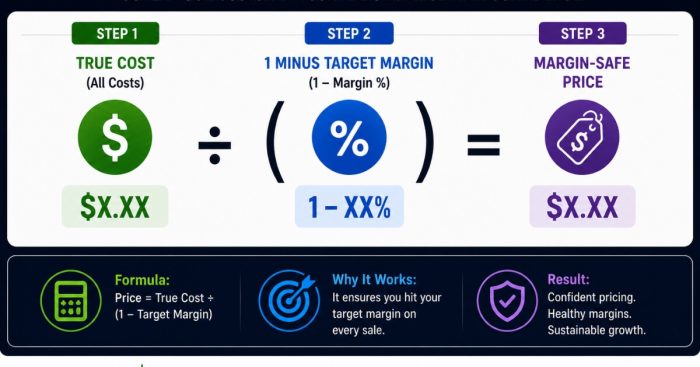
How do you actually calculate cost-based price per service?
Add the three cost layers together to determine true cost.
Then decide the gross margin you need.
Finally, divide.
Do not simply apply a markup.
The formula is:
Price = True Cost ÷ (1 – Target Margin)
For example:
- True cost: $150
- Target margin: 60%
Calculation:
- $150 ÷ (1 – 0.60)
- $150 ÷ 0.40
- Price = $375
Notice that this is not the same as adding a markup.
That distinction matters.
Markup and margin are different calculations.
A flat 50% markup on a $400 GLP-1 program with $250 in true cost produces a very different outcome than a 50% markup on a $100 sick visit with $40 in true cost.
Build pricing service by service.
Each line item should have its own:
- Goods cost
- Labor cost
- Overhead allocation
Then calculate pricing based on the margin you need.
Consider a concierge medicine service menu that includes:
- 60-minute initial consults
- Follow-up consultations
- Lab panels
- Follow-up lab reviews
- Monthly hormone programs
- GLP-1 programs
- 20-minute sick visits
Each carries a different labor burden and goods cost.
The 60-minute consult carries three times the labor cost of the 20-minute visit.
Meanwhile, a GLP-1 program typically carries substantially higher goods costs than a hormone subscription.
Apply one pricing rule to all of them, and at least one service will end up underwater.
What target margin should a cash-pay practice aim for?
There is no universal target.
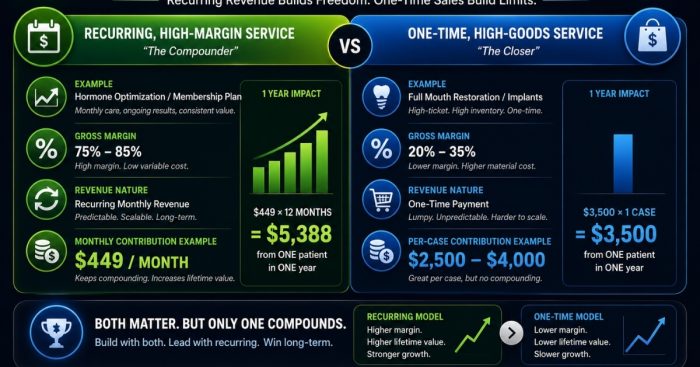
However, sustainable cash-pay practices price recurring services to high gross margins so membership economics support the business.
Recurring services with minimal goods costs, such as hormone memberships, should maintain very strong gross margins.
The cost to deliver each additional month is relatively low.
Meanwhile, lifetime value is high.
High-goods services operate differently.
Examples include:
- GLP-1 programs
- Lab-intensive diagnostic workups
These services carry meaningful per-unit costs.
Therefore, focus on protecting dollar contribution rather than forcing a specific percentage margin.
The goal is simple:
- Protect margin percentages on recurring services.
- Protect dollar contribution on high-goods services.
Then layer the services together.
Use front-end services to acquire patients.
Use recurring services to compound value over time.
That approach is exactly what helped Eternity Health Partners from roughly $1M to $4M.
The growth did not come from one dramatic price increase.
Instead, it came from understanding the true cost of every service and pricing recurring services to carry the business.
Why does underpricing quietly kill profit even when the practice looks busy?
Because volume hides margin leaks.
A service priced $40 below its margin-safe floor loses $40 every time it is delivered.
At first, that loss is difficult to see.
The schedule remains full.
Patients keep booking.
Staff stay busy.
Yet the profit never shows up.
Over time, the problem compounds.
Discounts, packages, and no-shows create even more pressure on a service that was already underpriced.
For example, a 20% promotional discount applied to a service priced at a 40% margin can drive actual delivered margin close to zero.
The solution is straightforward.
Establish the floor price from cost first.
Then determine how much discounting the margin can safely absorb.
Without knowing true cost, every discount becomes a guess.
Some of those guesses end up below cost.
This becomes especially dangerous in multi-service practices.
One underpriced offer can drag down the profitability of an otherwise healthy menu.
We saw the opposite effect when pricing was deliberately structured across an entire service portfolio at NuLevel Wellness Medspa, which added $6.7M in a single year.
Margin-safe pricing compounds.
Margin leaks compound too.
The difference is which one you choose to build.
How do you keep prices margin-safe as costs change?
Rebuild your service cost layout at least twice per year.
Additionally, update it whenever a major input cost changes.
Common cost shifts include:
- Drug acquisition costs
- Lab contracts
- Staff wages
- Rent
- Merchant processing fees
A service that was profitable in January can become underwater by July without any visible menu changes.
Treat the cost layout as a living document.
Each service should have its own row with:
- Goods costs
- Labor costs
- Overhead allocation
Whenever inputs change, rerun the formula:
Price = True Cost ÷ (1 – Target Margin)
The practices that protect margins consistently review pricing on a schedule.
They do not wait until profitability declines.
Ideally, tie pricing reviews to the same cadence used for:
- Marketing spend reviews
- Patient acquisition cost reviews
- Financial reporting
That way, costs and revenue remain part of the same conversation.
Pricing is not a one-time setup.
It is an ongoing operational process.
The practices that understand that principle are the ones whose profits grow alongside their schedules.
FAQ’s About Cost-Based Pricing for Cash-Pay Services
What counts as the “actual cost” of a cash-pay service?
Three layers determine actual cost:
- Cost of goods
- Direct labor
- Allocated overhead
Cost of goods includes consumables such as GLP-1 medication, lab panels, and filler syringes.
Direct labor is clinical time priced at a fully loaded hourly rate.
Allocated overhead includes rent, software, front-desk payroll, malpractice insurance, marketing, and merchant fees.
You cannot price accurately until all three are documented for every service.
How do you actually calculate cost-based price per service?
First, add together goods, labor, and overhead.
Then use the formula:
Price = True Cost ÷ (1 – Target Margin)
For example, a service with a $150 true cost and a 60% target margin should be priced at $375.
This approach differs from markup-based pricing because markup and margin are not the same calculation.
Each service should be priced individually based on its own cost structure.
What target margin should a cash-pay medical practice aim for?
There is no single benchmark.
Recurring services with low goods costs should maintain high percentage margins.
Meanwhile, high-goods services should protect dollar contribution.
The objective is to balance profitability across the entire service mix rather than forcing every service to hit the same percentage target.
Why does underpricing quietly kill profit even when the practice looks busy?
Because every underpriced service creates a hidden loss.
A service priced $40 below its required floor loses $40 every time it is delivered.
Volume hides the problem temporarily.
However, discounts, packages, and no-shows often magnify the damage.
Always establish pricing from true cost before deciding how aggressively to discount.
How often should you rebuild the cost layout and re-check prices?
At least twice per year.
Additionally, revisit pricing whenever major costs change.
Drug prices, wages, rent, lab contracts, and merchant fees all fluctuate.
Maintain a service-by-service cost layout and rerun pricing calculations whenever significant inputs move.
What’s the next step?
If you run a cash-pay medical practice and have never documented the true cost of every service, you are pricing blind.
A busy schedule is not the same thing as a profitable business.
Start by building a complete cost layout.
Document:
- Goods costs
- Labor costs
- Overhead allocation
Then determine the margin you need to keep.
Use the formula:
Price = True Cost ÷ (1 – Target Margin)
Protect percentage margins on recurring services.
Protect dollar contribution on high-goods services.
Finally, review the layout regularly so rising costs never quietly erode profitability.
If you want someone to pull your full service menu, build the cost layout with you, and identify exactly where your pricing is leaking margin, that is the conversation to book.
We will map your margin-safe price stack on the call.