
How Should a Cash-Pay Clinic Price Its À La Carte Services (So the Membership Wins)?
Most cash-pay clinic owners set à la carte prices as an afterthought — a number on a sheet for the rare patient who won’t join anything. That’s a mistake. Your per-service prices are the anchor that makes your membership look like a steal. Set them on purpose and the membership sells itself; set them carelessly and you’ve quietly capped your recurring revenue. Here’s the FAQ on pricing à la carte services at a cash-pay practice.
How should a cash-pay clinic price its à la carte services?
Price each service to stand on its own as a fair, profitable number — and to make the membership the obviously better deal by comparison.
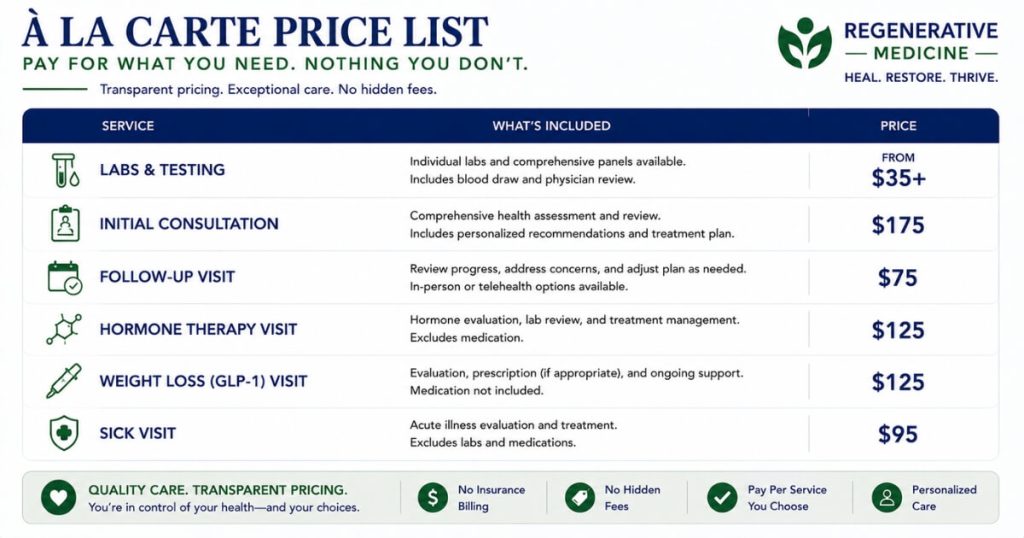
A clean à la carte sheet from a real concierge/optimization clinic looks like this:
- Labs: $300
- 60-minute initial consult: $300
- Follow-up labs: $300
- 60-minute follow-up consult: $300
- Hormones: $100 per month
- GLP-1 program: $400
- 20-minute sick visit: $100
Every line is a self-contained price a one-off patient can pay without joining anything.
That matters: the à la carte menu is what protects you from undercharging the patient who only wants one thing, and it’s the reference point every membership conversation is measured against.
The discipline is to set these numbers deliberately, not reactively.
Each price should reflect the real value and cost of delivering that service, hold a healthy margin, and read as credible to the patient in front of you.
Pricing is a core lever in any serious medical practice marketing strategy — it determines both what you earn per patient and how easily the membership converts.
Why price services à la carte at all if I want everyone on a membership?
Because the à la carte menu is the anchor — without it, the membership has nothing to be cheaper than.
If you only show a membership, the patient has no reference point.
“$199 a month” is just a number floating in space, and the brain has nothing to compare it to except their other monthly bills.
But put the à la carte sheet next to it — labs $300, consult $300, hormones $100/month, follow-ups $300 each — and the membership stops being an expense and becomes a discount.
The patient does the math themselves and concludes the membership is the smart move.
You didn’t discount anything.
You gave them a frame.
This is also basic revenue protection.
Some patients genuinely only want one service this year — one round of labs, one consult, one GLP-1 cycle.
Without an à la carte price, your front desk either improvises a number (usually too low) or pushes a membership the patient isn’t ready for and loses the sale entirely.
A clear per-service menu lets you capture revenue at every level of commitment.
How do I set the price of an initial consult and labs?
Price the entry point high enough to be taken seriously and to be worth crediting toward a membership later.
In the example sheet, labs and the 60-minute initial consult are each $300 — meaningful numbers, not throwaway “free consult” pricing.
There’s a reason for that.
A patient who pays $300 for a consult shows up, takes the visit seriously, and is dramatically more likely to enroll than a patient who booked a free call.
The entry price filters for intent.
And because it’s a real number, you can credit it toward the first month or first block of membership, which turns the consult fee into a reason to join rather than a barrier.
Follow-ups should be priced the same way — $300 for follow-up labs, $300 for a 60-minute follow-up consult in the example.
Consistent, credible pricing across the patient’s journey keeps the membership math clean: every à la carte visit they’d otherwise pay for is a visit the membership covers.
How should I price recurring services like hormones and GLP-1?
Price recurring services so the per-month or per-cycle number is fair on its own but clearly better inside the membership.
In the sample sheet, hormones are $100 per month à la carte and a GLP-1 program is $400.
These are the services that recur — and recurring services are where the membership earns its keep.
When hormones are $100/month à la carte but included or discounted inside a membership, the patient who plans to stay on therapy has an obvious reason to join.
The recurring line items are the hook that converts a one-time buyer into a member, and members are worth multiples of one-off patients over their lifetime.
This is exactly why high-LTV recurring verticals — HRT, TRT, functional medicine — build so much enterprise value.
That kind of recurring base starts with pricing recurring services so the membership is the rational choice for anyone who plans to stick around.
How do I use à la carte pricing to make my membership the obvious choice?
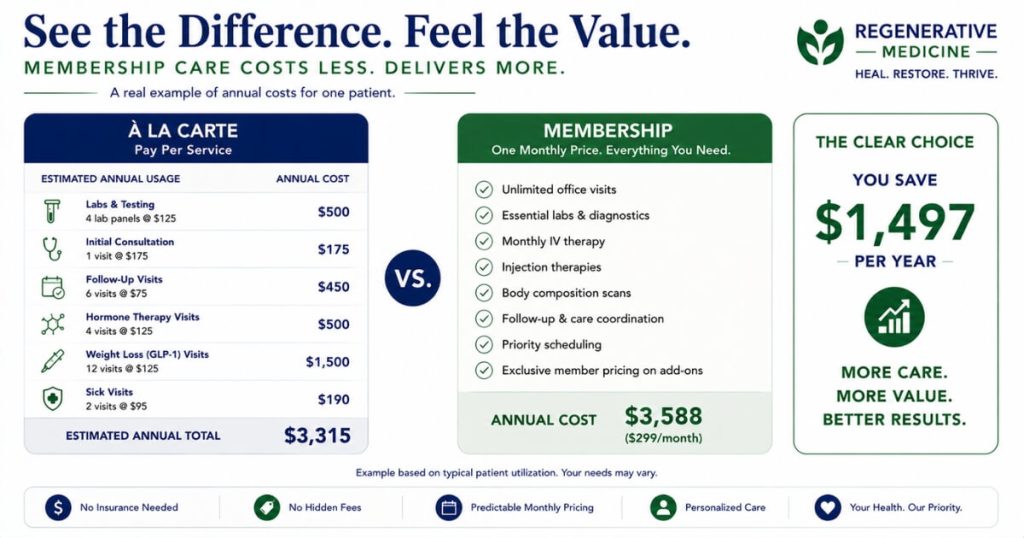
Show the patient the à la carte total they’d pay over a year, then show the membership beside it — and let the gap do the selling.
Add up what an engaged patient would actually spend à la carte across a year:
- An initial consult
- Labs
- Follow-up labs and consults
- Monthly hormones
- Maybe a GLP-1 cycle
That number climbs fast.
When you place that annual à la carte total next to the membership’s annual cost, the membership wins on price and convenience at the same time — and you never had to “discount.”
You simply made the comparison visible.
That’s the whole move:
- À la carte prices set high and on purpose
- Recurring services that are clearly cheaper inside the plan
- A side-by-side comparison that lets the patient talk themselves into the membership
It’s the same conversion logic that powers a predictable patient acquisition system — make the better option the easy option, and stop leaving money on the table at the point of sale.
VYVE Wellness grew website leads by 900% and added 100+ inbound calls a month; turning that demand into members instead of one-off visits is what pricing structure decides.
FAQ’s About À La Carte Pricing for a Cash-Pay Clinic
Should I show à la carte prices on my website?
Show enough to anchor, but steer the conversation to the membership.
Many clinics publish a starting à la carte price or a “from” range and reserve the full menu and membership comparison for the consult, where the front desk can frame the value.
The goal is to anchor expectations without letting a single number become the whole decision.
Won’t high à la carte prices scare patients away from booking?
A credible entry price filters for intent rather than scaring off real buyers.
Patients shopping purely on price were never going to become high-value members.
A $300 consult that’s credited toward the membership converts better than a free call full of tire-kickers.
How much higher should à la carte be than the membership equivalent?
Enough that the membership is clearly the better deal once a patient uses more than one or two services.
There’s no universal multiple.
The right gap is the one where any engaged patient who does the math concludes the membership saves them money over a year.
Should recurring services like hormones be included in the membership or just discounted?
Either works, as long as the membership is plainly the cheaper path for someone who plans to stay on therapy.
Including them simplifies the pitch.
Discounting them preserves more à la carte revenue.
Pick based on how aggressively you want to drive enrollment.
How often should I revisit my à la carte pricing?
At least annually, and any time your costs, your market, or your membership structure changes.
Prices set once and forgotten quietly erode your margin and weaken the membership comparison.
Treat the menu as a living document.
What’s the next step?
If your à la carte prices were set by guesswork and your membership isn’t converting the way it should, the two problems are connected.
Pricing the menu on purpose is how you protect your margin on one-off patients and make the membership the obvious choice for everyone else.
On a 60-minute strategy call we’ll look at your service menu, your membership, and your conversion numbers together, and map exactly how to price so more patients choose the recurring plan.