
How Do You Market a Regenerative Procedure Nobody Searches For? (The Percutaneous Tenotomy Email Playbook)
Stem cells have a search market. PRP has a search market. Percutaneous tenotomy — an ultrasound-guided procedure that removes damaged tendon tissue through a needle-sized opening — has almost none. No patient wakes up and Googles it, which means every ad dollar pointed at the procedure name dies on arrival. So how does a regenerative medicine clinic actually sell it? This is the FAQ on the email playbook a regenerative pain practice (Piedmont Physical Medicine & Rehabilitation) uses to introduce an unknown procedure to the leads it already has — and why the same structure works for any new service line patients can’t spell yet.
Why can’t you market percutaneous tenotomy the way you market stem cells?
Because stem cell therapy has category awareness and percutaneous tenotomy has none — and a procedure nobody searches for can’t be sold through search.
A patient with knee pain has heard of stem cells.
They arrive Product Aware, comparing providers.
The same patient has never heard of percutaneous tenotomy, so there’s no demand to capture — only demand to create.
That changes the channel math completely.
What that means in practice:
- Search ads on the procedure name reach nobody.
- Education has to come first.
- The cheapest audience to educate is the one you already own:
- existing leads
- existing patients
- former inquiries
That’s exactly where this playbook runs.
The clinic doesn’t launch the procedure with a cold-traffic campaign.
It launches with an email to people who already inquired about pain care.
The list already:
- trusts the practice
- has the condition
- only needs the bridge from:
- “my elbow hurts”
- to
- “this new procedure treats exactly that”
Creating awareness inside an owned audience before spending on a cold one is the foundational move in stem cell clinic marketing for any new orthobiologic or regenerative offering.
How do you introduce a procedure your patients have never heard of?
As news, not as science — a short “have you heard about our new service?” email with social proof attached and a link to the procedure page.
Email 3 of the sequence is disarmingly simple:
We just wanted to check in to see if you’ve heard about our new service — it’s percutaneous tenotomy — our patients won’t stop raving about it, and we thought it might interest you.
Then:
- a link to the clinic’s ultrasound-guided percutaneous tenotomy page
- the standing consult CTA
Notice what it doesn’t do.
It does NOT include:
- an anatomy lesson
- clinical-study citations
- a four-paragraph explanation of how the needle works
The announcement email has only three jobs:
- Plant the name.
- Attach borrowed enthusiasm.
- Route the curious to a page that provides deeper education.
Clinics consistently over-explain new procedures in email and watch open rates crater.
News format wins because curiosity — not comprehension — is what produces the click.
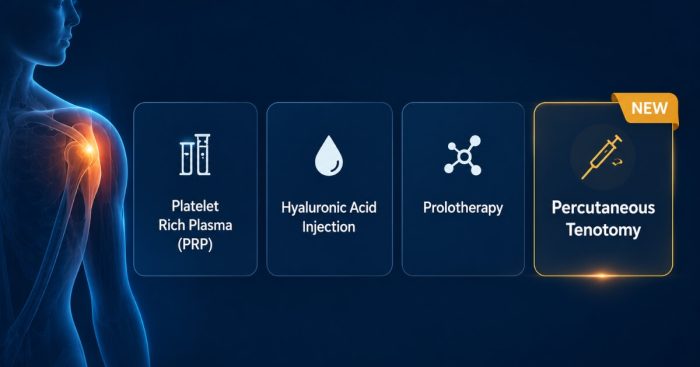
Where should a new procedure sit in your treatment menu?
Fourth line of a familiar list.
The sequence always presents it as:
- Prolotherapy
- Platelet-rich plasma injections
- Stem cell therapy
- Percutaneous tenotomy
Emails 4 and 8 both list the regenerative menu in that exact order.
Three knowns.
Then the new one.
That ordering is the credibility transfer.
The patient who recognizes:
- prolotherapy
- PRP
- stem cells
extends the category’s legitimacy to the unfamiliar fourth item automatically.
Compare the perception:
Presented alone:
- Percutaneous tenotomy feels experimental.
Presented inside a familiar regenerative menu:
- Percutaneous tenotomy feels like progress.
Email 4 also does the category framing:
Regenerative medicine restores structure and function to damaged cells and tissues, used primarily for musculoskeletal pain.
Then the menu.
Then the pivotal line:
Call us today and we’ll let you know which route is most suitable for your situation.
That’s important because the clinic never asks the patient to choose the new procedure.
Instead, it asks them to:
- book a consultation
- let the clinician decide
For an unfamiliar ultrasound-guided procedure, that consult-decides framing is the difference between intrigue and anxiety.
What conditions should anchor the campaign if the procedure has no search demand?
The conditions the patient already knows they have.
The sequence anchors on:
- neuropathy
- fibromyalgia
- tendonitis
- migraines
- neck and back pain
- osteoarthritis
- sports injuries
Email 2 never mentions percutaneous tenotomy at all.
Instead, it says:
If you see something on this list that relates to you, reach out now.
The patient self-identifies through the condition.
Examples:
- tendonitis
- a nagging sports injury
- osteoarthritis
Then they book the consult.
The procedure conversation happens later, in the room.
That’s where the clinician can connect:
- “your tennis elbow”
- to
- “this 15-minute needle procedure”
with credibility no email can provide.
This is the condition-first principle that governs all of pain management marketing.
Patients search by:
- symptoms
- diagnoses
- conditions
They do not search by procedure names.
Your campaign’s front end should always be built on condition language first.
The procedure gets introduced one step deeper in the funnel.
How do you use testimonials when the procedure is too new to have any?
Borrow proof from adjacent treatments.
The testimonial email runs:
- prolotherapy stories
- PRP stories
- stem cell stories
that prove the category and the clinician — not necessarily the specific procedure.
Email 6 stacks four different forms of proof:
- a prolotherapy elbow patient on the mend
- a patient praising that the doctor “does not use pain meds to mask the pain”
- a fibromyalgia patient won over by the whole-patient approach
- a knee patient who avoided surgery with PRP and stem cell treatments
None mention percutaneous tenotomy.
It doesn’t matter.
What prospects actually need to believe is:
- The regenerative approach works.
- The doctor is trustworthy.
- The clinic looks at root causes.
Once the category and clinician are trusted, the specific procedure inherits that trust.
This is the same dynamic that built Dr. Joy Kong into the #1 stem cell expert on YouTube — educating the market on procedures patients didn’t yet understand, until the audience trusted her enough to hire four more doctors and scale the clinic beyond her.
Education-led proof converts unfamiliar procedures because the trust attaches to the educator first.
Why is a free consultation the right offer for an unfamiliar procedure?
Because the procedure decision can’t be made from an email.
The free consultation moves the unfamiliar conversation into the highest-trust environment the clinic has.
Every email in the sequence uses the exact same CTA:
Book your FREE CONSULTATION.
Email 7 adds urgency:
Don’t let this offer expire.
Email 8 closes on identity:
Imagine living pain free.
Then the entire regenerative menu is restated.
Notice what’s missing:
- No pricing.
- No procedure discounts.
- No coupons.
- No “20% off tenotomy this month.”
That kind of discounting would make a new procedure look experimental.
The free consultation keeps:
- the barrier low
- the positioning premium
while converting curiosity into a calendar slot.
That’s where the clinician can do the actual selling.
Niche-procedure practices live and die on this structure.
Dr. Groysman, a pain specialist built around SGB — another procedure most patients have never heard of — grew monthly revenue by $40K+ and cut insurance dependence in half using exactly this pattern:
- Condition-first marketing
- Education in the middle
- Consultation-driven conversion
The unfamiliar procedure becomes the obvious answer only after trust has been established.
FAQ’s About Marketing a New Regenerative Procedure
How do you market a procedure with no search volume?
Create awareness inside your owned audience first.
- Email existing leads.
- Email existing patients.
- Introduce the procedure as news.
- Let the consultation provide the education.
Spend on cold traffic only after the owned-list campaign proves the messaging.
Should the procedure name lead the campaign?
No.
Patients self-identify through:
- tendonitis
- osteoarthritis
- sports injuries
- neck pain
- back pain
Lead with the condition.
Introduce the procedure deeper in the funnel.
How should a new procedure appear in the treatment menu?
As the fourth line of a familiar list:
- Prolotherapy
- PRP
- Stem cell therapy
- The new procedure
The known treatments transfer credibility to the unknown treatment.
Never present an unfamiliar procedure by itself.
What proof do you use before the procedure has testimonials?
Use adjacent-treatment proof:
- prolotherapy success stories
- PRP success stories
- stem cell success stories
- whole-patient testimonials
Trust attaches to:
- the doctor
- the category
- the clinic
before it attaches to the procedure.
What’s the right offer for an unfamiliar procedure?
A free consultation with an expiration frame.
That structure:
- converts curiosity into conversation
- keeps pricing in the clinician’s hands
- avoids discount framing
- preserves premium positioning
What’s the next step?
If your regenerative medicine or pain practice is adding a service line patients can’t spell yet —
- percutaneous tenotomy
- shockwave
- SGB
- a new orthobiologic
don’t point ad spend at the procedure name.
Run the owned-list play first:
- Condition-first email
- News-format announcement
- Familiar-menu placement
- Borrowed proof
- Free-consult close
If you want the launch campaign built for your specific procedure and patient list — the same education-led system behind the niche-procedure and stem cell practices above — book a strategy call.
We’ll map your new service line’s funnel on the call and slot it into your broader stem cell clinic marketing system.