
How Do You Map a New-Patient Acquisition Journey for a Cash-Pay Clinic?
Most cash-pay clinics do not have a patient-acquisition problem — they have a patient-journey problem. Demand comes in, but it leaks out between the ad and the booked appointment, between the booked appointment and the show, and between the show and the payment.
The clinics that scale do not generate more leads than everyone else. Instead, they map the journey a new patient actually takes from first touch to paid, assign an owner to every stage, and measure the conversion at every handoff.
This is the concrete map — the six stages, the handoffs where money disappears, why speed-to-lead decides so much of it, and the checkpoints you watch to turn raw demand into booked, paid patients.
What are the stages of a new-patient acquisition journey for a cash-pay clinic?
There are six stages in a cash-pay patient journey.
They begin the moment a prospect first encounters your clinic and end when that patient pays and rebooks.
The six stages are:
- First touch
- Lead capture
- Speed-to-lead contact
- Qualification and offer
- Booking
- Show-and-pay
The first touch may come from:
- A paid advertisement
- A search result
- A Google Business Profile
- A referral
- Word of mouth
Next comes lead capture.
This is where you obtain contact information through:
- Forms
- Phone calls
- Direct messages
- Website inquiries
The third stage is speed-to-lead contact.
This is the first human interaction after the inquiry arrives.
Then comes qualification and offer.
At this stage, you confirm fit and present the cash-pay solution.
After that, the patient books an appointment.
Ideally, a card is placed on file during booking.
Finally, the patient arrives, receives care, pays, and enters the retention cycle.
A typical new-patient intake page is simply stages two through four made visible:
- Capture
- Qualify
- Book
Cash-pay clinics face a unique challenge.
Patients are spending discretionary money.
As a result, trust must be earned repeatedly throughout the journey.
Map all six stages on a single page.
Assign one owner to every stage.
Then identify the single metric that proves a patient moved to the next stage.
The map is not documentation.
It is a diagnostic tool that reveals exactly where revenue leaks occur.
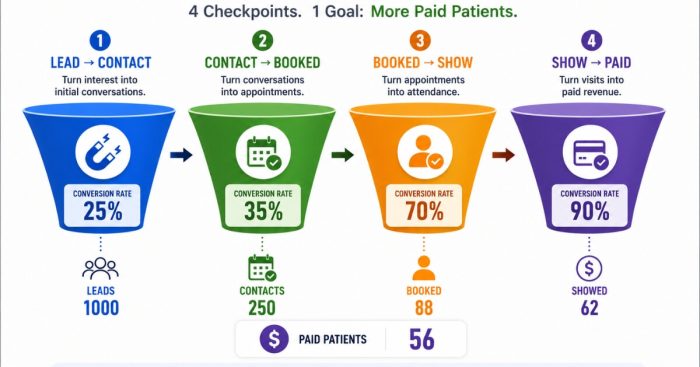
Where do most new-patient journeys leak at a cash-pay clinic?
The biggest leak almost always occurs between lead capture and first human contact.
A lead submits a form.
The inquiry lands in a CRM.
Then nobody follows up while the lead is still warm.
The second-largest leak occurs between booking and showing up.
Patients schedule appointments.
However, they never confirm.
Or they simply fail to arrive.
This problem becomes worse when:
- No card is collected
- No reminder sequence exists
- No confirmation process runs
The third major leak occurs during qualification.
Front-desk staff quote the cash price before establishing value.
As a result, prospects disappear without responding.
The pattern is remarkably consistent.
Every handoff between two people creates an opportunity for revenue leakage.
Patients get:
- Delayed
- Dropped
- Forgotten
The solution is structural.
Treat every handoff as a checkpoint.
Each checkpoint should have:
- A named owner
- A response-time standard
- A tracked conversion rate
That way, leaks become visible on a dashboard instead of hiding in someone’s task list.
This process is the foundation of our patient acquisition system, where the entire journey is managed as an operating asset rather than a sales afterthought.
Why does speed-to-lead matter so much for cash-pay patient acquisition?
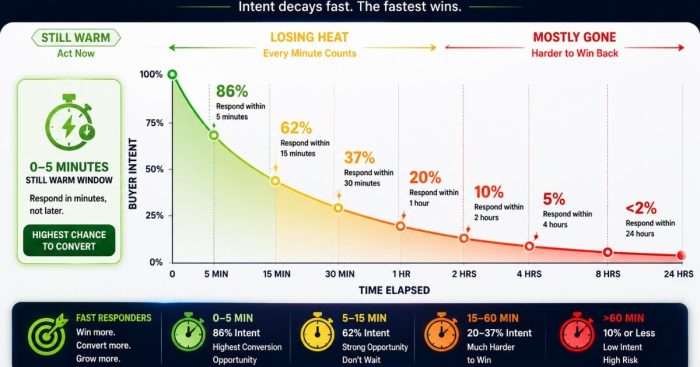
Because discretionary intent decays quickly.
The patient who submits a form is motivated at that exact moment.
Perhaps they:
- Saw an ad
- Experienced a symptom flare-up
- Received a recommendation
Whatever triggered the inquiry, the motivation fades fast.
Consequently, response speed becomes a major conversion driver.
Contacting a lead within minutes instead of hours dramatically increases booking rates.
You reach the patient while intent is still strong.
Additionally, you contact them before competing clinics do.
For cash-pay clinics, speed-to-lead serves a second purpose.
It signals professionalism.
Patients spending their own money look for signs that a clinic is responsive and trustworthy.
Therefore, speed is both a conversion factor and a credibility factor.
Build speed-to-lead into your journey map as a mandatory checkpoint.
Every lead should receive a human contact attempt within a defined timeframe.
That timeframe should be measured continuously.
If it is missed, it should trigger an alert rather than an excuse.
When clinics get this process right, booking volume increases substantially.
The demand itself does not change.
The clinic simply captures more of it before it cools.
That discipline is part of why Eternity Health Partners consistently fields 60 inbound calls and 40 web leads each month while maintaining a predictable booking pipeline.
What conversion checkpoints should a cash-pay clinic measure across the journey?
Measure conversion rates between every stage.
Do not focus only on leads and revenue.
Instead, track each handoff.
The core checkpoints include:
- Lead-to-contact
- Contact-to-booked
- Booked-to-show
- Show-to-paid
In addition, track two operational metrics:
- Median speed-to-lead
- No-show rate
Together, these six numbers describe the entire acquisition journey.
More importantly, they show exactly where performance breaks down.
When you know conversion rates at every stage, you can identify the weakest link immediately.
That allows you to improve the bottleneck instead of spending more money on advertising.
Often, improving one conversion checkpoint generates more revenue than doubling ad spend.
That is exactly the lever Orthobiologics Associates pulled to reach a 79.4% lead-to-booked conversion rate.
The demand source stayed largely the same.
The checkpoint improved.
The journey map tells you which checkpoint deserves attention next.
Who should own each stage of the new-patient journey?
Every stage should have one clearly defined owner.
Ownership eliminates confusion.
More importantly, it creates accountability.
A typical ownership structure looks like this:
| Stage | Owner |
|---|---|
| First Touch | Marketing Team |
| Lead Capture | Marketing Team |
| Speed-to-Lead Contact | Patient Coordinator |
| Qualification | Patient Coordinator |
| Booking | Patient Coordinator |
| Show-and-Pay | Clinical Team + Coordinator |
The most common mistake is assigning follow-up to whoever happens to answer the phone.
As a result, lead conversion becomes inconsistent.
High-performing clinics take a different approach.
They assign lead follow-up to a dedicated patient coordinator.
That person’s primary responsibility is converting leads into held appointments.
They operate with:
- Scripts
- Response-time goals
- Conversion targets
When every stage has an owner, the journey map becomes more than a diagram.
It becomes an accountability framework.
You can immediately identify who owns the underperforming checkpoint and who is responsible for improving it.
Ownership transforms a map into a machine.
How do I turn a journey map into more booked, paid patients?
Start by mapping all six stages.
Then assign:
- An owner
- A conversion checkpoint
To every handoff.
Next, collect data for at least one month.
Once the numbers are available, identify the weakest conversion point.
Fix that stage first.
For most clinics, the first improvement comes from:
- Faster speed-to-lead
- Card-on-file booking
- Automated confirmations
- Reminder sequences
After implementing the fix, measure again.
Then find the next weakest link.
Repeat the process.
This is how clinics compound growth.
Every improvement increases funnel throughput without increasing ad spend.
The gains stack month after month.
The clinics that grow predictably are rarely the ones with the biggest advertising budgets.
Instead, they are the clinics whose patient journeys are:
- Mapped
- Owned
- Measured
From beginning to end.
When every handoff is visible, leaks become obvious.
When leaks are fixed, the same demand produces more booked and paid patients.
FAQ’s About Mapping a New-Patient Acquisition Journey
How long does it take to map a cash-pay patient journey?
The first version can be completed in an afternoon.
Simply list the six stages, assign an owner to each, and identify the metric that proves advancement to the next stage.
The real work comes afterward.
You need at least a month of data collection to identify the weakest conversion point.
The map is quick.
The diagnosis requires measurement.
What is a good speed-to-lead target for a cash-pay clinic?
Aim for a human contact attempt within minutes, not hours.
Discretionary intent fades quickly.
Therefore, the first outreach should happen while the patient is still motivated.
Set a target response window.
Measure median response time.
Then treat missed response windows as process failures requiring attention.
Do I need a CRM to map and track the journey?
You need a system capable of tracking leads and timestamps.
A CRM is usually the best option.
However, the software itself is not the important part.
What matters is tracking:
- Lead-to-contact
- Contact-to-booked
- Booked-to-show
- Show-to-paid
Without timestamps, you cannot identify bottlenecks.
Without measurement, the map becomes a guess.
How is a cash-pay journey different from an insurance-based one?
Cash-pay patients make discretionary purchasing decisions.
As a result, trust and value must be reinforced at every stage.
That makes the following especially important:
- Speed-to-lead
- Qualification
- Offer framing
- Appointment commitment
A card on file and a value-first conversation are not optional.
They are core components of a successful cash-pay acquisition process.
What single change improves a leaking journey fastest?
For most clinics, it is faster speed-to-lead.
Responding while intent remains high often produces faster gains than changing advertising creative.
It captures demand you have already paid to generate.
If speed-to-lead is already strong, the next fastest improvement is collecting a card on file at booking to improve show rates.
What’s the next step?
If you run a cash-pay clinic and patient demand seems inconsistent, the problem may not be lead generation.
It may be the journey itself.
Map the six stages.
Assign ownership.
Track conversion at every handoff.
Then identify the weakest checkpoint and improve it first.
Most clinics do not need more leads.
They need better conversion of the demand they already generate.
That is how predictable growth happens.
If you want someone to audit your entire patient acquisition journey, identify the leaks, and build a measurable conversion framework around every stage, that is the conversation to book.
We will map the entire acquisition journey with you on the call.