
How Do You Map a Weight-Loss or Longevity Clinic’s Patient Journey to Drive Retention and Lifetime Value?
Most weight-loss and longevity clinics are brilliant at the first sale and helpless at everything after it. They pay real money to acquire a patient, deliver a great first result, and then watch her walk out the door because nothing was engineered to keep her. A mapped patient journey fixes that — it is the deliberate ladder that moves a patient from a $199 entry offer into a multi-year, five-figure longevity relationship. This is the field-tested map, grounded in a real longevity and weight-loss clinic’s actual program tiers, on how to build a patient journey that drives retention and compounds lifetime value instead of resetting it with every new patient.
Why does a weight-loss or longevity clinic need a mapped patient journey instead of just selling treatments?
Because treatments are transactions and a mapped patient journey is a relationship — and only the relationship produces the retention and lifetime value that make a cash-pay longevity clinic profitable.
A weight-loss patient who buys a single GLP-1 program and disappears is worth a few hundred to a few thousand dollars once. By comparison, the same patient, mapped onto a journey that moves her from an initial weight-loss result into hormone optimization, gut health, and a long-term maintenance membership, is worth ten or twenty times that over several years. The journey is the difference between a one-time sale and a compounding asset.
Without a mapped journey, every patient is a fresh acquisition cost and your clinic is on a treadmill — you have to find a brand-new patient every time you want revenue. Instead, with a mapped journey, each patient has a defined next step at every stage, so retention compounds and the cost you paid to acquire her amortizes across years of programs instead of a single visit.
The clinics that win in longevity are not the ones with the best single treatment. Rather, they are the ones who have engineered, on purpose, what happens after the first result because that is where lifetime value is made. This is the foundation of functional medicine & longevity clinic marketing that actually scales.
What does a longevity and weight-loss clinic’s patient journey actually look like, stage by stage?
It looks like a deliberate ladder: an entry offer that captures the patient, a discovery intake that diagnoses the whole picture, a results-driven core program, and a long-term maintenance membership that retains her for years.
A real longevity and weight-loss clinic maps it almost exactly this way. The entry is an accessible on-demand offer — a GLP-1 weight-loss start or a vitamin-injection membership in the $199 to $299 per month range — that lowers the barrier and gets the patient in the door. Then comes a Discovery Intake at roughly $897 that includes labs and a comprehensive evaluation, which is the pivot point of the entire journey because it reframes the patient from “I want to lose weight” to “here is my whole metabolic and hormonal picture.”
From there, the core programs ladder up — a Gold-tier program around $2,399 for three months covering HRT/TRT, peptides, GLP-1 microdosing, labs, and dose visits, with specialty add-on pathways like gut optimization, hair and skin health, or athletic performance in the $2,197 to $2,397 range.
At the top sits a Platinum longevity program around $11,000 for nine months covering metabolic, hormone, and gut fine-tuning. Underneath all of it is a long-term maintenance membership starting around $199 per month. As a result, each stage has a clear next stage, which is what makes the journey retain rather than leak.
How does the discovery intake or initial assessment drive retention and lifetime value?
The discovery intake drives retention and lifetime value because it converts a single-symptom buyer into a whole-person patient — once she sees her full lab picture, the next several programs become obvious clinical recommendations instead of upsells.
A patient who walks in for weight loss is buying one outcome. However, a discovery intake — a comprehensive evaluation with labs, around $897 at a real longevity clinic, often with part of that fee applied to her first program — changes what she is buying. The labs reveal the hormone, metabolic, and gut issues underneath the weight, and suddenly the path forward is a multi-stage optimization plan she actually wants, not a sale she resists.
This is the single highest-leverage stage in the entire journey. Clinics that skip straight from “lose weight” to “buy our membership” get resistance because nothing has reframed the patient’s understanding of her own situation. On the other hand, clinics that route every patient through a real discovery intake convert far more of them into the higher-tier programs because the intake makes the value self-evident.
Apply a portion of the intake fee to the first program and conversion climbs again because the patient feels she is moving forward rather than starting over. We saw this exact reframing engine drive growth at VYVE Wellness, where we increased website leads by 900% and added 100+ inbound calls per month in just 4 months. Ultimately, the intake is where one-time patients become long-term patients.
What follow-up cadence keeps longevity and weight-loss patients retained over the long term?
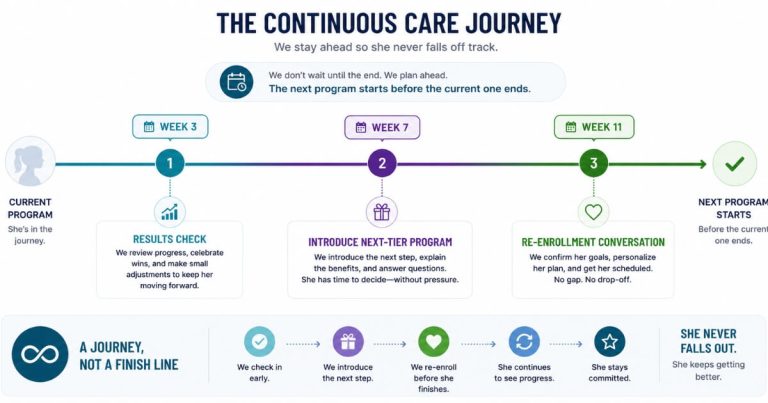
A structured follow-up cadence at the three-week, seven-week, and eleven-week marks keeps patients engaged through the first program and sets up the next one before the current one ends — that timed sequence is what prevents churn.
Retention is not luck; it is a built cadence. The danger window for a weight-loss or longevity patient is the gap between programs, when the first result has landed and nothing has been queued to follow it. For that reason, a cadence at roughly the three-, seven-, and eleven-week points keeps the clinic in contact during the active program — checking results, adjusting the protocol, and, critically, surfacing the next stage of the journey while the patient is still seeing wins.
The seven-week check is often the natural moment to introduce the next-tier program because results are visible and trust is high. Likewise, the eleven-week check is the re-enrollment conversation, timed so the next program starts before the current one lapses and the patient never falls out of the journey.
Build follow-up consultation intake forms and satisfaction surveys into the cadence so each touchpoint also collects the proof and the testimonials that fuel the rest of the practice. In the end, retention is engineered at these touchpoints, not hoped for between them.
How do tiered membership programs increase lifetime value at a longevity clinic?
Tiered membership programs increase lifetime value by giving every patient a defined next rung to climb — from an entry membership to a core program to a top-tier longevity package — so revenue per patient grows over time instead of ending at the first sale.
A flat single-offer clinic caps lifetime value at the price of that one offer. A tiered clinic does not. When the ladder runs from a roughly $199 per month entry membership up through a $2,399 three-month core program, specialty pathways around $2,197 to $2,397, and a $11,000 nine-month longevity program, each patient has somewhere to go after every result, and the highest-value patients self-select up the ladder.
Additionally, the tiers let the clinic serve a wider range of budgets and commitment levels without discounting. A patient who is not ready for the $11,000 program can start at $199 per month and ascend as trust and results build.
The key is that the tiers are connected by the journey, not just listed on a menu. A menu of disconnected prices does not retain anyone. Instead, a ladder where every stage points to the next, supported by the discovery intake and the follow-up cadence, is what turns a single transaction into years of compounding revenue. That is how lifetime value is built on purpose, not by accident.
What is the biggest patient-journey mistake weight-loss and longevity clinics make?
The biggest mistake is treating the first sale as the finish line instead of the starting line — selling a weight-loss program with no mapped next stage, no discovery intake, and no follow-up cadence, which guarantees the patient churns after the first result.
Most weight-loss and longevity clinics are excellent at the first transaction and terrible at everything after it. They acquire a patient at real cost, deliver a great first result, and then have nothing engineered to keep her — no reframing intake, no next-tier program, and no timed re-enrollment conversation. As a result, she gets her result and leaves, and the clinic goes back to paying to acquire a replacement.
This is the most expensive way to run a cash-pay practice because acquisition is the costliest part and the clinic only ever monetizes it once. The fix is to design the journey backwards from lifetime value: decide what a fully retained, multi-year patient looks like, then build every earlier stage — entry offer, discovery intake, core program, follow-up cadence, and maintenance membership — to move her toward it.
The clinics that do this stop living on new-patient volume and start compounding on the patients they already have. The first sale is not the win. The retained patient is.
FAQ’s About Mapping a Longevity Clinic Patient Journey
Why does a weight-loss or longevity clinic need a mapped patient journey instead of just selling treatments?
Because treatments are transactions and a mapped patient journey is a relationship — and only the relationship produces the retention and lifetime value that make a cash-pay longevity clinic profitable.
A weight-loss patient who buys a single GLP-1 program and disappears is worth a few hundred to a few thousand dollars once. The same patient, mapped onto a journey that moves her from an initial weight-loss result into hormone optimization, gut health, and a long-term maintenance membership, is worth ten or twenty times that over several years.
Without a mapped journey, every patient is a fresh acquisition cost and your clinic is on a treadmill — you have to find a brand-new patient every time you want revenue. Instead, with a mapped journey, each patient has a defined next step at every stage, so retention compounds and the cost you paid to acquire her amortizes across years of programs instead of a single visit.
The clinics that win in longevity are not the ones with the best single treatment. They are the ones who have engineered, on purpose, what happens after the first result because that is where lifetime value is made.
What does a longevity and weight-loss clinic’s patient journey actually look like, stage by stage?
It looks like a deliberate ladder: an entry offer that captures the patient, a discovery intake that diagnoses the whole picture, a results-driven core program, and a long-term maintenance membership that retains her for years.
A real longevity and weight-loss clinic maps it almost exactly this way. The entry is an accessible on-demand offer — a GLP-1 weight-loss start or a vitamin-injection membership in the $199 to $299 per month range — that lowers the barrier and gets the patient in the door.
Then comes a Discovery Intake at roughly $897 that includes labs and a comprehensive evaluation, which is the pivot point of the entire journey because it reframes the patient from “I want to lose weight” to “here is my whole metabolic and hormonal picture.”
From there the core programs ladder up — a Gold-tier program around $2,399 for three months covering HRT/TRT, peptides, GLP-1 microdosing, labs, and dose visits, with specialty add-on pathways like gut optimization, hair and skin health, or athletic performance in the $2,197 to $2,397 range.
At the top sits a Platinum longevity program around $11,000 for nine months covering metabolic, hormone, and gut fine-tuning. Underneath all of it is a long-term maintenance membership starting around $199 per month. Each stage has a clear next stage, which is what makes the journey retain rather than leak.
How does the discovery intake or initial assessment drive retention and lifetime value?
The discovery intake drives retention and lifetime value because it converts a single-symptom buyer into a whole-person patient — once she sees her full lab picture, the next several programs become obvious clinical recommendations instead of upsells.
A patient who walks in for weight loss is buying one outcome. However, a discovery intake — a comprehensive evaluation with labs, around $897 at a real longevity clinic, often with part of that fee applied to her first program — changes what she is buying. The labs reveal the hormone, metabolic, and gut issues underneath the weight, and suddenly the path forward is a multi-stage optimization plan she actually wants, not a sale she resists.
This is the single highest-leverage stage in the entire journey. Clinics that skip straight from “lose weight” to “buy our membership” get resistance because nothing has reframed the patient’s understanding of her own situation. By contrast, clinics that route every patient through a real discovery intake convert far more of them into the higher-tier programs because the intake makes the value self-evident.
Apply a portion of the intake fee to the first program and conversion climbs again because the patient feels she is moving forward rather than starting over. The intake is where one-time patients become long-term patients.
What follow-up cadence keeps longevity and weight-loss patients retained over the long term?
A structured follow-up cadence at the three-week, seven-week, and eleven-week marks keeps patients engaged through the first program and sets up the next one before the current one ends — that timed sequence is what prevents churn.
Retention is not luck; it is a built cadence. The danger window for a weight-loss or longevity patient is the gap between programs, when the first result has landed and nothing has been queued to follow it. Accordingly, a cadence at roughly the three-, seven-, and eleven-week points keeps the clinic in contact during the active program by checking results, adjusting the protocol, and surfacing the next stage of the journey while the patient is still seeing wins.
The seven-week check is often the natural moment to introduce the next-tier program because results are visible and trust is high. Similarly, the eleven-week check is the re-enrollment conversation, timed so the next program starts before the current one lapses and the patient never falls out of the journey.
Build follow-up consultation intake forms and satisfaction surveys into the cadence so each touchpoint also collects the proof and the testimonials that fuel the rest of the practice. Retention is engineered at these touchpoints, not hoped for between them.
How do tiered membership programs increase lifetime value at a longevity clinic?
Tiered membership programs increase lifetime value by giving every patient a defined next rung to climb — from an entry membership to a core program to a top-tier longevity package — so revenue per patient grows over time instead of ending at the first sale.
A flat single-offer clinic caps lifetime value at the price of that one offer. A tiered clinic does not. When the ladder runs from a roughly $199 per month entry membership up through a $2,399 three-month core program, specialty pathways around $2,197 to $2,397, and a $11,000 nine-month longevity program, each patient has somewhere to go after every result, and the highest-value patients self-select up the ladder.
The tiers also let the clinic serve a wider range of budgets and commitment levels without discounting. A patient who is not ready for the $11,000 program can start at $199 per month and ascend as trust and results build.
The key is that the tiers are connected by the journey, not just listed on a menu. A menu of disconnected prices does not retain anyone. Instead, a ladder where every stage points to the next, supported by the discovery intake and the follow-up cadence, is what turns a single transaction into years of compounding revenue.
What is the biggest patient-journey mistake weight-loss and longevity clinics make?
The biggest mistake is treating the first sale as the finish line instead of the starting line — selling a weight-loss program with no mapped next stage, no discovery intake, and no follow-up cadence, which guarantees the patient churns after the first result.
Most weight-loss and longevity clinics are excellent at the first transaction and terrible at everything after it. They acquire a patient at real cost, deliver a great first result, and then have nothing engineered to keep her — no reframing intake, no next-tier program, and no timed re-enrollment conversation.
This is the most expensive way to run a cash-pay practice because acquisition is the costliest part and the clinic only ever monetizes it once. The fix is to design the journey backwards from lifetime value: decide what a fully retained, multi-year patient looks like, then build every earlier stage — entry offer, discovery intake, core program, follow-up cadence, and maintenance membership — to move her toward it.
The clinics that do this stop living on new-patient volume and start compounding on the patients they already have. The first sale is not the win. The retained patient is.
What’s the next step?
If your weight-loss or longevity clinic is great at the first sale but your patients vanish after their first result, you do not have a treatment problem — you have a patient-journey problem. The revenue is not in finding more new patients; it is in the ladder, the discovery intake, and the follow-up cadence that turn the patients you already paid to acquire into multi-year, high-LTV relationships.
That is the exact map we build for functional medicine and longevity clinics — the same retention-and-leadflow engine behind VYVE Wellness, where we drove a 900% increase in website leads and 100+ inbound calls per month in 4 months. On the call, we will map your current journey, find the leaks, and show you where the lifetime value is hiding.