
How to Lower Patient Acquisition Cost at a Cash-Pay Medical Practice (The Membership Model That Makes Marketing Math Work)
INTRO:
Most cash-pay clinics are running paid acquisition at break-even because patient acquisition cost eats most of the first-visit margin. The clinics that escape don’t lower CAC — they multiply LTV. One HRT clinic we work with has 250 active members at $1,000 a month: $250,000 in monthly recurring revenue and $1.7M a year in memberships from SEO alone. Here’s the FAQ on how that math actually gets built.
——————————————————————————
Why is patient acquisition cost so high at most cash-pay medical practices?
Because the business runs on a one-and-done transaction model.
Every new dollar of revenue requires a fresh marketing dollar. There’s no compounding. A patient pays $1,500 for a single hormone panel and disappears. The next $1,500 has to be paid for with another patient, another acquisition cost, another round of ads or SEO or referrals. The math reshapes itself the moment the clinic starts earning from the same patient more than once.
Instead of a patient paying $1,500 for one panel, they pay $500 to $1,500 a month for ongoing care — labs, dosing adjustments, telehealth visits, refills — and stay for two to four years. A clinic with a one-and-done model has to find a new patient every time it wants a new dollar. A clinic with a membership model finds the patient once and earns from them for years on the same acquisition spend.
——————————————————————————
How do membership models lower patient acquisition cost at a cash-pay clinic?
They don’t lower CAC directly — they multiply LTV against the same CAC.
Run the math. $200 to acquire a patient who pays $800 and leaves is an LTV-to-CAC ratio of 4:1 — decent on paper, brutal in practice because every month resets to zero. Take the same $200 acquisition cost, drop the patient into a $750-a-month membership averaging 30 months of retention, and the LTV becomes $22,500. Ratio: 112:1. Same ad. Same agency. Same first-call. Different downstream model.
This is the core principle behind how to lower patient acquisition cost in a cash-pay clinic. Most owners focus on reducing ad spend or finding cheaper leads, when the bigger opportunity is increasing the amount of revenue each acquired patient generates over time. When retention improves and recurring revenue becomes part of the care model, the same acquisition cost suddenly produces dramatically better economics.
The proof at scale: **Eternity Health Partners, a hormone replacement clinic we’ve worked with for four years, has 250 active members paying $1,000 a month — $250,000 in monthly recurring revenue, $1.7M a year in memberships from SEO alone — and grew from $1M a year to $4M a year over the same window**. The membership wasn’t a side product. It was the business model that made every marketing dollar earn out four to five times longer.

Why do most cash-pay clinic membership programs fail to lower acquisition cost?
Because they’re promotional, not clinical.
A “VIP membership” with vague perks — a discount on supplements, two free B12 shots, priority scheduling — and no clinical reason to renew is a marketing gimmick. Patients sign up because they like the clinic. They churn at 60 days because the perks aren’t worth the monthly charge. The clinic concludes that memberships don’t work for their specialty, and the LTV math never compounds.
Memberships work. Promotional memberships don’t. The membership models that hold are clinical, not promotional. They solve a real ongoing problem the patient can’t solve themselves: hormone optimization, weight management, regenerative therapy follow-up, peptide therapy, pain management. The membership IS the protocol. Cancel the membership, lose the care. That’s why it holds. Convenience perks are negotiable; clinical outcomes are not. And only the clinical version actually multiplies LTV enough to move acquisition math.
——————————————————————————
What should a cash-pay medical practice charge for a membership?
Roughly one-third of the equivalent annual transactional price, paid monthly, in exchange for ongoing access.
If a clinic charges $6,000 for a 12-month hormone optimization protocol as a one-and-done, the same protocol delivered as a membership might be $750 a month with labs and adjustments included. The patient pays more in total — $9,000 versus $6,000 — because the value is higher (ongoing access, no surprise costs, no re-onboarding), the clinic captures recurring revenue, and the patient stays in care rather than rotating out at month 12.
The pricing mistake most clinics make is offering the membership as a discount tier — “save 20% if you commit to a year.” That trains the patient to think of the membership as a coupon and to value the protocol at the discounted number forever after. Price the membership as a different product: a different scope, a different cadence, a different clinical relationship. Not a sale on the old thing.
——————————————————————————
How do I market a membership program to my existing cash-pay patients?
Stop pitching it. Build it into the protocol.
The clinics that successfully convert existing patients to memberships don’t run an email blast saying “introducing our new membership.” They restructure the standard care path so the next clinical step IS the membership. After the initial workup and the 90-day stabilization phase at a hormone clinic, the patient is told: “Your maintenance protocol is monthly labs, dosing adjustments, and unlimited messaging — $750 a month.” There’s no upsell pitch. It’s the next visit.
Protocol-integrated memberships convert existing patients at 60–80%. Promotional “announcement” memberships sent by email blast convert at 5–15%. The difference isn’t messaging. It’s whether the membership is a logical clinical step or a marketing layer pasted on top.
——————————————————————————
How do I keep cash-pay membership patients from canceling (and keep marketing ROI compounding)?
Make month two more valuable than month one.
The biggest cancellation cliff in cash-pay memberships is days 60–90, when the initial novelty wears off and the patient asks “what am I actually paying for?” Every cancellation at month three resets the LTV math back toward the one-and-done baseline. The clinics that hold churn under 5% a month do three specific things.
One: deliver something tangible in month two that didn’t exist in month one. A re-test of the labs from intake. A protocol upgrade. An unsolicited check-in call from the provider. The patient needs to feel forward motion in the second month, or the membership becomes a recurring bill instead of a recurring relationship.
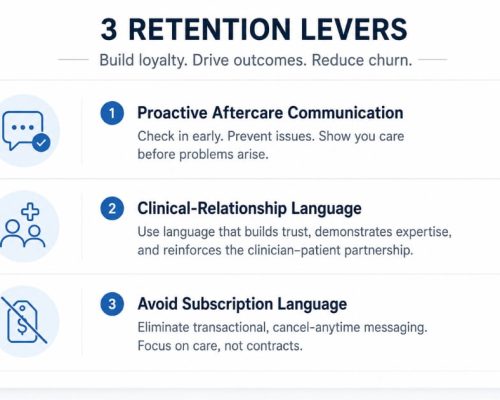
Two: communicate proactively. Members shouldn’t have to chase the clinic for results. Aftercare email sequences — automated touchpoints at day 7, 30, 60, and 90 — handle the operational baseline so no member ever falls into the silence that precedes a cancellation.
Three: treat the membership like a clinical relationship, not a subscription. Subscription language (“manage your plan,” “billing portal”) trains the patient to think of the membership in the same category as Netflix. Clinical language (“your care team,” “next protocol check-in”) trains them to think of it as healthcare. One is easy to cancel. The other is not.
The clinics that combine all three — a clinical reason to stay, a 60-day proactive touchpoint, and a real second-month deliverable — see retention curves that compound LTV against the original CAC for years.
What’s the next step?
If you’re a cash-pay medical practice owner and your patient acquisition cost looks healthy on paper but the practice still feels like it resets to zero on the first of every month, the fix isn’t a better marketing agency — it’s a recurring-care model your patients can’t logically leave. **We’ve built the same compounding revenue base inside non-HRT specialties too — including a pain management and regenerative practice we added $2,095,039 in revenue to over 10 months**. Book a strategy call. In 60 minutes we’ll map which of your existing protocols can be restructured into recurring care, what to price each at, and how to enroll your current patient base without an awkward “new offering” announcement.