
How Do I Hire and Train a Front Desk That Grows a Cash-Pay Clinic 30-50% a Year?
The front desk is the most underrated growth lever in a cash-pay clinic. The right hire, screened for the right trait and trained to treat hospitality as the job, can grow a practice 30 to 50 percent a year without spending another dollar on ads. The wrong hire quietly leaks new patients out the back door. Here’s the FAQ on how to recruit, screen, and train a front desk into a growth engine — built from the front-desk playbook our fastest-growing clinics run.
How Do I Hire and Train a Front Desk That Grows My Cash-Pay Clinic?
Hire for hospitality and temperament rather than medical experience, recruit through a simple three-step funnel, train hospitality as the number-one priority above admin tasks, and define the role with the 4 R’s so it runs without you.
Those four moves are what turn a front desk from a cost center into a growth engine.
The clinics that grow 30 to 50 percent a year without ads don’t do it with a clever campaign — they do it with a front desk that:
- Makes every patient feel cared for
- Books every inquiry
- Keeps members engaged
That outcome is built, not lucky.
It starts with:
- Hiring the right kind of person
- Running them through a recruiting process that filters for fit
- Locking in expectations through clear training
Get those right and the same lead volume produces dramatically more:
- Booked patients
- Retained patients
- Paying patients
Which is the cheapest growth a clinic will ever buy and a foundational piece of any predictable patient acquisition system.
What Should I Look for When Hiring a Cash-Pay Clinic Front Desk?
Organized, punctual, and — counterintuitively — lacking medical experience, which is actually a bonus.
You’re hiring a hospitality and conversion role, not a clinical one.
The instinct is to hire someone with healthcare front-desk experience.
The playbook says the opposite:
- A great hire is organized.
- A great hire is punctual.
- A lack of medical experience is a feature, not a bug.
People who come from traditional medical front desks often arrive trained in:
- Insurance-first thinking
- Task-first thinking
- “Next patient please” habits
Those habits are exactly wrong for a cash-pay practice built on hospitality and conversion.
Someone from:
- Hospitality
- Retail
- High-end service
Brings the warmth and the sales instinct you actually need.
You can teach clinical vocabulary in a week.
Hire for:
- Temperament
- Trainability
Add the medical knowledge later.
What Should I Look for When Hiring a Cash-Pay Clinic Front Desk?
Organized, punctual, and — counterintuitively — lacking medical experience, which is actually a bonus.
You’re hiring a hospitality and conversion role, not a clinical one.
The instinct is to hire someone with healthcare front-desk experience.
The playbook says the opposite:
- A great hire is organized.
- A great hire is punctual.
- A lack of medical experience is a feature, not a bug.
People who come from traditional medical front desks often arrive trained in:
- Insurance-first thinking
- Task-first thinking
- “Next patient please” habits
Those habits are exactly wrong for a cash-pay practice built on hospitality and conversion.
Someone from:
- Hospitality
- Retail
- High-end service
Brings the warmth and the sales instinct you actually need.
You can teach clinical vocabulary in a week.
Hire for:
- Temperament
- Trainability
Add the medical knowledge later.
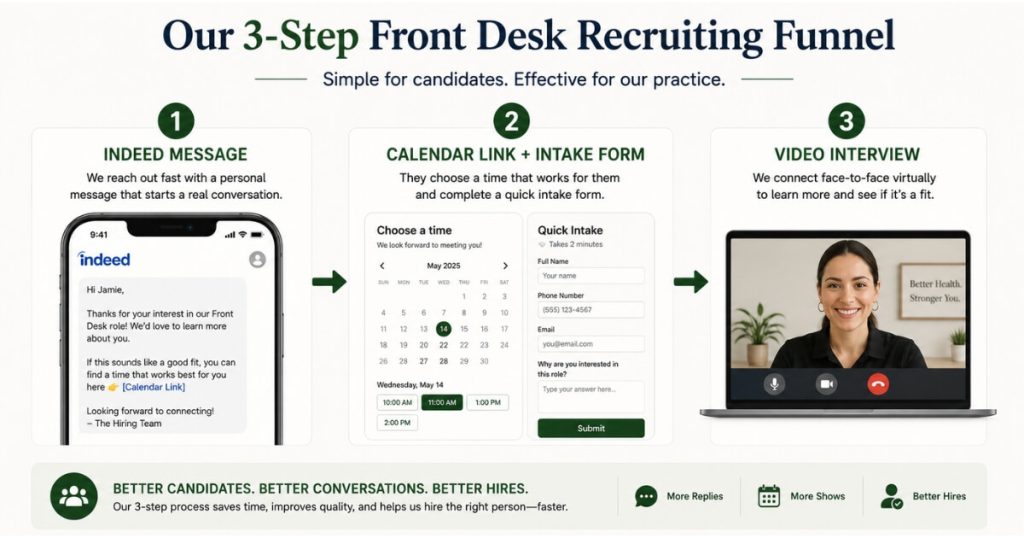
What’s the Recruiting Funnel That Finds Great Front-Desk Hires?
A simple three-step funnel:
- A templated Indeed message with a calendar link
- An intake form attached to that calendar booking
- A video interview
Screen with capture, connect, close.
You don’t need a recruiter — you need a funnel.
Post the role (something like “Executive Administrative Assistant,” emphasizing organized and punctual), then run applicants through three steps built in a tool like GoHighLevel:
Step 1: Initial Outreach
A templated message in Indeed that sends them to a calendar link to book.
Step 2: Intake Form
An intake form attached to that calendar that answers the basic qualifying questions before you ever speak.
Step 3: Video Interview
A Zoom or Google Meet interview.
The funnel does the filtering.
People who can’t follow three simple steps self-select out.
In the interview, use the same capture-connect-close pattern your front desk will use with patients:
- Capture the candidate’s contact information
- Connect with them on a human level
- Close them on the next step only
How a candidate moves through your hiring funnel is a preview of how they’ll move patients through yours.
What’s the Number-One Thing I Should Train Into My Front Desk?
Hospitality, treated as the actual job — above charting, admin, and every other task.
The team has to understand that excellent customer service is the priority and the admin work is the cleanup that protects it.
Most front desks quietly invert their priorities:
- Admin tasks feel urgent
- Hospitality becomes whatever’s left over
That’s backwards.
The role is a customer-facing position, and its performance is judged by one thing:
Are new and existing patients raving about how they’re treated?
Charting, prepping, and covering for teammates are real, but they’re secondary.
They exist to keep the machine running so excellent hospitality can continue.
When the front desk:
- Gets pulled into back-office work
- Lets the phone go to voicemail
- Greets a patient without looking up
The clinic is trading its growth engine for a filing task.
Make it explicit:
- In writing
- In onboarding
- In coaching conversations
Hospitality first. Admin second.
What Do Front-Desk Hospitality “Personal Touches” Actually Look Like?
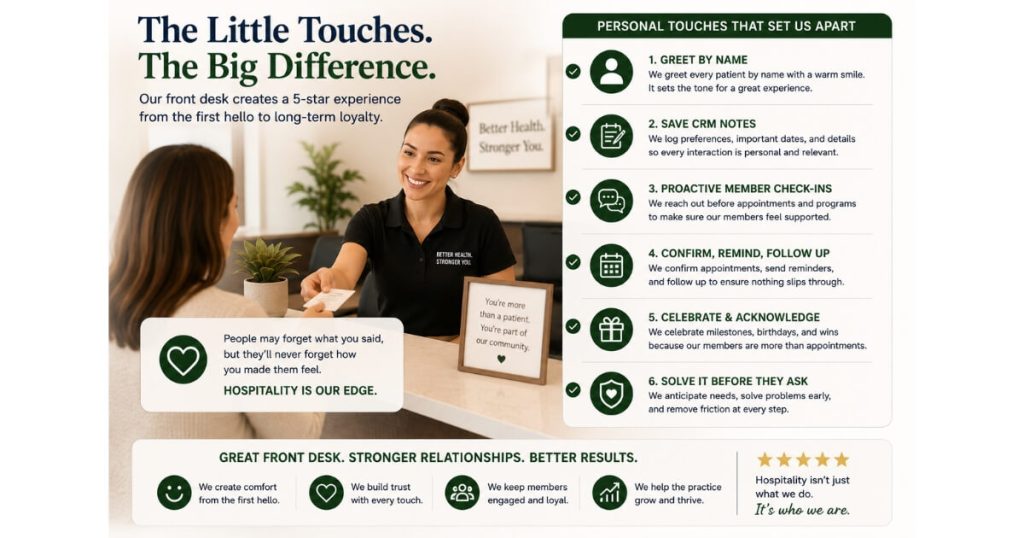
A warm greeting by name, contact and family details saved in the CRM so every interaction feels personal, proactive check-ins on members, and never saying “sorry for the wait.”
These small, repeatable touches are what compound into 30–50% annual growth.
“Good customer service” is meaningless until you define what it feels like to the patient.
The playbook is specific:
At the Front Desk
- Greet patients by name when they walk in.
- Learn names and faces from the day’s schedule.
On the Phone
- Save existing patients’ contact information.
- Greet callers by name whenever possible.
In the CRM
- Make notes about families and personal details.
- Ask about them the next time you interact.
During Wait Times
Instead of:
“Sorry for the wait.”
Say:
“Thank you so much for your patience.”
In Membership Practices
Be proactive:
- Reach out before members call you.
- Check in by phone.
- Check in by text.
- Never rely on lazy email follow-up.
These are the touches our clinics use to grow 30 to 50 percent every year without spending on ads — the same hospitality edge that helped Dr. Groysman lift monthly revenue by $40K+ while boosting team retention.
How Do I Define the Front-Desk Role So It Runs Without Me?
Document it with the 4 R’s:
- Role
- Responsibilities
- Requirements
- Results
So the hire knows exactly:
- What they own
- What’s expected
- The numbers they’re accountable for
A role you can’t write down is a role you can’t delegate.
The reason the front desk keeps routing problems back to the owner is that the role was never actually defined.
The 4 R’s fix that:
Role
What this position is.
Responsibilities
What they own day to day.
Requirements
The standards and tools they must meet.
Results
The specific outcomes and numbers they’re measured on, including:
- Booking rate
- Conversion rate
- Hospitality feedback
Once those four are written down and handed to the hire, accountability stops depending on the owner hovering.
The front desk knows what good looks like and can be coached against it.
This is the same documentation discipline that let an HRT clinic we grew from $1M to $4M a year remove its owner-operators from the day-to-day.
FAQs About Hiring and Training a Cash-Pay Front Desk
Should I Hire a Front Desk With Medical Experience?
Not necessarily — a lack of medical experience can be a bonus.
You’re hiring for:
- Hospitality
- Organization
- Conversion instinct
Those traits are hard to teach, and you can add the clinical vocabulary in about a week.
What Recruiting Process Finds Great Front-Desk Hires?
A three-step funnel:
- A templated Indeed message linking to a calendar
- An intake form attached to the booking
- A video interview
The funnel filters out anyone who can’t follow simple steps, and the interview uses the same capture-connect-close pattern the role requires.
What’s the Most Important Thing to Train a Front Desk to Do?
Treat hospitality as the actual job, above admin tasks.
The role is customer-facing and judged by whether patients rave about their experience.
Charting and admin are secondary cleanup work that protects the hospitality.
What Do Front-Desk Hospitality Personal Touches Look Like?
- Greeting patients by name
- Saving contact and family details in the CRM
- Proactively checking in on members by phone or text
- Saying “thank you for your patience” instead of “sorry for the wait”
Small, repeatable touches compound into double-digit annual growth.
How Do I Define the Front-Desk Role So It Doesn’t Depend on Me?
Document it with the 4 R’s:
- Role
- Responsibilities
- Requirements
- Results
When the hire knows what they own and the numbers they’re measured on, accountability stops depending on the owner hovering.
What’s the Next Step?
If your front desk is treating hospitality as an afterthought and your hiring is a gamble, you’re leaking the cheapest growth your clinic will ever get.
Hire for temperament, recruit through a simple funnel, train hospitality as the job, and define the role with the 4 R’s — and the same lead volume produces far more booked, retained patients.
If you want help building the hiring funnel, the training, and the 4 R’s documents for your front desk, that’s the conversation to book. We’ll show you exactly where your current intake is costing you patients.