
How to Evaluate Any New Lead Source for Your Cash-Pay Medical Practice
(The 4-Criterion Difficulty / Scalability / Quality / Speed Filter)
Most cash-pay clinics don’t have a lead-source problem — they have an evaluation problem. Every quarter, a new platform, vendor, or marketing trend promises explosive growth. However, the clinics that actually scale consistently use the same filter before they spend a dollar. Across 40 of the fastest-growing cash-pay clinics in the country, the pattern is predictable: the channels that survive are the ones that pass the Difficulty / Scalability / Quality / Speed test. This FAQ breaks down exactly how to score any lead source before you commit budget.
What are the 4 criteria for evaluating a lead source for a cash-pay medical practice?
The four criteria are:
- Difficulty
- Scalability
- Quality
- Speed
Every new lead source should pass through these four filters before you invest meaningful time or money.
We built this framework after seeing the same pattern repeatedly across fast-growing cash-pay clinics. A practice owner hears about a new platform, allocates $10K to test it, and three months later has nothing to show for the spend. Consequently, the filter forces four practical questions before scaling anything.
The Four Questions
- Difficulty — Can your team realistically operate this channel?
- Scalability — If it works at $1K, will it still work at $10K?
- Quality — How ready-to-buy are the leads?
- Speed — How quickly will you know whether it works?
Different channels score differently.
For example:
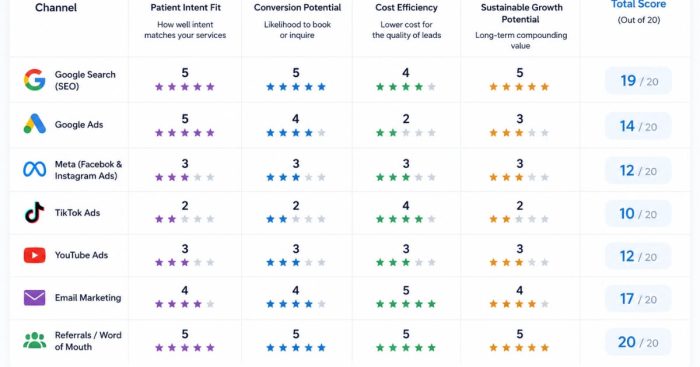
- Google Search Ads score high on quality and speed.
- TikTok scores high on scalability and speed for the right offers.
- SEO scores extremely high on quality, but low on speed.
No platform scores perfectly. Therefore, the goal is not to find a “perfect” channel — it’s to find the channel profile that matches your cash flow, operational capacity, and offer structure.
Why does “difficulty” matter when evaluating a lead source?
Difficulty matters because the channel you cannot operate yourself is the channel that breaks the moment your specialist disappears.
The honest test is simple:
If your agency vanished tomorrow, could you keep the channel alive for the next 90 days?
For some channels, the answer is yes.
Lower-Difficulty Channels
- TikTok testimonial-style ads
- Simple Google phrase-match campaigns
- Google My Business optimization
These are manageable for many internal teams.
Higher-Difficulty Channels
Meanwhile, some channels require specialized expertise:
- Facebook / Instagram ads at scale
- Advanced Meta testing
- SEO technical optimization
- Internal linking structures
- Site-speed optimization
- Domain authority building
Meta, in particular, is deceptive. Almost any offer can work there, but scaling profitably usually requires an experienced media buyer.
Difficulty also includes the operational burden surrounding the channel.
For example:
- Facebook ads fail when follow-up speed is slow.
- Events fail when staff cannot capture leads properly.
- Google Ads fail when inbound calls are mishandled.
In other words, the platform itself is rarely the real difficulty. The surrounding operational system is.
Why does “scalability” matter when evaluating a lead source?
Scalability matters because many channels work at small budgets and collapse the moment you try to grow them.
Your goal is not simply to find a channel that works. Instead, your goal is to find a channel where increasing spend keeps producing proportional revenue growth.
Channels With Lower Ceilings
Some channels naturally cap out:
- Organic social content
- Local Services Ads
- ZocDoc
- Certain referral partnerships
Organic social, for example, produces extremely high-quality leads. However, content production at scale becomes expensive quickly. Good short-form editors are not cheap, and consistent production requires operational discipline.
Similarly, Local Services Ads are constrained by geography and service-area size.
Channels With Higher Ceilings
Other channels scale aggressively:
- Meta
- TikTok
- Google Search
- Performance Max
Meta has one of the largest ceilings because almost any offer can work if:
- the economics are correct,
- the creative is strong,
- and the follow-up process is fast.
TikTok scales especially well for:
- GLP-1
- filler
- body contouring
- CO2 laser
- hormone optimization
Meanwhile, Google scales cleanly from phrase-match campaigns into Performance Max once conversions stabilize.
A medspa we helped scale to $6.7M in one year and a $1M+/month run rate from multi-channel paid ads succeeded largely because it concentrated budget on channels that passed the scalability test instead of spreading spend thin across multiple mediocre channels.
Why does “quality” matter when evaluating a lead source?
Quality matters because two leads at the same cost can produce completely different revenue outcomes.
One lead books immediately. The other consumes front-desk time for 30 days and never converts.
Lead quality depends heavily on awareness stage.
High-Quality Channels
Google Search traffic tends to be higher quality because the patient is already searching for:
- “GLP-1 near me”
- “Botox [city]”
- “TRT clinic”
These patients are already solution-aware.
SEO and organic social also produce high-quality leads because patients self-qualify through long-form content consumption.
Lower-Quality Channels
TikTok and Meta typically generate colder traffic because users are scrolling, not actively searching.
However, funnel structure dramatically changes quality.
The progression we use across clinics is:
- Lead form
- Landing page
- Quiz
- Scheduling page with credit-card hold
Each step increases lead quality while reducing volume.
Importantly, the credit-card-hold step filters out tire-kickers more effectively than almost any other funnel adjustment.
Consequently, many clinics blaming “bad leads” actually have a funnel problem — not a traffic problem.
Why does “speed” matter when evaluating a lead source?
Speed matters because every channel has a different payback timeline.
If your runway is short, slow channels become dangerous. Conversely, if your cash position is strong, slower compounding channels become extremely valuable.
Fast Channels
Paid media produces fast feedback:
- Meta
- TikTok
- Google Search
- LSAs
These platforms can produce leads within days.
Meta and TikTok, however, require:
- fast follow-up,
- strong sales processes,
- and healthy front-end cash flow.
We generally prefer Meta for offers above $3,000 in front-end cash collected.
Slower Channels
Organic channels compound more slowly:
- SEO
- Organic social
- Long-form YouTube
- Podcast authority
SEO takes the longest to build. Nevertheless, once rankings stabilize, the economics become extremely attractive.
Organic social also converts slowly. However, brand presence improves every other channel’s performance.
The same paid ad performs differently when:
- the prospect Googles your clinic and sees an active trusted brand,
versus - finding an empty profile with little authority.
What is the “depth before width” rule?
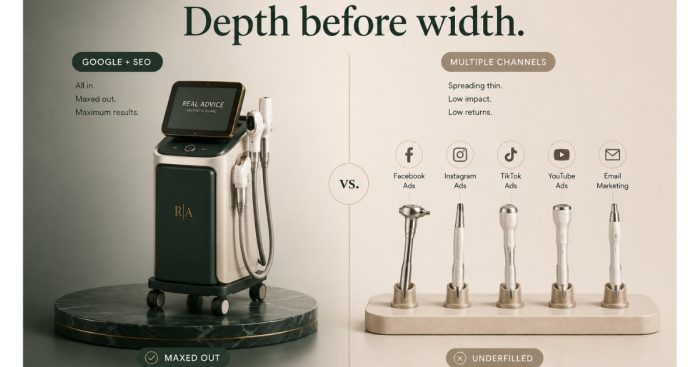
The depth-before-width rule means:
Maximize 1–2 channels first before expanding into additional channels.
This consistently outperforms trying to operate five channels simultaneously.
Every additional channel creates:
- another learning curve,
- another creative budget,
- another operational process,
- another attribution problem.
As a result, most clinics spread themselves too thin.
The clinics that scale from:
- $1M to $4M,
- or $30K/month to $1M/month,
typically go deep on two channels before adding a third.
Common High-Performing Channel Pairs
- Medspa → TikTok + Google
- HRT / TRT → SEO + GMB
- Pain / Neuropathy → Meta + SEO
- GLP-1 → Google + TikTok
Depth means:
- more creative testing,
- better funnel optimization,
- stronger follow-up systems,
- and 90–180 days of committed spend.
Not a $500 “test.”
How should a cash-pay medical practice score a new lead source?
Score the lead source from 1–5 across all four criteria.
Scoring Framework
Difficulty
- 5 = current team can run it internally
- 1 = requires specialist expertise you do not have
Scalability
- 5 = spend can scale aggressively
- 1 = volume caps quickly
Quality
- 5 = highly solution-aware buyers
- 1 = cold awareness-stage traffic
Speed
- 5 = cash flow impact within 14 days
- 1 = payoff requires 6+ months
A score of 14+ generally justifies a serious test.
However, there is an important second filter:
Does this new channel score better than simply investing more into one of your top two existing channels?
If not, deepen the existing winner instead.
The cash-pay medspa we scaled to $6.7M in 1year and 3,727 new patients did not run every available platform. Instead, they identified the channels that passed the filter, scaled them aggressively, and ignored the rest.
What’s the next step?
If you want an honest evaluation of your current channel mix — and a second opinion on which lead sources actually deserve more budget — book a strategy call with Real ADvice.
In 60 minutes, we’ll:
- score your current channels,
- identify which ones fail the 4-criterion filter,
- and map the two channels your clinic should go deep on over the next 90 days.