
How Do I Convert Insurance Callers Into Cash-Pay Patients? (The Front-Desk Script)
Every week, patients call your cash-pay clinic asking about insurance—and most front desks either turn them away or get stuck defending why you don’t take it. There’s a better approach. The clinics that grow their cash-pay base convert a meaningful share of those insurance callers by leading with something patients usually care about even more than their copay: how quickly they can be seen. This FAQ is built from a real front-desk script, including exactly what to say and why it works.
How do I convert insurance callers into cash-pay patients?
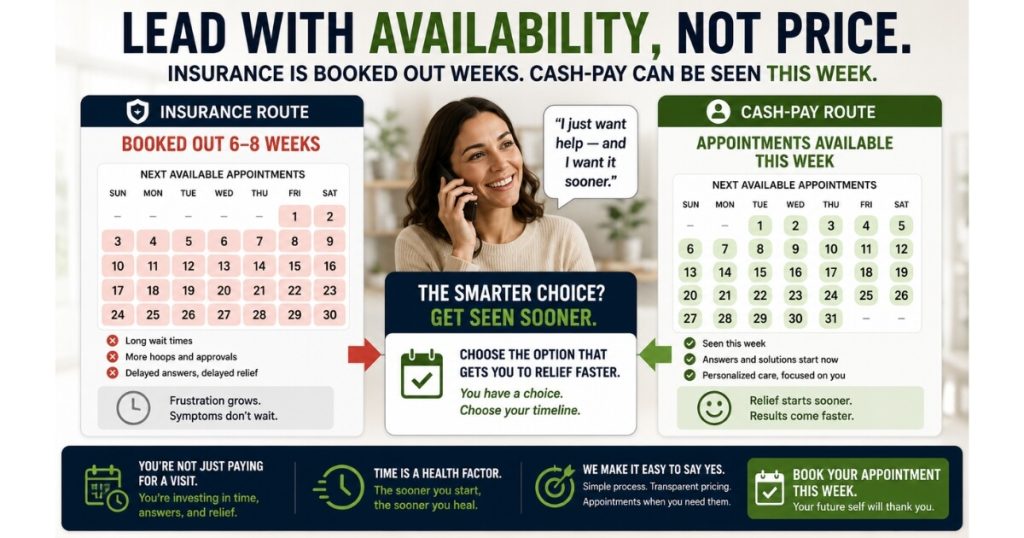
Lead with availability, not price.
The honest advantage of a cash-pay practice is that you can usually see patients much sooner than an insurance practice can.
For most callers, speed is the real priority.
The core insight behind the script is simple.
From the patient’s perspective, the biggest difference between insurance and cash-pay is often how quickly they can receive care.
Insurance schedules are frequently booked six to eight weeks out.
Cash-pay appointments may be available this week.
When a patient asks about insurance, don’t immediately say you don’t accept it.
Instead:
- Check the insurance schedule.
- Acknowledge the wait honestly.
- Offer the faster cash-pay option.
For example:
“So we can actually get you in as a new cash-pay patient. It’s just $200 for your initial visit, and I could get you in as soon as this week. Would that work better for you?”
That completely changes the conversation.
Instead of hearing:
“We don’t take your insurance.”
the patient hears:
“I can help you get seen much sooner.”
That is a solution—not a rejection.
Many callers willingly choose the faster appointment when presented with:
- A six-to-eight-week insurance wait.
- A same-week cash-pay appointment.
It’s a transparent way to strengthen your patient acquisition by converting inquiries that otherwise would have been lost.
What exactly should my front desk say to an insurance caller?
Follow a simple conversation flow.
Step 1: Answer their initial question.
Then ask:
“Would you be a new insurance patient or a new cash-pay patient?”
Step 2: If they say insurance…
Respond honestly:
“Okay, let me check. Honestly, the biggest difference right now is going to be availability for you.”
Pause briefly.
Then continue:
“It looks like we’re booked out about six to eight weeks for new insurance patient visits.”
Immediately follow with the alternative:
“But let me see what I can do. We can actually get you in as a new cash-pay patient, and it’s just $200 for your initial visit. I could get you in as soon as this upcoming week. Would that work better for you?”
Step 3: If they want more information about cash-pay…
Keep the explanation simple.
For example:
“It’s $200 for your initial visit, and follow-ups are just $200 each.”
Then introduce the membership.
Explain:
“If you’d like, we also have all-inclusive cash-pay membership programs where members receive exclusive access to services that insurance patients don’t. For many patients, it actually ends up costing less than paying repeated copays if you’re doing labs or ongoing care.”
Finally, move directly toward scheduling.
For example:
“When’s your next available? I can get you in Friday at 2.”
The entire conversation stays:
- Warm.
- Honest.
- Focused on helping the patient receive care sooner.
Why does leading with availability work better than leading with price?
Because availability solves the patient’s actual problem.
Price is usually just an objection—not the real reason they called.
Most insurance callers are really asking:
- Can you help me?
- How soon can I be seen?
They are rarely asking only about insurance coverage.
If your first response focuses on explaining cash-pay pricing, you’ve immediately shifted the conversation toward money.
Insurance appears to have the advantage.
Instead, lead with what cash-pay genuinely does better:
- Faster appointments.
- Better access.
- Less waiting.
Now the conversation becomes about convenience instead of cost.
The script intentionally delays pricing.
First, patients understand the value of getting care quickly.
Only afterward does the cost become part of the discussion.
Price still matters.
However, it is now connected to a benefit the patient already wants.
That simple shift dramatically changes how patients perceive the investment.
How do I frame cash-pay so it doesn’t feel more expensive than insurance?
Help patients understand the total value—not just the visit price.
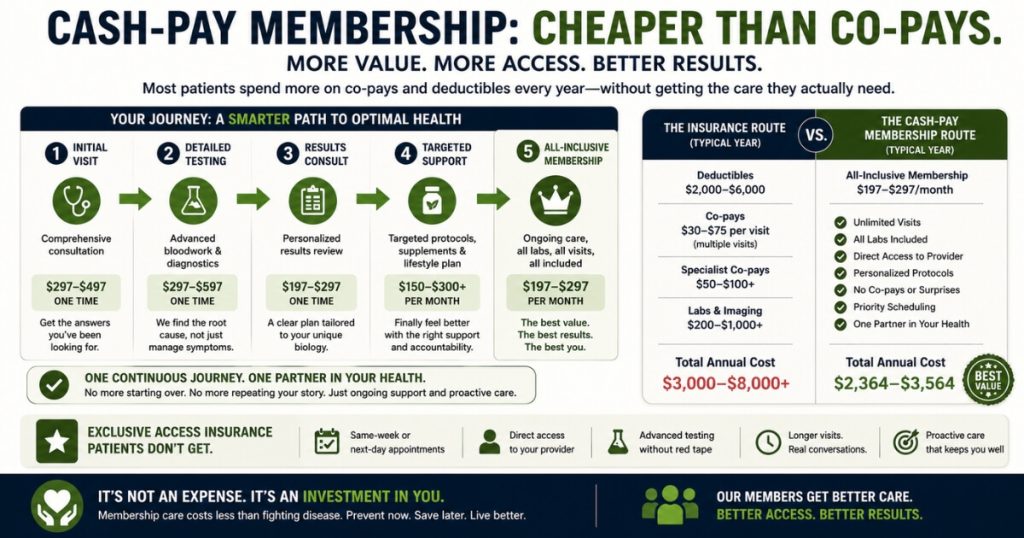
One effective way is to explain how membership often costs less than repeated insurance copays over time.
Patients frequently assume cash-pay automatically means paying more.
The script gently challenges that assumption.
Explain that an all-inclusive membership:
- Often costs less than repeated copays.
- Includes laboratory work.
- Covers ongoing follow-up care.
- Simplifies long-term treatment.
For patients who regularly use healthcare services, a predictable monthly membership often becomes more economical than paying:
- Copays.
- Coinsurance.
- Deductibles.
- Individual visit charges.
Then introduce the second advantage.
Membership patients also receive:
- Faster availability.
- Greater provider access.
- Additional services.
- More personalized care.
Those benefits represent the real advantage of a cash-pay practice.
When patients recognize they may actually spend less while receiving better access and better care, the price conversation becomes much easier.
Value is what justifies the investment.
Isn’t it wrong to steer insurance patients toward cash-pay?
No.
As long as you’re completely transparent and give patients a genuine choice, offering a faster—and sometimes less expensive—alternative is simply good service.
The script never hides information.
Instead, it:
- Asks whether the patient wants insurance or cash-pay.
- Explains the actual insurance wait time.
- Presents cash-pay as another option.
- Allows the patient to decide.
There is no pressure.
There are no misleading statements.
Many patients are genuinely relieved to learn they can receive care this week instead of waiting two months.
The ethical standard is straightforward:
- Be transparent.
- Present accurate information.
- Let the patient choose.
Helping patients access care sooner is exactly what a great front desk should do.
How do I move a converted patient into a membership from that first visit?
Treat the initial visit as the beginning of the relationship.
The membership becomes the natural next step.
The first phone call introduces the membership without forcing it.
For example:
“We have all-inclusive membership programs…”
The immediate objective is still booking the first visit.
Once patients experience:
- Faster access.
- More personalized attention.
- Better care.
the membership becomes much easier to present.
Patients now compare it against the insurance experience they’ve already known.
Instead of selling a membership over the phone, you’re allowing the experience itself to demonstrate the value.
That two-step process works exceptionally well:
- Low-friction initial visit.
- Membership after trust has been established.
By that point, patients are no longer comparing insurance versus cash-pay.
They’re deciding whether they want to continue receiving care they’ve already experienced and appreciated.
That value ladder is what transforms a one-time insurance caller into a long-term cash-pay member.
FAQ’s About Converting Insurance Callers to Cash-Pay
What should the initial cash-pay visit cost?
Keep the initial visit affordable enough to make saying “yes” easy, while still requiring real commitment.
One clinic uses this pricing structure:
- Initial visit: $200
- Follow-up visits: $200 each
- All-inclusive membership available after that
The purpose of the first visit is simple.
Get the patient through the door so they can experience your care.
Your exact pricing should reflect your:
- Market
- Services
- Business model
The principle remains the same.
Keep the first visit accessible.
The long-term value—and the long-term revenue—comes from the membership.
How do I handle “Does this work with my insurance?”
Answer the question honestly.
Then immediately shift the conversation toward availability and value.
For example, explain that you’re a cash-pay practice.
Then continue with something like:
“The biggest difference right now is actually availability. We can usually get cash-pay patients in much sooner.”
From there, explain that your membership often ends up costing less than repeated insurance copays for patients receiving:
- Lab work
- Follow-up care
- Ongoing treatment
You’re not avoiding the insurance question.
You’re answering it honestly while redirecting the conversation toward where cash-pay genuinely provides a better experience.
Will converting insurance callers actually reduce my insurance dependence?
Yes.
Every insurance caller who becomes a cash-pay patient increases the percentage of revenue you receive directly from patients.
Over time, that gradually shifts your practice toward a stronger cash-pay model.
The long-term benefits include:
- More predictable revenue.
- Less dependence on insurance reimbursement.
- Better control over pricing.
- Greater operational flexibility.
Clinics that consistently follow this process steadily reduce their reliance on insurance without needing to eliminate insurance patients overnight.
It’s one of the most practical ways to transition toward a stronger cash-pay practice.
How do I train my front desk to run this script?
Start by giving your team the exact words.
Then practice until the conversation feels natural.
The best training includes:
- Role-playing.
- Recorded-call reviews.
- Weekly coaching.
Focus especially on helping the team become comfortable with:
- The availability reframe.
- Presenting cash-pay confidently.
- Explaining membership value.
The goal is not memorization.
The goal is confidence.
Patients should feel like they’re having a genuine conversation—not listening to someone read a script.
Consistency matters.
When everyone answers the phone using the same proven framework, conversion becomes predictable regardless of who picks up the call.
What’s the next step?
If insurance callers are leaving your clinic without scheduling, you’re likely losing patients who could have become long-term cash-pay members.
The solution isn’t arguing about insurance.
It’s changing the conversation.
Lead with:
- Faster availability.
- Better access.
- Greater value.
Then position cash-pay as the solution—not the obstacle.
From there, build a simple value ladder:
- Schedule an affordable initial visit.
- Deliver an exceptional patient experience.
- Introduce the membership as the logical next step.
That approach is transparent.
It benefits the patient.
And it consistently converts more insurance callers into long-term cash-pay patients.
On a strategy call, we’ll build the exact insurance-to-cash-pay script for your clinic and help your front desk deliver it confidently.
We’ll install the process through:
- Role-playing.
- Recorded-call reviews.
- Ongoing coaching.
It’s the same conversion system behind a specialist practice where we cut insurance dependence in half and added over $40K per month in cash-pay revenue.