
How Do I Calculate Cost Per Scheduled Appointment and Attendance Rate at My Clinic?
If you want to know how well your clinic turns interest into booked, kept appointments, two numbers tell you almost everything: your cost per scheduled appointment and your new-patient attendance rate. Together they measure how well you nurture leads — the step between a lead coming in and a patient actually sitting in your chair. Here’s the FAQ on how to calculate both, and how to use them to grow.
What is cost per scheduled appointment, and how do I calculate it?
It’s the total you spend to book one new-patient appointment — and you calculate it by dividing everything you spend to generate bookings by the number of new-patient appointments you got.
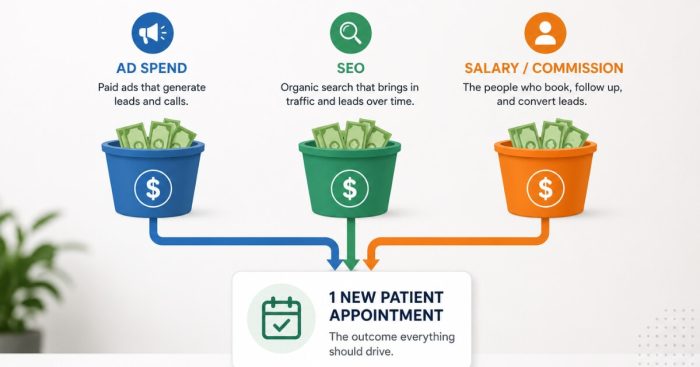
The formula is simple: Salary + Ad Spend + SEO, divided by total new-patient appointments booked, equals your cost per schedule.
The key is to count all the money that goes into producing those bookings, not just ad spend.
If you pay for SEO to generate inbound calls, that counts even though it’s not “ads.” The salary, hourly pay, or commission you pay the person who books the appointments counts too.
Add it all up, divide by the number of new-patient appointments that month, and you have a real number.
Most owners either don’t track this or count only ad spend, which badly understates the true cost.
Knowing the real figure changes behavior, including your team’s. When your staff know that every inbound call cost the business money to generate, they treat each lead with more care.
This single metric is one of the clearest windows into your patient acquisition efficiency.
Why should I include salary and SEO, not just ad spend?
Because those are real costs of getting an appointment booked, and leaving them out gives you a fake number that leads to bad decisions.
An inbound call from SEO isn’t free. You paid for the SEO that produced it.
The staff member who answers and books isn’t free either. You pay their wage or commission to do exactly that.
If you only count ad spend, a clinic that “doesn’t run ads” would show a cost per schedule of near zero. That number is obviously false and useless for decisions.
Including salary and SEO gives you the true economics of booking a patient. That’s what you need to judge whether a channel or a process is worth it.
There’s a culture benefit too. When the team understands that each booking carries real cost, they stop treating leads as disposable.
A lead that costs the business money to generate is one they’ll fight a little harder to book. That quietly lifts your numbers.
What is attendance rate, and what’s a good one?
Attendance rate is the percentage of booked new-patient appointments that actually show up — and around 80% is solid.
The calculation is straightforward. Of the new appointments you booked, how many showed?
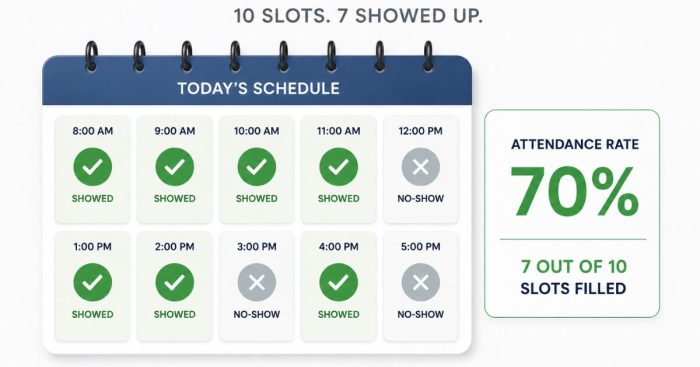
If you booked 10 and 7 showed, that’s a 70% attendance rate. Anything around 80% is a healthy target.
Attendance rate matters because a booked appointment that no-shows is a lost slot you can’t get back. It’s also money you spent to generate for nothing.
A clinic with great lead flow and a weak attendance rate is leaking revenue at the finish line.
Attendance rate is the other half of measuring lead nurture.
Cost per schedule tells you how efficiently you book. Attendance rate tells you how well you hold those bookings through to the visit.
Improving it usually comes down to reminders, pre-appointment education, and clear expectations. It’s the same nurture work that separates thriving clinics from busy-but-flat ones.
NuLevel Wellness raised its call answer rate from about 63% to 98% and quadrupled inbound calls by tightening exactly this nurture-and-booking layer.
How do these two metrics fit into measuring my whole business?
They’re the KPIs for lead nurture — one of the five core functions of a clinic business: lead generation, lead nurture, conversion, delivery, and upsell/resell/cross-sell.
If you grade your business monthly and quarterly across those five core functions, cost per scheduled appointment and attendance rate are how you score the lead-nurture function specifically.
That matters because it isolates the problem.
If leads are coming in fine (lead gen is healthy) but they’re not turning into kept appointments, the weakness is in nurture. These two numbers prove it and point you to the fix.
Measuring each function separately keeps you from blaming “marketing” for what is actually a booking or follow-up issue.
This is the difference between running your clinic by numbers and running it by intuition.
A business run by numbers can find and fix its weakest function. A business run by feel just guesses.
These two metrics make lead nurture measurable, and what gets measured gets improved.
How do I use these numbers to actually improve performance?
Bonus the person responsible on attendance rate and total appointments attended — so the metric that matters is the one they’re rewarded for.
The most effective way to move attendance rate is to tie your booker’s incentive directly to it.
Bonus them on new-patient appointment attendance rate and on the total number of new-patient appointments attended that month.
That aligns their effort with the outcome you actually care about — patients in the chair, not just names on a calendar.
When staff are rewarded for kept appointments, they get better at reminders, confirmations, and the small touches that reduce no-shows.
Watch cost per schedule alongside it.
If cost per schedule is creeping up, either a channel is getting less efficient or booking is taking more effort than it should.
If attendance rate is slipping, the nurture between booking and visit needs work.
Reviewed monthly, these two numbers turn vague worry into specific action.
FAQ’s About Cost Per Scheduled Appointment and Attendance Rate
How do I calculate cost per scheduled appointment?
Add up everything you spend to generate bookings — ad spend, SEO, and the salary or commission of whoever books appointments — and divide by the number of new-patient appointments booked that month.
Counting only ad spend understates the true cost and leads to poor decisions.
What is a good new-patient attendance rate?
Around 80% is solid.
Attendance rate is the percentage of booked new-patient appointments that actually show up. If you book 10 and 7 show, that’s 70%.
A booked appointment that no-shows is a lost slot and wasted acquisition cost, so protecting this number protects revenue.
Why include staff salary and SEO in cost per schedule?
Because they’re real costs of producing a booking.
SEO-driven inbound calls aren’t free, and the staff who answer and book are paid to do it.
Leaving them out gives a fake, near-zero number that’s useless for decisions. Including them also makes your team treat each lead with more care.
How do these metrics relate to the five core functions?
They are the KPIs for the lead-nurture function, one of the five core functions of a clinic business (lead generation, lead nurture, conversion, delivery, upsell/resell/cross-sell).
Scoring each function separately lets you pinpoint whether a problem is in generating leads, nurturing them to a kept appointment, or converting them into patients.
What’s the next step?
If you can’t state your cost per scheduled appointment or your new-patient attendance rate off the top of your head, you’re missing the two numbers that reveal how well your clinic nurtures leads.
Book a strategy call. In 60 minutes we’ll help you calculate both correctly, benchmark them, and build the incentives and nurture systems that improve them — so more of the leads you already pay for turn into patients in the chair.
If it’s a fit, we’ll build the tracking and the systems with your team.