
How Do I Present a Membership So the Price Feels Small? (Value-Stacking a Good-Better-Best Menu)
Two cash-pay clinics can charge the exact same membership price and get completely different enrollment rates. The difference is rarely the number — it’s how the number is presented. The clinics that convert show the patient everything they get and what it’s worth before they ever show the price, then offer three tiers built so the middle one is the obvious choice. Here’s the FAQ on value-stacking a good-better-best membership menu.
How do I present a membership so the price feels small?
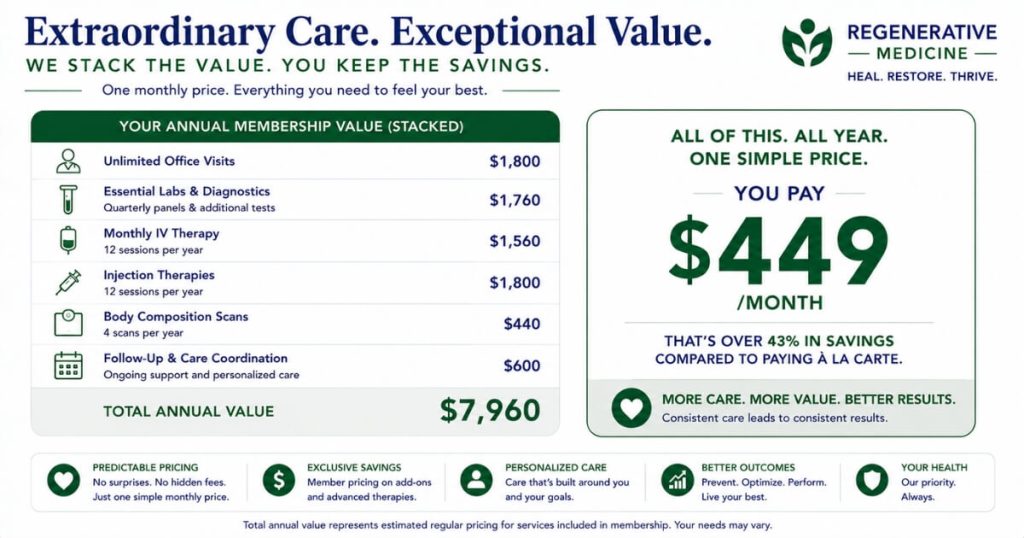
Show the total value of everything included first, then reveal the monthly price beneath it — so the price reads as a discount, not a cost.
Here’s how a real optimization clinic structures it. Their top tier bundles provider consultations, included hormones, discounts on peptides and supplements, diagnostic labwork, unlimited red-light therapy, body-scan sessions, HBOT and specialty-testing discounts, a longevity guide, and concierge care-team access — a stack with a total value of $7,960.
Then the price: $449 a month, with the menu noting “enroll and save $2,572/year.”
The patient sees $7,960 of value before they see $449.
The number lands as a steal.
That sequence is the entire technique.
Lead with the price and the brain compares it to other bills.
Lead with the value and the brain compares the price to the value.
Same dollar figure, opposite reaction.
Getting this right is one of the highest-leverage moves in a clinic’s medical practice marketing, because it changes conversion without changing the offer.
What is value stacking in clinic membership pricing?
Value stacking is listing every component of a membership with its standalone value, summing it to a total, and presenting that total directly above the actual price.
Most clinics describe their membership as a vague bundle — “everything you need for optimization.”
Value stacking makes it concrete and countable.
Each provider consultation is worth $250.
The labwork has a number.
The red-light sessions, the body scans, the supplement discount — each line gets a value.
When you total them, the membership has a defensible worth that dwarfs the monthly fee.
The “save $X/year” line at the bottom isn’t a gimmick; it’s the arithmetic the patient would otherwise do in their head, done for them and shown plainly.
The honesty of it matters.
You’re not inventing value — you’re surfacing value the patient was getting but couldn’t see.
A membership that genuinely includes $7,960 of services for $449 a month is a great deal whether or not anyone stacks it.
Stacking just makes the great deal visible at the moment of decision.
How should I structure good-better-best membership tiers?
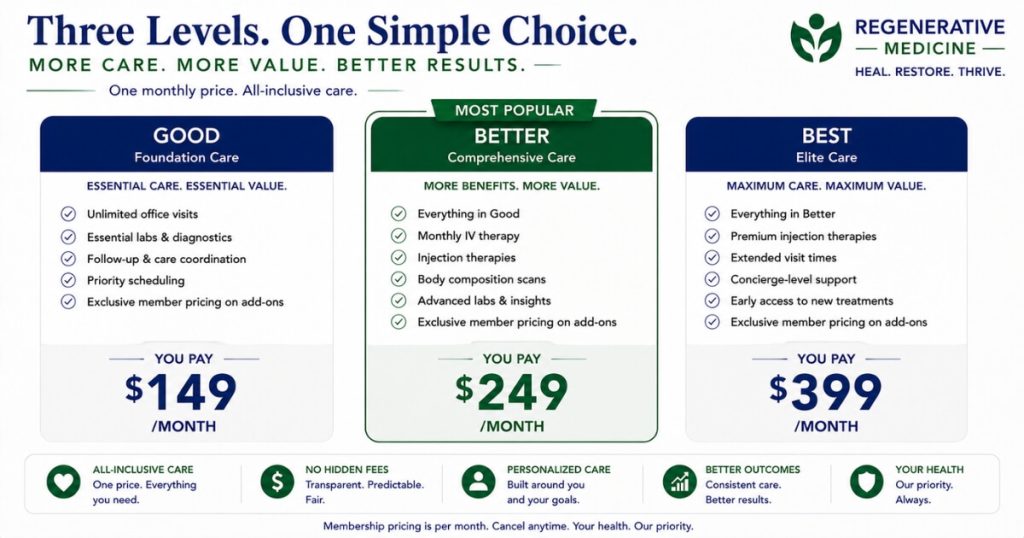
Three tiers, where each step up adds clearly more value — so the patient’s only real question is “how much do I want,” not “do I want this at all.”
The optimization clinic’s menu runs:
- Foundation: $99/month (total value $1,670)
- Core: $199/month (total value $2,905)
- Elite: $449/month (total value $7,960)
Foundation includes the essentials — a couple of provider consultations a year, basic labwork, a monthly red-light session, supplement and refill support.
Core adds more consultations, more labwork, more sessions, and deeper discounts.
Elite includes hormones, unlimited red-light, the longevity guide, concierge care-team access, and the steepest discounts across the board.
The structure does two jobs.
It captures patients at three budget levels instead of forcing one take-it-or-leave-it price, and it reframes the decision.
Once there are three tiers, the patient stops asking whether to join and starts asking which tier fits — a far easier “yes” to get.
This is the same conversion principle behind a patient acquisition system that turns interest into enrollments.
How do I get patients to pick the middle tier?
Build the middle tier to be the obvious value, and let the top tier do its real job — making the middle look reasonable.
With Foundation at $99, Core at $199, and Elite at $449, most patients land on Core — and that’s by design.
The Elite tier at $449 isn’t only there for the patients who buy it.
It’s there to anchor high so the $199 Core reads as the sensible, balanced choice rather than the expensive one.
Without the $449 option, $199 would feel like the premium splurge.
With it, $199 feels like the smart middle.
The top tier reframes everything beneath it.
So design the middle tier to be the one you actually want most patients in:
- Enough included that it’s clearly better than Foundation
- Priced far enough below Elite that it feels like restraint
- Clearly positioned as the best overall value
Badge it “Most Popular” and you’ve told the patient where their peers landed, which is its own quiet push.
The goal isn’t to trick anyone — it’s to make the tier that’s genuinely right for most patients also feel right.
What should each membership tier actually include?
Anchor every tier on the recurring, high-value services patients care about most, then differentiate with frequency, inclusion, and discount depth.
In the optimization example, the differentiators are clean:
- Provider consultations (two, three, or four per year)
- Hormones (included only at Elite)
- Diagnostic labwork (once or twice a year)
- Red-light therapy (one session a month, two a month, or unlimited)
- Body scans
- Escalating discounts on peptides, supplements, HBOT, and specialty testing
- Concierge refill guidance at every level
- Full concierge care-team access at the top tier
The pattern is simple:
The categories stay the same across all tiers.
The quantity, access, and savings increase as the patient climbs.
That consistency is what makes the menu easy to read and easy to upsell.
A Foundation member who wants hormones has a clear reason to move to Elite.
A Core member who wants unlimited red-light knows exactly what the next tier costs.
The menu becomes a built-in upgrade path.
High-LTV recurring verticals reward this structure the most.
Eternity Health Partners runs about 250 active members at roughly $1,000 a month, generating $1.7M a year in membership revenue from SEO alone, and VYVE Wellness turned a 900% jump in website leads into a longevity membership base.
A well-built tier menu is how that demand becomes durable monthly revenue.
FAQ’s About Value-Stacking a Cash-Pay Clinic Membership Menu
How many membership tiers should a cash-pay clinic offer?
Three is the proven sweet spot.
One tier forces a take-it-or-leave-it decision.
Four or more creates analysis paralysis.
Three lets you capture different budgets while using the top tier to anchor the middle as the obvious choice.
Does value stacking actually work or do patients see through it?
It works because it’s true, not because it’s a trick.
You’re surfacing value the patient is genuinely receiving but wouldn’t otherwise tally.
The “save $X/year” line is simply the math done for them.
Patients see through fake value.
They respond to real value made visible.
Should I put my membership prices on my website?
You can publish the tiers to anchor expectations, but the full value stack lands hardest when a person walks the patient through it.
Many clinics show the three prices online and reserve the complete stacked breakdown for the consult, where the value can be explained line by line.
What if a patient only wants the top-tier service but not the price?
That’s what the middle tier and à la carte pricing are for.
Offer the Core tier as the balanced option, and keep a per-service price for anyone who truly wants just one thing.
The menu should have an answer at every level of commitment.
How do I price the tiers relative to each other?
Set the top tier high enough to anchor.
Set the bottom tier low enough to be an easy entry.
Design the middle tier as the option you most want patients to choose.
The exact numbers depend on your services and market, but the gap between tiers should always buy the patient clearly more value.
What’s the next step?
If your membership is a single price on a page and enrollment is softer than it should be, the problem is presentation, not the number.
Value-stacking and a good-better-best structure can lift conversion without touching what you actually charge.
On a 60-minute strategy call we’ll build your three-tier menu, stack the value on each tier, and design the middle tier to be the one most patients choose.