
How Do You Advertise Peptide Therapy Without Making Illegal Drug Claims?
Peptide therapy is one of the fastest-growing cash-pay offers in the country — and one of the easiest to get an ad account shut down over.
The problem is not the treatment; it is the marketing.
The clinics that scale peptides do not name the compound and promise a result. They advertise the condition, route the patient to a licensed provider, and let the prescriber discuss the specifics inside the clinical relationship.
This is the practical 2026 playbook for marketing peptide therapy compliantly — what you can and cannot say, how to frame the benefit, how the ad platforms actually treat speculative treatments, and how to build creative that books patients without triggering bans or regulatory risk.
Is it actually illegal to name a peptide in an ad?
Naming the peptide is not always a criminal act.
But it is the fastest way to create a non-compliant ad.
It is also the most common reason peptide ads get rejected or trigger regulatory attention.
Compounded peptides dispensed under 503A are patient-specific prescriptions. They are not FDA-approved drugs cleared for public marketing.
So an ad that names the compound and pairs it with a treatment outcome is functionally making a drug claim about an unapproved drug.
Ad platforms read it exactly the same way, which is why those ads get rejected.
The practical rule is simple:
- Advertise the condition.
- Advertise the outcome the patient wants.
- Route the conversation to a licensed-provider consultation.
- Let the provider discuss any specific peptide one-to-one inside the clinical relationship.
That separation is the whole strategy.
Keep the marketing about the problem.
Keep the drug conversation where it belongs — with a prescriber and a patient, not in a public ad.
For a fuller picture of how compliant patient acquisition fits together across a clinic, our med spa marketing framework shows how the same principles run across every cash-pay offer.
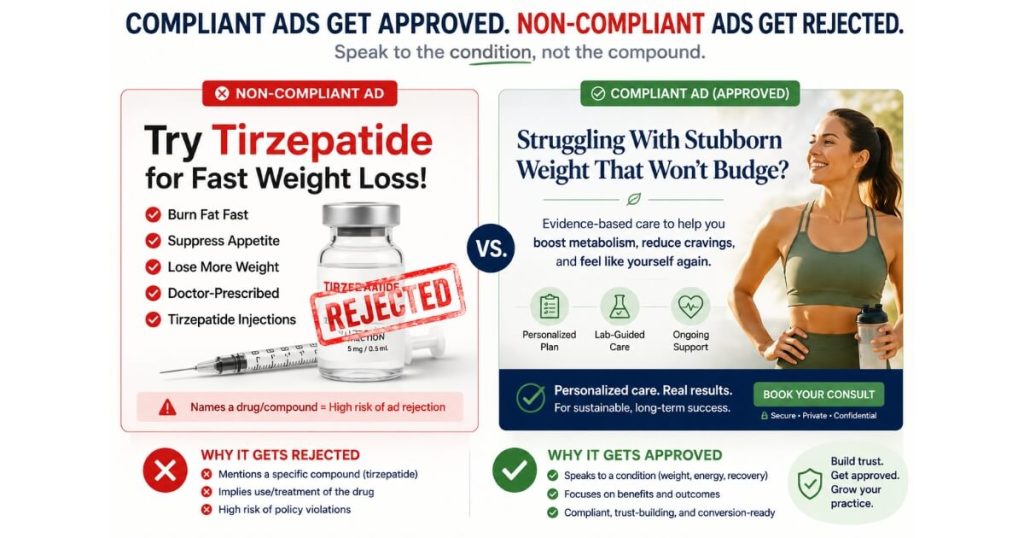
What can you actually say in a peptide therapy ad without making a drug claim?
Talk about the condition and the result the patient is after, not the compound.
Condition-first framing is the entire game.
You can run language like:
- “Non-surgical solution for stubborn weight”
- “A breakthrough approach to recovery and energy”
- “A medically supervised program for fatigue”
That copy describes the problem and the experience the patient wants.
It does not name a peptide.
It also does not promise that a peptide cures or treats a disease.
The model here is the same one that keeps any speculative-treatment ad compliant.
You can say:
- “Non-surgical knee pain solution”
- “Breakthrough treatment for knee pain”
But you cannot say the compound plus the condition.
What you cannot do is:
- Name the peptide alongside a condition
- Claim it treats a disease
- Claim it cures a disease
- Claim it prevents a disease
- Imply guaranteed clinical results
Condition-specific language has a second payoff beyond compliance.
It reaches people earlier in the buying process, because they recognize the problem before they know the product name.
That is exactly the audience a cash-pay clinic wants to capture and educate on the consult.
How do ad platforms like Facebook treat peptide and speculative-treatment ads?
Facebook and Instagram enforce a restrictive medical and pharmaceutical policy.
Peptides fall squarely into the speculative-treatment category that policy is built to catch.
Ads that name a peptide, name a regulated therapy, or promise clinical outcomes get flagged.
They get rejected.
Or worse, they get the ad account shut down.
Facebook is rarely the top channel for the highest-quality leads.
But it is:
- The easiest to set up
- The fastest way to start generating leads
- The least expensive
That is why clinics keep coming back to it.
The way to run on these platforms is to build the campaign clean from the start.
That means:
- A properly set up Business Manager
- A simple lead-generation campaign using native lead forms
- Tight radius targeting around the clinic
- An audience of roughly 150,000 to 250,000 people
- Ad-level copy that stays strictly condition-specific
A properly set up Business Manager helps the platform see you operating the right way.
It also gives you more grace if you ever land in review.
Native lead forms remove the need for a landing page or complex pixel setup.
The treatment-name rule matters.
You never name:
- Stem cells
- Regenerative medicine
- PRP
- HRT
- TRT
- Hormone therapy
- Any treatment by name
The same rule that keeps every speculative-treatment ad alive applies to peptides.
Get the structure right, and the platform becomes a low-cost, fast lead source instead of a liability.
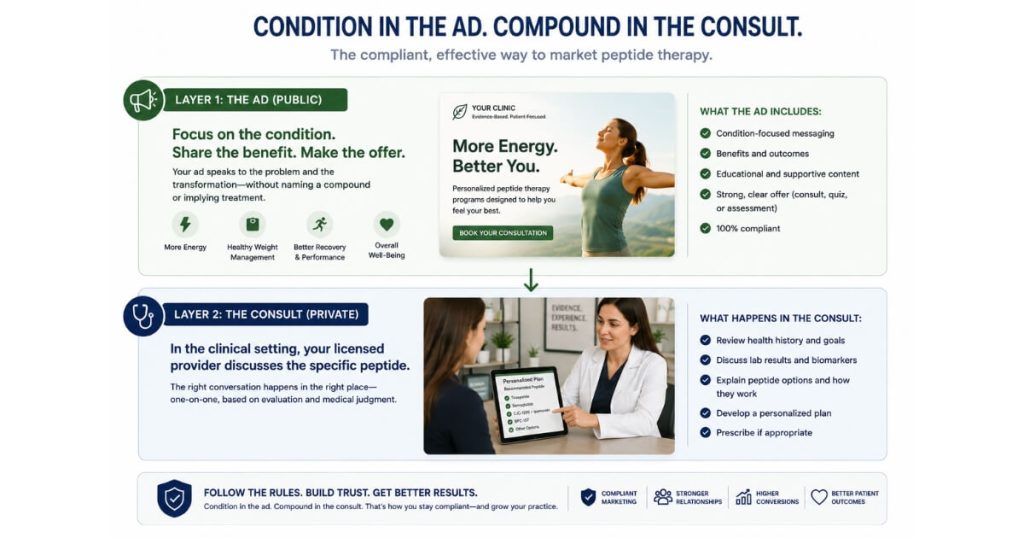
What does compliant peptide ad creative that actually converts look like?
A strong offer, a strong image, and a condition-first headline — in that order.
People barely read the body copy.
The headline, the image, and the offer do the work.
Each one has to carry the condition without naming the compound or claiming a cure.
A medically supervised weight or recovery program with a clear, aggressive front-end offer outperforms a paragraph of clinical detail every time.
Route the click to:
- A native lead form
- A quiz
Do not route it to a page stacked with peptide names and outcome promises.
Then follow up fast.
Speculative-treatment ads bring in earlier-stage leads.
That means the sales conversation is where the real conversion happens.
Most clinics that fail on this channel fail because they have no team to convert the leads.
They do not fail because the ads were bad.
The creative wins by being:
- Simple
- Offer-led
- Compliant
Then it hands a warm lead to a team that can book the consult while the interest is hot.
That is the same operating discipline behind Eternity Health Partners, who grew from $1M to $4M on a membership model by pairing compliant front-end demand with a real follow-up engine.
Why does condition-first framing convert better and not just safer?
Because condition-specific language reaches people earlier in the buying process.
Earlier-stage demand is far bigger than the small pool already searching for a peptide by name.
Someone who is tired, carrying stubborn weight, or struggling to recover recognizes the problem long before they know which compound a clinic might prescribe.
Speaking to that problem captures the whole top of the funnel.
It also helps you avoid competing for the handful of product-aware buyers.
It keeps the marketing compliant, which keeps the ad account alive and the spend compounding.
That is better than getting reset every time an account is shut down.
The trade-off is that these leads need a real consultation and fast follow-up to convert.
But a cash-pay clinic with a sales process in place turns that earlier-stage volume into booked patients.
The lower cost per lead more than pays for the extra nurture.
We saw this compounding effect at NuLevel Wellness Medspa, where we added $6.7M in revenue in one year across 3,727 new patients.
Compliant, condition-first demand worked at the front.
A team that converts worked at the back.
What’s the safest end-to-end way to market peptide therapy in 2026?
Advertise the condition, route to a licensed-provider consult, and discuss specific peptides only inside the clinical relationship.
Then support that with a clean account structure and fast follow-up.
The marketing layer never names the compound.
It does not claim the compound treats a disease.
It speaks to the problem and the outcome the patient wants.
Then it drives a consultation.
The clinical layer is where a prescriber evaluates the patient and discusses any specific therapy one-to-one.
That is where the conversation is supposed to live.
Underneath both, a low-cost channel becomes a reliable patient-acquisition engine when you have:
- A properly set up Business Manager
- Native lead forms
- Radius targeting
- Offer-led creative
- A sales team that follows up quickly
That separation — condition in the ad, compound in the consult — is what keeps peptide marketing compliant, durable, and profitable.
FAQ’s About Advertising Peptide Therapy Compliantly
Can I run peptide ads on Google instead of Facebook to avoid the policy issues?
Google enforces its own restrictive healthcare and medication policy.
Switching platforms does not switch off the rules.
The same discipline applies everywhere:
- Advertise the condition.
- Never name the compound.
- Never promise a clinical cure.
- Route to a consult.
The platform changes.
Compliant condition-first framing does not.
Does mentioning “FDA” or “clinically proven” help my peptide ad look credible?
It usually does the opposite.
Compounded 503A peptides are not FDA-approved drugs.
So implying approval or proven clinical outcomes is exactly the kind of claim that gets ads rejected and creates regulatory risk.
Lead with the offer and the condition.
Keep specifics in the consultation.
What happens if my ad account does get shut down?
This is why you set up a proper Business Manager before you spend a dollar.
When the platform sees you took the steps to operate the right way, it tends to extend more grace in review.
Can I show before-and-after photos for peptide therapy?
Most platforms restrict before-and-after imagery for medical treatments.
It also invites outcome-claim scrutiny.
Lean on:
- A condition-first headline
- A clean image
- A strong offer
instead.
Do I need a landing page to run compliant peptide ads?
No.
Facebook’s native lead forms let you generate leads without a landing page or complex pixel setup.
Use a landing page or quiz when you want higher lead quality.
But it is not required to start.