
How Do the Most Successful Cash-Pay Clinic Owners Actually Think?
Over the last seven years we’ve done more than 10,500 discovery calls with medical practice owners. That’s not an assumption — it’s a large enough sample to see a real, repeatable difference in how the owners who scale think versus the ones who stay stuck. The gap is rarely talent or market. It’s mindset. Here’s the FAQ on the thinking patterns that separate the most successful cash-pay clinic owners from the rest — presented as the case those owners consistently make.
What’s the biggest mindset difference between owners who scale and those who don’t?
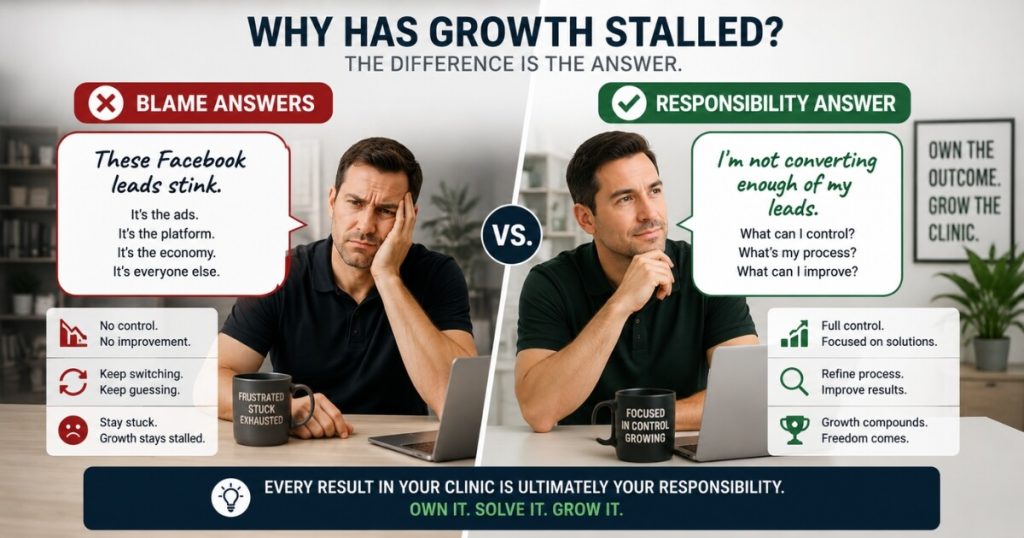
Successful owners take responsibility for their numbers; struggling owners assign blame.
Nearly every discovery call follows the same path. We ask what they want to accomplish, they name a revenue goal, and we ask, “What do you think you need to do to get there?” The answers vary enormously. Some say, “I’m not converting enough of my leads into patients.” Others say, “These leads from Facebook stink,” or “I’m not sure.” One of those answers takes responsibility. The others place blame — and the responsibility answer is the one successful owners give.
This isn’t about self-flagellation. It’s that responsibility is where leverage lives. If the problem is your conversion, you can fix it. If the problem is “bad leads” or forces outside your control, you’re powerless. It’s your business, and it’s your job to know what’s actually going on. That ownership mindset is the foundation everything else in medical practice marketing consultants work is built on, because we can only help an owner who’s willing to look at their own numbers honestly.
Should doctors feel comfortable charging premium prices?
Yes — and successful owners aren’t ashamed of wanting to get wealthy, because charging well is what funds better care.
There’s a cultural taboo that doctors should be near-public servants and that it’s somehow wrong for them to charge as much as they can. Successful owners reject that framing, and their reasoning is patient-centered: better resources produce better care. Given the choice for a family member between a clean, modern, well-staffed office with current equipment and a dated one with older tools, everyone picks the first. But that first office only exists because someone charged enough to fund it. Better equipment, higher-quality staff, and a better patient experience all cost money.
So the argument goes: if you know you could deliver better care and better service with more resources, charging as much as you ethically can isn’t greedy — it’s what makes that quality possible. The most successful owners want to build wealth and aren’t apologetic about it, precisely because they see it as inseparable from the quality of care they can provide. (Reasonable people weigh access and affordability differently. This is the case top owners make, not a claim that price maximization is the only ethical stance.)
Should I focus on my competition or on my patients?
On your patients — copying competitors gets you a slightly better version of their results, while rethinking the experience for patients gets you a categorically different one.
It’s intuitive and easy to build a business by copying the clinic down the street: their website, their services, their org chart, their pricing, and their ads. But if you do what they do and only do it slightly better, you get a slightly better version of their results. If instead you rethink the process and build something genuinely better around what patients actually need, you get a dramatically different outcome. The lazy path is imitation. The growth path is patient obsession.
Practically, this means you stop asking colleagues whether they like your website and start asking patients whether they find it clear, easy, and worth their time. Your competitor’s opinion of your clinic doesn’t pay you. Your patients’ experience does. When you take the focus off matching everyone else and put it on creating the best possible care and experience, patient satisfaction rises and the business grows with it.
How educated about my own business do I really need to be?
Educated enough to run it by numbers, not intuition — successful owners know their metrics cold.
A sophisticated owner knows their:
- Leads
- Appointments booked
- Attendance rate
- Consults completed
- Procedures scheduled
- Conversion rates
Not vaguely — specifically. A business run by numbers can find and fix its weak point. A business run on intuition can only go so far before it plateaus because the owner can’t see what to improve. Knowing your numbers lets you make educated decisions about which lever to pull instead of guessing.
Being sophisticated also means knowing when to hire to solve a specific problem and not being afraid to ask for help. The best owners recognize that seeing patients is their skill set, and that tools, software, and people should handle everything else. Eternity Health Partners grew from $1M to $4M a year on exactly this basis — an owner who ran the practice by its numbers and built a team and systems to carry the rest.

Why does “how you do anything is how you do everything” matter for a clinic?
Because the standard you hold in your own conduct is the standard your team and patients mirror back — including on things like no-shows.
This one is uncomfortable but high-impact. If you commit to an appointment with a vendor, colleague, or friend and then cancel or no-show, that same looseness shows up in your practice. Teams and patients take their cues from the owner. When a successful owner is asked to commit their time, they answer clearly yes or no. If the answer is yes, they follow through and they’re on time. If they can’t answer yet, they say so, set the expectation, and follow through on when they’ll respond. Everyone is watching the owner: the team, the patients, and the competition. Hold a high standard in your own commitments and it propagates through the whole organization.
The flip side is just as real. Loose personal standards leak into loose operations. Owners who guard their time, keep their word, and set firm boundaries tend to run tighter, more reliable practices — and command more respect (and higher prices) as a result.
Do I really need to invest in myself and stay willing to change?
Yes — successful owners make real investments in their own growth and stay willing to shift their thinking, because that’s what unlocks new results.
Investing in yourself — coaching, programs, marketing, and skill-building — does a few things at once:
- Builds conviction by betting on yourself.
- Creates productive pressure that drives bigger action.
- Buys new information you can immediately apply.
The owners who grow fastest treat investment in themselves as a driver of results, not a cost. As one framing puts it, the larger the investment you make in yourself, the larger the result you become capable of.
Underneath all of it is a willingness to change how you think. None of these patterns work without the self-awareness to examine your own habits and reactions honestly. If you keep thinking and acting the same way, you can’t expect a different result. Dr. Joy Kong scaled herself out of the day-to-day, hired four additional doctors, and built a leading regenerative-medicine brand by being willing to rethink how her practice — and her role in it — worked.
FAQ’s About How Successful Clinic Owners Think
What separates clinic owners who scale from those who stall?
Mindset — specifically, taking responsibility for their numbers instead of assigning blame. Asked why growth has stalled, successful owners answer with something they control (“I’m not converting enough leads”) rather than something they don’t (“These leads stink”). Responsibility is where the leverage to fix things lives.
Should doctors charge premium prices?
Successful owners believe so because better resources fund better care, better staff, and a better patient experience. They reject the idea that doctors should charge as little as possible, viewing fair premium pricing as what makes high-quality care possible. Owners weigh access and affordability differently, but this is the case top owners consistently make.
Should I focus on my competition or my patients?
On your patients. Copying competitors yields a slightly better version of their results, while rethinking the experience around what patients actually need yields a categorically better outcome. Ask patients—not colleagues—whether your clinic serves them well, and let that drive decisions.
How well do successful owners know their numbers?
Cold. They track leads, appointments booked, attendance rate, consults completed, procedures scheduled, and conversion rates specifically—not vaguely. Running a clinic by numbers lets you find and fix the weak point. Running on intuition eventually plateaus. They also know when to hire to solve a problem rather than doing everything themselves.
What’s the next step?
If any of these mindsets hit a nerve—blaming leads, avoiding your numbers, copying competitors, or undercharging out of guilt—that’s usually where the growth is hiding. Book a strategy call. In 60 minutes we’ll look honestly at your numbers and your positioning, show you where a shift in approach would move the needle most, and map the specific changes that follow.
If it’s a fit, we’ll build the plan with you.