
How Does a Regenerative or Stem Cell Clinic Get Found in AI Search Like ChatGPT and Perplexity?
Your next regenerative patient may never type a query into Google. They’re asking ChatGPT “is stem cell therapy worth it for knee arthritis,” asking Perplexity “who are the best regenerative medicine clinics near me,” and reading Google’s AI Overview before they ever click a link. If your clinic isn’t part of what those models say, you’re invisible at the exact moment the patient is deciding. This is the FAQ on how a regenerative or stem cell clinic gets found — and recommended — in AI search.
Why does AI search matter for a regenerative or stem cell clinic now?
Because regenerative patients research for weeks before booking, and that research increasingly happens inside ChatGPT, Perplexity, Gemini, and Google’s AI Overview rather than a list of blue links.
If the AI doesn’t mention you, you’re not in the consideration set.
Regenerative treatment is a high-consideration, high-cost decision.
Patients ask:
- Whether it works
- Whether they’re a candidate
- What it costs
- Who to trust
These are exactly the open-ended questions people now bring to AI assistants instead of search engines.
The model reads the web, synthesizes an answer, and often names specific clinics or describes what a good one looks like.
The patient treats that answer as a trusted recommendation and acts on it.
Being absent from it is like being unlisted in the era of the phone book.
This is the natural extension of search-driven growth.
The same authority and content that ranks a regenerative clinic in organic search is what feeds the AI’s answer — which is why clinics with a strong stem cell clinic marketing foundation are already showing up in AI responses while their competitors wonder where the leads went.
How do AI models like ChatGPT and Perplexity decide which regenerative clinics to recommend?
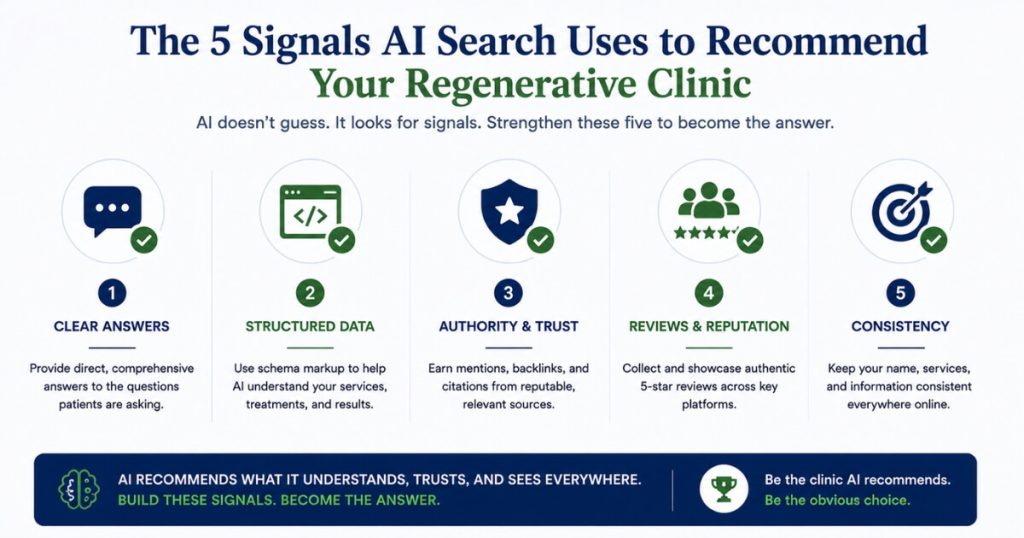
They pull from content across the web that clearly answers the patient’s question, that’s structured so a machine can read it, and that carries authority signals — credentials, reviews, consistency, and citations.
The clearer and more authoritative your content, the more liftable it is into an answer.
AI answers are assembled from sources the model trusts and can parse.
That favors content that:
- Directly answers real patient questions in plain language
- Is marked up with structured data so the machine understands what it’s reading
- Is published by an entity that looks legitimate (consistent name and details across the web, real credentials, genuine reviews)
- Is corroborated by other sources
A clinic whose website buries its expertise in vague brochure copy gives the model nothing to quote.
A clinic that publishes clear, question-shaped answers about regenerative treatment hands the model exactly what it needs.
In other words, the clinic AI recommends is usually the clinic that already answered the question best on the open web.
You earn the recommendation by being the clearest, most authoritative source on the questions your patients are asking.
What content gets a regenerative clinic cited by AI search?
Content built around the exact questions patients ask — phrased as questions, answered directly in the first sentence, backed by specifics and proof.
That structure is liftable into an AI answer almost verbatim.
Think about how a patient talks to ChatGPT:
- “does PRP work for knee arthritis”
- “am I too old for stem cell therapy”
- “how much does regenerative treatment cost”
The content that gets cited mirrors those questions as headings and answers them plainly and immediately.
Then it elaborates with specifics:
- Conditions treated
- What the process involves
- Real outcomes
- Honest candidacy guidance
Vague, salesy copy doesn’t get quoted.
Clear, useful answers do.
This is also why proof and specificity matter so much.
An answer that includes concrete results and credentials is more citable than one full of adjectives.
The clinics getting pulled into AI answers are the ones that treat their website like a thorough, honest FAQ for their specialty — which, not coincidentally, is the same content that wins organic search and converts human readers.
Does structured data and schema markup help a regenerative clinic show up in AI search?
Yes — structured data helps machines understand and trust your content, making it easier for AI search to parse, attribute, and surface.
It’s not the whole game, but it removes friction between your expertise and the model.
Schema markup — FAQ schema, article schema, medical and local-business schema — labels your content so a machine knows exactly what each part is:
- This is a question
- This is the answer
- This is the clinic
- This is the location
When a model is assembling an answer, content it can cleanly parse and attribute is easier to use than content it has to guess at.
Pair that with clear on-page answers and you’ve made your expertise maximally available to both search engines and AI assistants.
It also reinforces the entity signals that build trust:
Consistent clinic name, address, and details, marked up and matching across the web, tell the model you’re a real, established practice.
That consistency is part of why some clinics get named and others get skipped.
How do reviews and reputation affect a regenerative clinic’s AI visibility?
Heavily.
AI assistants lean on reputation signals like reviews, consistency, and third-party mentions to decide which clinics are trustworthy enough to recommend.
A clinic with strong, specific reviews is a safer answer for the model to give.
When a patient asks an AI for a recommendation, the model is making a trust judgment on the patient’s behalf.
It reads the same reputation signals a careful human would:
- Volume and quality of reviews
- What those reviews actually say
- Consistency of the clinic’s information across platforms
- Whether other sources mention the practice
Reviews that name specific conditions and outcomes are especially valuable because they give the model concrete, attributable evidence of what you do well.
So the reputation work that already drives local search — genuine reviews that mention your services, an accurate and consistent profile everywhere you appear — does double duty by making you a more recommendable answer in AI search.
Authority and trust are the currency, whether the gatekeeper is a search algorithm or a language model.
How is AI search optimization different from regular SEO for a regenerative clinic?
It’s mostly an extension of good SEO, not a separate discipline — but it shifts the emphasis toward directly answering questions, structured data, and authority, and away from chasing keywords and rankings for their own sake.
Traditional SEO got a clinic to rank a page for a keyword.
AI search rewards being the clearest, most trustworthy answer to a question because the model is synthesizing rather than listing.
The overlap is huge:
- Clear question-shaped content
- Schema
- Reviews
- Consistency
- Genuine authority
These help both.
The difference is that AI doesn’t hand out ten blue links — it gives one synthesized answer.
Being merely present isn’t enough.
You have to be among the best answers.
The practical move is to build your site as the definitive, honest resource on your specialty’s real questions, marked up cleanly, backed by proof and reviews.
That same investment built durable organic growth for regenerative clinics before AI search existed, and it’s what positions them to be the answer now.
If you want a foundation that wins both, that’s what real stem cell clinic marketing and pain management marketing are built to do.
FAQ’s About Getting a Regenerative Clinic Found in AI Search
How do I get my regenerative clinic recommended by ChatGPT or Perplexity?
Be the clearest, most authoritative answer to the questions patients ask.
Publish content phrased as the real questions patients bring to AI — “does PRP work for knee arthritis,” “am I a candidate for stem cell therapy” — answered directly and backed by specifics and proof.
Mark it up with structured data, keep your clinic’s information consistent across the web, and build genuine reviews.
AI recommends the clinic that already answered the question best on the open web.
Does schema markup help with AI search visibility?
Yes.
Schema markup labels your content so machines know exactly what each part is — question, answer, clinic, location — which makes it easier for AI assistants to parse, attribute, and surface your expertise.
It also reinforces entity signals (consistent name, address, details) that tell the model you’re a real, established practice.
It’s not the whole game, but it removes friction between your expertise and the answer.
Is AI search optimization different from SEO?
It’s largely an extension of good SEO rather than a separate discipline.
Both reward:
- Clear, question-shaped content
- Structured data
- Reviews
- Consistency
- Genuine authority
The key difference is that AI gives one synthesized answer instead of ten links, so being merely present isn’t enough — you have to be among the best answers.
The same content investment wins both.
Do online reviews affect whether AI recommends my clinic?
Significantly.
When a patient asks an AI for a recommendation, the model makes a trust judgment using the same reputation signals a careful human would:
- Review volume and quality
- What reviews say
- Consistency of your information across platforms
- Third-party mentions
Reviews that name specific conditions and outcomes are especially valuable because they give the model concrete, attributable evidence of what you do well.
Why are patients using AI search to research regenerative treatment?
Because regenerative treatment is a high-cost, high-consideration decision and AI assistants answer exactly the open-ended questions patients have:
- Does it work?
- Am I a candidate?
- What does it cost?
- Who can I trust?
Instead of scanning blue links, patients get a synthesized, trusted-feeling answer in seconds.
If your clinic isn’t part of that answer, you’re invisible at the moment the patient is deciding.
What’s the next step?
Your next regenerative patient is asking an AI assistant whether the treatment works and who to trust — and acting on the answer.
The clinics that get recommended are the ones that already answered those questions best on the open web:
- Clear, question-shaped content
- Structured data
- Real reviews
- Consistent authority
It’s the same authority that wins organic search, now feeding the AI’s answer.
On a strategy call we’ll audit how visible your clinic is in AI search and build the content-and-authority foundation that gets you recommended — the same foundation that grew a regenerative clinic to $309,590 in cash-pay revenue in 10 months on organic search alone.