
How Should a Regenerative or Pain Clinic Handle Negative Reviews and Online Reputation?
When a patient is deciding whether to spend fifteen or twenty thousand dollars on a regenerative treatment they’re already skeptical of, your reviews aren’t a nice-to-have — they’re the deciding factor. They’ll read every one, and a single bad review left unhandled can quietly cost you a five-figure case. Yet most clinics either ignore their reputation entirely or, worse, respond to a negative review in a way that breaks HIPAA. Here’s how a pain or regenerative clinic protects its reputation, responds to criticism the right way, and builds a review profile strong enough that one bad day can’t sink a booking.
Why do online reviews matter so much for a high-ticket regenerative or pain clinic?
Because the regenerative patient is making an expensive, skeptical, cash decision, and reviews are the single most trusted form of proof they have when choosing whom to believe.
Every patient considering a five-figure treatment they’ve never had, for a condition that’s been frustrating them for years, is fundamentally asking one question: can I trust these people?
They can’t evaluate your medical skill directly, so they lean on the closest available signal — what other patients say.
Reviews carry more weight than any ad or website claim because they come from peers with nothing to sell, which is exactly the credibility a skeptical high-ticket buyer is hunting for.
This makes your reputation a direct revenue lever, not a vanity concern.
A patient comparing your clinic to a competitor will often decide on reviews alone, and the difference between a strong profile and a weak one is the difference between a booked case and a lost one.
Reviews and conversion go hand in hand — the same trust signals that drove a 79.4% lead-to-appointment conversion rate at a regenerative clinic we grew to $309,590 in cash-pay revenue in ten months are the ones that make every other piece of your pain management marketing work harder.
How should you respond to a negative review without violating HIPAA?
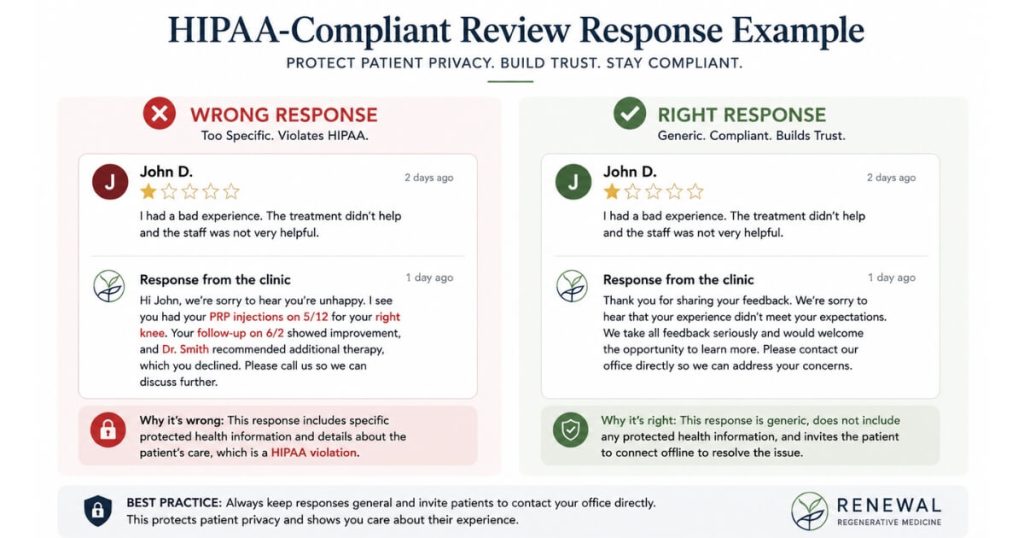
Respond promptly, professionally, and generically — thank them for the feedback, express that you take concerns seriously, and invite them to contact the office directly — but never confirm they were a patient or reference any detail of their care.
This is the single most important rule, and the one clinics break most often.
Even if a reviewer publicly describes their treatment, you cannot respond in kind, because confirming a treatment relationship or any care detail discloses protected health information regardless of what the patient revealed first.
A reply like “we’re sorry your knee injection didn’t meet expectations” is a HIPAA violation even though it feels like a reasonable response.
The patient waiving their own privacy does not waive your obligation.
The compliant response stays warm but generic: acknowledge the feedback, affirm that your practice takes all concerns seriously, and move the substance offline by inviting them to call the office.
This shows every future reader — who matters far more than the one reviewer — that your clinic is professional, attentive, and gracious under criticism.
Train everyone who touches your reviews on this, because a single well-meaning but specific reply can turn a small problem into a compliance one.
(This is general guidance, not legal advice; confirm specifics with your compliance counsel.)
What should you NOT do when you get a bad review?
Don’t get defensive, don’t argue the facts publicly, don’t disclose any patient information, and never try to bribe, threaten, or pressure the reviewer into removing it — every one of those reactions does more damage than the review itself.
The instinct when a review feels unfair is to set the record straight, and it’s almost always the wrong move.
A defensive, argumentative, or detailed public reply makes the clinic look thin-skinned and, worse, can expose patient information.
Future patients reading it judge you far more on your composure than on the original complaint.
A graceful, generic response to a harsh review can actually win trust; a combative one loses it.
Equally damaging is anything coercive: offering money or discounts to take a review down, having staff pressure the patient, or threatening them.
These tactics violate most platforms’ terms, are ethically wrong, and create a far bigger crisis if they ever surface.
The reputation of a high-ticket pain and regenerative practice is built on trust and professionalism — the same qualities that helped Dr. Groysman grow monthly revenue by $40K+ while building a stronger, more trusted practice.
Don’t trade that away to win an argument with one reviewer.
How do you build enough positive reviews to outweigh the occasional negative one?
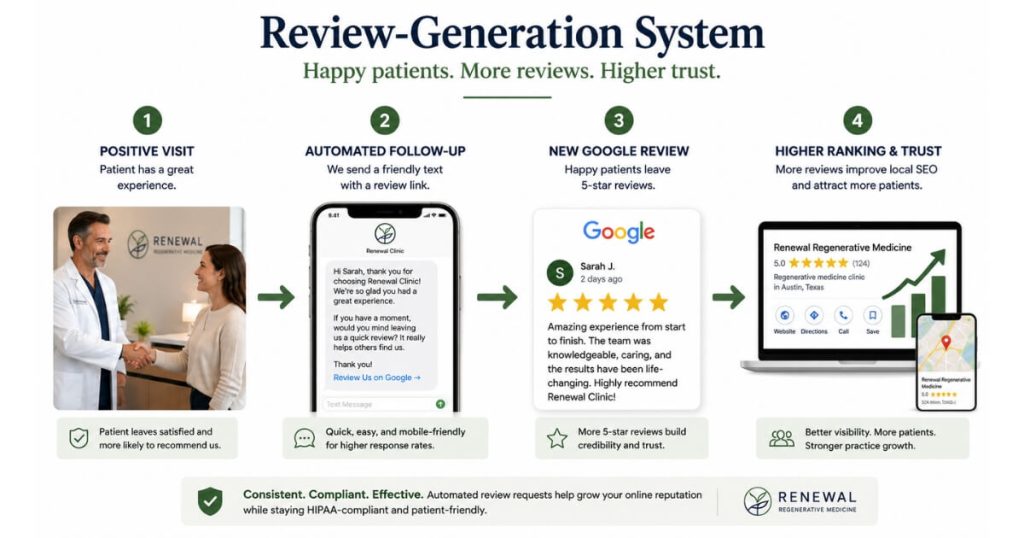
You build a simple, consistent system that asks every satisfied patient for a review at the right moment, so that a steady flow of genuine positives keeps your rating high and pushes any single negative far down the page.
The best defense against a bad review is volume of good ones.
A clinic with a handful of reviews is fragile — one complaint tanks the average and dominates the page.
A clinic with hundreds of recent reviews is resilient, because one negative among many positives reads as an outlier, not a pattern.
The way you get there is not luck; it’s process.
Most happy patients will leave a review if you simply ask at the moment they’re most satisfied and make it effortless with a direct link.
Build that ask into your patient journey — a follow-up text or email after a great visit, a friendly request from the care coordinator, a simple QR code in the office.
The goal is steady recency, not a one-time blast, because fresh reviews signal that the clinic is consistently good now.
Done well, this review engine becomes a compounding asset that protects your reputation automatically and makes your clinic the obvious, trusted choice.
It’s a core piece of any serious medical practice marketing foundation.
How do you handle fake or malicious reviews?
Flag genuinely policy-violating reviews — those from non-patients, competitors, spam, or hate speech — for removal through the platform, respond to anything public with the same calm generic reply, and rely on your volume of real positive reviews to bury what you can’t remove.
Fake and malicious reviews are infuriating, and you do have options for the clear-cut ones.
If a review comes from someone who was never a patient, a competitor, or is obvious spam, you can report it to Google or the relevant platform for violating their content policies, and these are sometimes removed.
It takes persistence and isn’t guaranteed.
Document the case and be patient with the process.
For everything else, removal is unreliable, so your real protection is overwhelming it.
A steady stream of authentic positive reviews dilutes any single fake one and keeps your average strong, so the malicious review becomes a footnote rather than the headline.
Respond publicly only with your calm, generic, professional reply, and never let a troll bait you into a defensive exchange that does their work for them.
For a clearly defamatory review causing real financial harm, talk to an attorney.
But for the everyday malicious review, a strong, recent body of genuine reviews is the most reliable shield you have.
How do reviews affect whether AI search and Google recommend your clinic?
Reviews are a major signal in both local search rankings and the answers that tools like Google’s AI Overview, ChatGPT, and Perplexity give, so a strong, recent review profile makes your clinic more likely to be found and recommended, not just more persuasive once found.
Reviews do double duty.
They convince the patient who’s already looking at you, and they help patients find you in the first place.
Google’s local rankings weigh review quantity, quality, and recency heavily, so a clinic with many strong recent reviews tends to show up higher in the map pack and local results.
As patients increasingly ask AI assistants questions like “what’s the best regenerative medicine clinic near me,” those systems lean on the same public reputation signals — review volume, ratings, and what people consistently say — to decide whom to surface and recommend.
That means your review profile is now an SEO and AI-visibility asset, not just a trust asset.
A clinic actively building genuine reviews is feeding the exact signals that both Google and AI answer engines use to decide who gets recommended for high-value regenerative searches.
Neglect your reviews and you become harder to find.
Build them and you become the clinic the algorithms — and the patients — keep pointing to.
It’s one of the highest-leverage moves in modern pain management marketing.
How do you build an ongoing reputation system so this runs itself?
You make reputation a defined, owned process — someone responsible for monitoring reviews, a built-in ask after every positive visit, fast compliant responses, and regular reporting — so it runs continuously instead of only flaring up when a bad review appears.
Most clinics treat reputation reactively, scrambling only when a one-star review shows up.
The clinics that win make it a system.
That means assigning ownership so reviews are monitored daily across Google and the platforms that matter, baking the review request into your post-visit workflow so new positives arrive every week, and having a pre-approved, HIPAA-safe response template ready so negatives are handled fast and consistently.
It also means watching the trends — your average, your velocity, the themes in feedback — so problems in the patient experience get fixed at the root.
Built this way, your reputation becomes a self-reinforcing engine: steady positive reviews lift your rankings and conversions, fast graceful responses neutralize the occasional negative, and the whole thing compounds without constant firefighting.
For a high-ticket regenerative or pain practice, that engine is one of the most valuable assets you own, because it protects and amplifies every other dollar you spend on marketing.
It’s exactly the kind of operational discipline behind the durable growth we build into clients like a pain and regenerative practice where we added $2,095,039 in revenue in ten months.
FAQ’s About Managing a Regenerative Clinic’s Online Reputation
Can you respond to a patient’s online review without violating HIPAA?
Yes, you can respond to a review, but you must never confirm that the person was a patient or reveal any details about their care, because doing so discloses protected health information even if they posted publicly first.
The compliant response stays generic and does not acknowledge a treatment relationship: thank the reviewer for the feedback, state that your practice takes all concerns seriously, and invite them to contact the office directly to discuss it offline.
You do not say “when you came in for your knee injection” or “your results were” or anything that ties this individual to specific care, because the patient waiving their own privacy by posting does not waive your obligation under HIPAA.
Train every team member who touches reviews on this rule, because a well-meaning but specific reply is one of the most common and costly compliance mistakes a clinic makes.
When in doubt, keep the public reply short and invite the conversation offline, and consult your compliance counsel for your specific situation, as this is general guidance and not legal advice.
Should you ever ask a patient to remove a negative review?
You can sincerely try to resolve the underlying problem offline, and a genuinely satisfied patient may choose to update or remove their review on their own.
But you should never pressure, incentivize, or pay someone to take a review down, because that backfires and can violate platform rules.
The right move when you get a negative review is to reach out privately, listen, and make a real attempt to fix whatever went wrong.
If you solve the problem and the patient feels heard, they will often update the review themselves, and that voluntary change is far more powerful than a deletion.
What you must avoid is anything coercive or transactional: offering money or a discount to remove a review, threatening the patient, or having staff badger them.
Those tactics are unethical, often against the review platform’s terms, and create far worse problems than the original review if they become public.
Focus your energy on resolution, not removal.
A handful of negative reviews handled gracefully, surrounded by many genuine positive ones, actually builds trust, while an aggressive deletion campaign destroys it.
How many reviews does a regenerative or pain clinic need?
There is no magic number, but a high-ticket regenerative or pain clinic should aim for a large, steady, and recent volume of reviews — ideally dozens to hundreds with a strong average rating and fresh activity every month — because volume and recency matter as much as the score.
A patient about to spend five figures scrutinizes reviews far more than someone choosing a coffee shop, and they look for three things: a high overall rating, a large enough number of reviews to feel credible, and recent reviews that prove the clinic is consistently good now, not years ago.
Ten reviews from three years ago, even if perfect, looks thin and stale next to a competitor with two hundred reviews and several new ones this month.
That is why the goal is a system that consistently generates new reviews from happy patients rather than a one-time push.
Steady recency also dilutes the impact of any single negative review, because one complaint among many recent positives reads as an outlier rather than a pattern.
Aim for continuous growth, not a fixed target.
Can you get a fake or defamatory review removed from Google?
Sometimes — if a review genuinely violates the platform’s policies, such as a review from someone who was never a patient, spam, hate speech, or a clear conflict of interest, you can flag it for removal, but reviews that are simply negative opinions are very hard to get taken down.
Google and other platforms allow you to report reviews that breach their content policies, and a fake review from a competitor or a person with no relationship to your practice can sometimes be removed through that process, though it often takes persistence and is not guaranteed.
What you generally cannot remove is an honest negative opinion from a real patient, even an unfair-feeling one, because that is protected as legitimate feedback.
The most reliable long-term protection is not removal but burial: a steady stream of genuine positive reviews pushes any single bad one down and out of view and overwhelms its impact on your average.
For clearly defamatory or fraudulent reviews causing real damage, consult an attorney, but for the everyday negative review, your best defense is a strong volume of authentic positive ones.
What’s the next step?
For a high-ticket regenerative or pain practice, your online reputation isn’t a side project — it’s the trust signal that decides whether a skeptical patient books a five-figure case with you or your competitor.
Handling negative reviews with compliant grace, building a steady engine of genuine positive reviews, and turning the whole thing into a system that runs itself is one of the highest-return investments you can make.
That reputation engine is part of the complete growth system we build for regenerative and pain practices — the same approach behind a regenerative clinic that produced $309,590 in cash-pay revenue from organic leads with a 79.4% conversion rate.
If you want us to audit your current reputation and build the system that protects and grows it, that’s the conversation to book.