
How Can a Regenerative or Pain Practice Generate More Patient Referrals?
Patient referrals are the best patients a regenerative or pain practice can get — they arrive pre-trusted, close at a higher rate, and cost nothing to acquire.
Yet most clinics treat referrals as something that just happens, a happy accident they can’t control.
That’s the mistake.
Referrals are a channel you can engineer, and in a high-ticket, trust-first category like regenerative medicine, a deliberate referral system is one of the highest-ROI things you can build.
Here’s how to turn satisfied patients into a steady, predictable stream of new ones — when to ask, how to ask, whether to incentivize, and how reviews multiply the whole thing.
How can a regenerative or pain practice generate more patient referrals?
Make referring easy.
Ask for it at the moment a patient is happiest.
Build a simple system so it happens consistently instead of by accident.
Most regenerative practices get referrals passively and assume that’s the ceiling.
However, referrals are a channel you can engineer.
A successful referral system includes:
- An outcome worth talking about
- An experience worth talking about
- A timely referral ask
- An easy referral path
- Review collection
- Referral tracking
Deliver an outcome and an experience worth talking about.
Then ask at the peak moment.
That often happens right after a patient reports relief or hits a milestone.
Give them an easy way to refer.
Provide something concrete they can hand to a friend.
Capture reviews that do the referring for you online.
Track referrals so you know the system is working.
Because regenerative patients are high-ticket, a referred patient closes faster, at a higher rate, and at zero acquisition cost.
As a result, a deliberate referral system is one of the highest-ROI things a clinic can build.
Almost no competitor does it on purpose.
Referrals also belong inside your broader patient acquisition system.
They are the cheapest, highest-converting source you have.
They also compound every other channel because referred patients and strong reviews make your ads and SEO convert better.
Why don’t satisfied regenerative patients refer more on their own?
Because being happy isn’t the same as being prompted.
Most patients would gladly refer someone.
They simply never think to do it.
Others don’t know you want referrals.
Some don’t have an easy way to refer.
A patient who got their knee back after a stem cell procedure is thrilled.
However, they’re busy living their life, not thinking about your growth.
They may not realize who in their circle is a fit.
They may also assume you’re already full.
The gap between a satisfied patient and an actual referral is almost never dissatisfaction.
It’s the absence of:
- A prompt
- An easy path
That’s good news.
It means the referrals are already there waiting.
You simply have to ask at the right time and remove the friction.
Clinics that close that gap unlock a stream of patients their equally good competitors leave sitting on the table.
The practices generating the most word-of-mouth aren’t necessarily delivering better care than their neighbors.
They’re the ones who actually ask.
Everyone else assumes a happy patient will remember to do it unprompted.
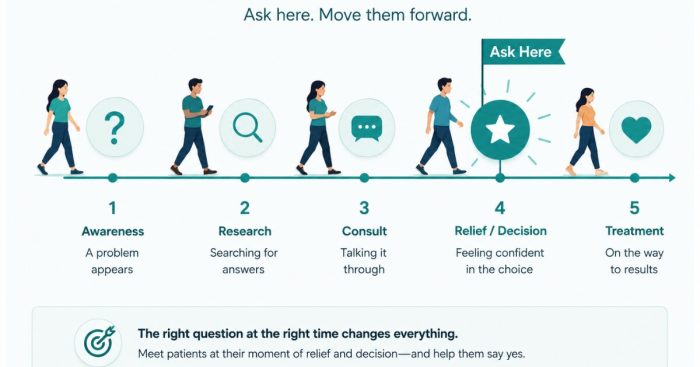
When is the best moment to ask a regenerative patient for a referral?
At the peak of their satisfaction.
That means right after they:
- Report meaningful relief
- Hit a recovery milestone
- Thank you or your team
That moment of genuine gratitude is when a patient is most motivated to share their experience.
Asking then feels natural rather than transactional.
For a regenerative or pain patient, that often happens a few weeks or months into treatment.
At that point, the treatment has clearly worked.
They’re actively telling you how much better they feel.
Train your team to recognize these moments.
Then act on them instead of leaving the ask to chance.
You can also build natural ask-points into the patient journey:
- A follow-up call after a milestone
- A check-in when results land
- The close of a successful treatment series
The principle is simple:
Ask when they’re happiest, not when it’s convenient for your calendar.
The yes rate climbs dramatically when you do.
This is the same operational discipline that produces strong organic lead flow.
At Elite Pain Doctors, where we added $2,095,039 in revenue in 10 months, the practices that win build these moments into the process instead of hoping they happen.
How do you ask a patient for a referral without feeling pushy?
Frame it around helping someone they care about.
Make it specific.
Make it effortless.
Instead of saying:
“Refer your friends.”
Try something like:
“If you know someone living with the same knee pain you had, we’d love to help them too — here’s an easy way to send them my way.”
That approach changes the context.
You’re no longer asking for a favor.
You’re helping a friend get access to something valuable.
That removes the pushiness entirely.
Give patients a concrete next step:
- A referral card
- A referral link
- A simple introduction process
There should be no work on their end.
Asking sincerely, once, at a happy moment, with an easy path never feels pushy.
What feels pushy is:
- Repeated asks
- Generic asks
- Self-serving asks
- No easy follow-through
Lead with their friend’s benefit.
Support it with your results.
The request lands as generosity rather than salesmanship.
Done well, the patient feels good about connecting a friend to something that genuinely helped them.
That’s exactly the emotion that drives the strongest word-of-mouth.
Should a regenerative clinic run a formal patient referral program or incentives?
A simple, compliant referral program can help.
However, the bigger lever is consistently asking at the right moment and delivering an experience worth talking about.
Structure beats incentives.
A light referral program can:
- Thank referrers
- Give new patients a reason to come in
- Create consistency around referrals
Examples include:
- A complimentary consultation
- Relevant added value
Be careful with cash-for-referral incentives in healthcare.
Depending on your services and jurisdiction, they can create regulatory or compliance concerns.
Always check the applicable rules before offering anything tied to payment.
What works reliably and cleanly is:
- Gratitude
- Ease
- Great outcomes
- Great experiences
Acknowledge and thank patients who refer.
Make referring effortless.
Focus most of your energy on creating results patients naturally want to talk about.
The clinics with the strongest referral flow rarely have the most aggressive incentives.
They have the most consistent ask and the most remarkable patient experience.
If you’re building this into your operations, it’s exactly the kind of system good pain management marketing bakes in from the start.
That turns referrals into a reliable channel rather than a lucky accident.

How do patient reviews and testimonials drive referrals for a regenerative practice?
Reviews and testimonials are referrals that scale.
They allow one happy patient to influence hundreds of prospective patients.
They also convert the patients your other marketing brings in.
When a prospective patient is choosing between regenerative clinics, detailed reviews and patient-result stories often become the deciding factor.
Regenerative care is a trust-first, high-consideration purchase.
Ask happy patients for a Google review at the same peak moment you’d ask for a referral.
Capture video testimonials from your best outcomes.
Use those assets across:
- Your website
- Social media
- Marketing campaigns
A strong review profile also improves local search visibility.
That means it helps:
- Bring in new patients
- Convert existing prospects
That conversion power is real.
That’s the type of close rate strong trust signals help support.
Think of reviews as a referral engine running 24/7.
Every prospective patient reading them is effectively receiving a referral from someone who was once in their exact situation.
FAQ’s About Generating More Patient Referrals at a Regenerative or Pain Practice
How can a regenerative or pain practice generate more patient referrals?
Make referring easy, ask for it at the moment a patient is happiest, and build a simple system so it happens consistently instead of by accident.
Most regenerative practices get referrals passively and assume that’s the ceiling.
However, referrals are a channel you can engineer.
Deliver an outcome and an experience worth talking about.
Ask at the peak moment.
Give patients an easy way to refer.
Capture reviews that do the referring online.
Track referrals so you know the system is working.
Because regenerative patients are high-ticket and referred patients close faster, at a higher rate, and at zero acquisition cost, a deliberate referral system is one of the highest-ROI assets a clinic can build.
Why don’t satisfied regenerative patients refer more on their own?
Because being happy isn’t the same as being prompted.
Most patients would gladly refer someone.
They simply never think about it, don’t know you want referrals, or don’t have an easy way to do it.
The gap between a satisfied patient and an actual referral is rarely dissatisfaction.
It’s usually the absence of a prompt and an easy path.
When is the best moment to ask a regenerative patient for a referral?
Ask at the peak of their satisfaction.
That typically happens after they report meaningful relief, reach a recovery milestone, or thank you for their results.
Train your team to recognize these moments and act on them.
The happier the patient is when you ask, the higher the referral rate tends to be.
How do you ask a patient for a referral without feeling pushy?
Frame the referral around helping someone they care about.
Make the ask specific and effortless.
Provide a referral card, link, or introduction process.
Asking sincerely at a happy moment rarely feels pushy.
Repeated, generic, self-serving asks are what create discomfort.
Should a regenerative clinic run a formal patient referral program or incentives?
A simple, compliant referral program can help.
However, structure and consistency matter more than incentives.
Be cautious with cash-for-referral programs because healthcare regulations vary by service and jurisdiction.
What works best is gratitude, ease, strong outcomes, and a remarkable patient experience.
How do patient reviews and testimonials drive referrals for a regenerative practice?
Reviews and testimonials scale referrals.
They allow one patient’s experience to influence hundreds of future patients.
Strong reviews improve trust, increase local search visibility, and help convert patients generated through other marketing channels.
They effectively function as referrals that work around the clock.
What’s the next step?
Patient referrals aren’t luck.
They’re a system.
Deliver an outcome worth talking about.
Ask at the peak moment when a patient is happiest.
Frame the ask around helping someone they care about.
Make referring effortless.
Capture reviews and testimonials that refer for you around the clock.
Because referred regenerative patients close faster, at a higher rate, and at zero acquisition cost, building this system is one of the highest-ROI moves a high-ticket clinic can make.
Almost none of your competitors are doing it on purpose.
Real ADvice helps regenerative and pain practices build referral, review, and patient-experience systems that turn happy patients into a predictable growth channel.
It’s part of the same engine behind $2,095,039 added in 10 months at Elite Pain Doctors.
If you want help engineering a referral system for your practice, that’s the conversation to book.