
How Much Should a Regenerative or Pain Practice Spend on Marketing?
“How much should I be spending on marketing?” is one of the most common questions regenerative and pain practice owners ask — and one of the most commonly answered wrong, because the honest answer isn’t a number.
It’s a method.
A high-ticket regenerative practice that treats marketing as a fixed cost to minimize will always underinvest and stay stuck.
One that treats it as an investment governed by return will scale as far as its capacity allows.
Here’s how to actually size a marketing budget for a regenerative or pain practice — percent of revenue, return on ad spend, how much to start with, and how to split it.
How much should a regenerative or pain practice spend on marketing?
Established regenerative and pain practices typically invest roughly 7–10% of revenue in marketing.
Clinics in active growth mode often spend 15–20% or more to capture share faster.
However, the percentage is the wrong place to start.
The better way to size a high-ticket regenerative budget is by return on ad spend.
Follow this process:
- Decide how much profitable revenue you want.
- Work backward through your close rate.
- Factor in your average case value.
- Calculate the ad spend required.
- Fund that amount.
Because a single regenerative case can be worth thousands or tens of thousands in cash, the math supports spending far more aggressively per patient than a low-ticket clinic could.
Spend should be governed by:
- The return it produces
- Your capacity to treat the patients
It should not be governed by an arbitrary percentage.
A campaign returning three-to-one or better isn’t a cost to cap.
It’s an engine to feed until it stops returning.
This investment mindset is the foundation of all effective medical practice marketing.
The practices that grow fastest size their budget to the opportunity and the return.
The ones that stay stuck size it to a number that feels comfortable.
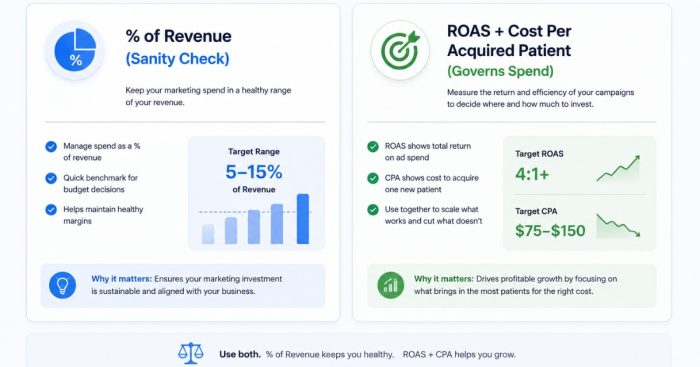
Is marketing budget better measured as a percent of revenue or by return on ad spend?
Return on ad spend is the better governing metric.
Percent of revenue is a useful sanity check, not a target.
A percent-of-revenue rule tells you whether you’re roughly in line with peers.
It cannot tell you whether your next dollar of spend will be profitable.
That’s the only question that matters.
The right approach is simple:
- Track what each channel returns
- Put more money into what’s profitable
- Pull money from what isn’t
If your paid ads reliably return three, five, or ten dollars for every one you put in, the constraint on spend isn’t a budget percentage.
It’s how many patients you can actually treat well.
Use percent of revenue to make sure you’re not chronically underinvesting.
Use ROAS and cost per acquired patient to decide:
- Where the next dollar goes
- How big the total budget can get
The proof of what disciplined, return-governed spend produces:
Elite Pain Doctors added $2,095,039 in revenue in 10 months by funding what worked rather than capping spend at a comfortable percentage.
When the return is there and the capacity is there, the budget should follow.
How much does a regenerative clinic need to spend to get started and see results?
Enough to run a real test on one channel with a real offer and proper tracking.
For most regenerative and pain practices, that means:
- A committed monthly budget
- A statistically meaningful number of leads
- At least 90 days of data
- A strong offer
- A landing page
- A follow-up system
Underfunding is the most common way clinics waste money.
A budget too small to gather data produces noise, not signal.
The owner then concludes “ads don’t work” when really the test was never given a chance.
Because high-ticket cases pay back fast, a properly funded test often recoups itself within the first one to three months.
That can happen from just a handful of closed cases.
The mistake isn’t spending too much to start.
The mistake is spending too little to ever learn anything.
Then quitting before the channel had the budget to prove itself.
Give one channel:
- A real budget
- A real offer
- A full quarter
You’ll get a clear answer about whether it works for your market.
Starve it, and all you’ll learn is that starved channels don’t perform.
Which you already knew.
Why can high-ticket regenerative practices spend more per lead than other clinics?
Because the case value is so high that a costly lead is still wildly profitable.
If a regenerative program is worth $15,000 and you close a meaningful share of consults, you can afford a cost per lead and cost per acquired patient that would bankrupt a clinic selling a $200 service.
You can still earn a strong return.
This is the structural advantage of the niche.
High ticket means high tolerance for acquisition cost.
That allows you to outbid lower-ticket competitors for the same attention and win the patient.
The clinics that understand this stop obsessing over a cheap cost per click.
Instead, they optimize for profitable cost per acquired patient.
That shift frees them to compete in channels and placements others can’t afford.
You can see the principle in a different high-ticket setting.
An orthopedic surgical practice added $2 million in revenue from Facebook ads alone precisely because the case values justified aggressive spend that lower-ticket clinics couldn’t match.
The lever isn’t paying less per lead.
It’s closing enough cases at full value that you can afford to pay more and still win.
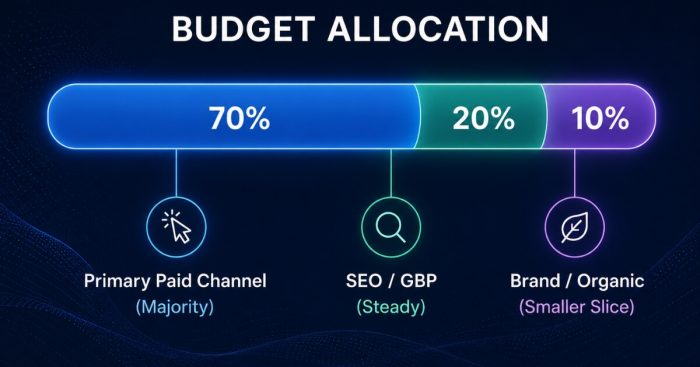
How should a regenerative practice split its marketing budget across channels?
Fund one lead channel to a level where it can actually perform before spreading money thin.
At the same time, keep an always-on investment in SEO and brand underneath it.
A common, durable split includes:
- The majority of the active budget into the primary paid channel that fits your offer
- A steady allocation to SEO and Google Business Profile
- A smaller allocation to brand and organic social
The exact mix depends on your offer and market.
However, the principle is always the same:
Depth before width.
A fully funded single channel beats five underfunded ones.
As the first channel maxes out its profitable return, layer in a second channel to fill the gap it can’t reach.
Avoid splitting a modest budget across six platforms at once.
That’s how clinics spend a lot and learn nothing.
If you’re unsure how to allocate, this is a core question for pain management marketing specifically.
The right channel for a $20K neuropathy program is not the right channel for a $1,500 PRP injection.
The budget split should follow:
- The offer
- The awareness stage of the buyer
What’s the biggest marketing-budget mistake regenerative and pain practices make?
Treating marketing as a fixed cost to minimize instead of an investment to scale based on return.
Then capping a profitable campaign at an arbitrary number.
When a channel is returning several dollars for every one spent and you still have capacity to treat patients, holding the budget flat because you “already hit your marketing number” leaves money on the table.
The opposite mistake is just as costly.
That mistake is pouring money into a channel that isn’t returning because spending feels like progress.
The disciplined approach is to tie spend to:
- Measured return
- Treatment capacity
Scale what’s profitable until:
- It stops being profitable
- You run out of capacity
Fix or cut what isn’t working.
Never let a fixed percentage override what the numbers are telling you.
Budget by ROAS and capacity.
Not by habit.
Not by what you spent last year.
The regenerative practices that break through their plateau are almost always the ones that stopped asking, “What’s the right percentage?”
Instead, they started asking:
“What’s the most profitable revenue I can fund and actually deliver?”
FAQ’s About Regenerative and Pain Practice Marketing Budgets
How much should a regenerative or pain practice spend on marketing?
Established regenerative and pain practices typically invest roughly 7–10% of revenue in marketing.
Clinics in active growth mode often spend 15–20% or more to capture share faster.
The better way to size a high-ticket regenerative budget is by return on ad spend.
Decide how much profitable revenue you want, work backward through your close rate and average case value, and fund the required ad spend.
Because a single regenerative case can be worth thousands or tens of thousands in cash, the math supports spending aggressively.
Spend should be governed by return and treatment capacity, not by an arbitrary percentage.
Is marketing budget better measured as a percent of revenue or by return on ad spend?
Return on ad spend is the better governing metric.
Percent of revenue is a useful sanity check.
A percent-of-revenue rule helps you compare yourself to peers.
ROAS tells you whether the next dollar spent is likely to be profitable.
Track channel performance, invest more into what works, and pull back from what doesn’t.
Use percent of revenue as a benchmark and ROAS as the decision-making tool.
How much does a regenerative clinic need to spend to get started and see results?
Enough to run a meaningful test.
For most regenerative and pain practices, that means a committed monthly budget, a real offer, proper tracking, and at least 90 days of data.
Underfunding is one of the most common reasons clinics fail to get results.
A properly funded test often recoups itself within the first one to three months from a handful of closed cases.
Why can high-ticket regenerative practices spend more per lead than other clinics?
Because the case value is so high that a costly lead is still profitable.
A regenerative program worth $15,000 can support a much higher acquisition cost than a clinic selling a $200 service.
This structural advantage allows regenerative practices to compete more aggressively for attention and still earn strong returns.
The key metric is profitable cost per acquired patient, not cheap cost per click.
How should a regenerative practice split its marketing budget across channels?
Fund one lead channel properly before spreading money across multiple platforms.
Keep SEO and brand-building efforts running underneath the primary channel.
The principle is simple:
Depth before width.
A fully funded channel almost always outperforms several underfunded channels.
As profitable return maxes out, add additional channels strategically.
What’s the biggest marketing-budget mistake regenerative and pain practices make?
Treating marketing as a fixed cost instead of an investment tied to return.
Many clinics cap profitable campaigns because they have already reached their marketing number.
Others continue funding channels that aren’t producing results.
The disciplined approach is to scale profitable channels, cut underperforming ones, and let ROAS and capacity drive the budget.
What’s the next step?
The right marketing budget for a regenerative or pain practice isn’t a percentage you copy from a peer.
It’s the amount of profitable, deliverable revenue you choose to fund.
Use percent of revenue as a sanity check so you’re not chronically underinvesting.
Govern the actual spend with return on ad spend and cost per acquired patient.
Fund one channel properly.
Give it a full quarter.
Scale what returns until it stops returning or you hit capacity.
Fix or cut what doesn’t.
Because your case values are high, you can afford to spend aggressively and still win.
That’s the niche’s structural advantage.
Real ADvice helps regenerative and pain practices size and allocate their budget to maximize return.
It’s the same discipline behind $2,095,039 in 10 months at Elite Pain Doctors.
If you want help building a budget tied to your case values, close rate, and capacity, that’s the conversation to book.