
How Many New Patients Does a Regenerative Medicine Clinic Need to Add $1 Million in Revenue?
Ask a regenerative or pain practice owner how many new patients they would need to add a million dollars a year, and most picture a flood — hundreds and hundreds of new faces, a waiting room they could never staff. That mental picture is usually wrong, and it is the reason so many high-ticket clinics over-invest in lead volume and under-invest in conversion and case value. Because of how the math works in a cash-pay regenerative practice, $1 million is often a surprisingly small number of patients. Here is the simple way to size it for your own practice, and the funnel you actually need to get there.
How many new patients does a regenerative medicine clinic need to add $1 million in revenue?
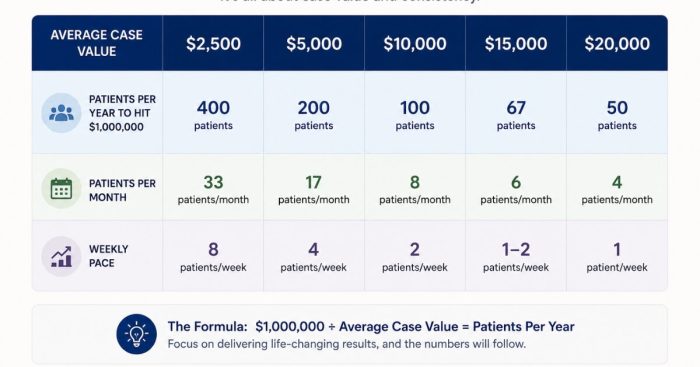
Far fewer than most owners think — it depends almost entirely on your average case value, but at a $10,000 average case it is roughly 100 patients a year, at $20,000 it is about 50, and even at $5,000 it is only around 200.
The whole answer hinges on one number: your average case value, meaning the total revenue a typical patient generates.
Divide your revenue goal by that number and you have your patient target.
For example:
- At a $10,000 average case, $1 million is about 100 patients in a year.
- At a $20,000 average case, it is roughly 50 patients.
- At a $5,000 average case, it is around 200 patients a year.
Put another way:
- 100 patients per year is fewer than two new patients per week.
- 50 patients per year is about one new patient per week.
Compare that to an aesthetics or low-ticket model that might need thousands of transactions for the same revenue.
You can quickly see why regenerative economics are so attractive: a small number of well-served, high-value patients gets you there.
This is not theoretical — we helped Elite Pain Doctors add more than two million dollars in revenue in just ten months, which at high-ticket case values is a very manageable patient count when the funnel is built right.
Why is average case value the number that actually matters?
Because in a high-ticket regenerative practice, what you earn per patient swamps how many patients you have — doubling your average case value halves the number of patients you need for the same goal.
Most clinic owners obsess over lead count and ignore the lever that moves the math fastest.
If your average case value goes from $5,000 to $10,000, you just cut the number of patients you need for $1 million from 200 to 100 — without generating a single additional lead.
That is why the highest-leverage work in a regenerative practice is often not “get more patients” but “structure better offers.”
Examples include:
- Treating the full problem rather than a single joint.
- Building maintenance and follow-up into the plan.
- Presenting comprehensive programs instead of one-off injections.
A clinic that runs single-joint PRP at an entry price of around $750 has a very different patient-count requirement than one that guides appropriate candidates into a complete regenerative program.
Neither is wrong.
However, you cannot size your marketing until you know your number.
And raising case value is frequently faster and cheaper than raising volume.
The clinics with the healthiest economics treat average case value as a number they actively manage, not one they passively accept.
How do you calculate your own number?
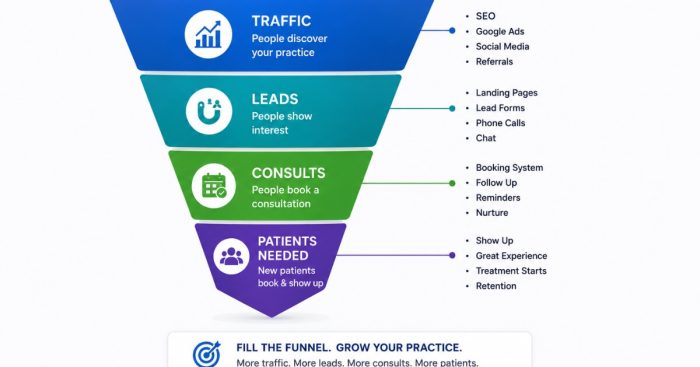
Take your revenue goal, divide by your real average case value to get patients needed, then work backward through your conversion rates to get the consults, leads, and traffic required.
The exercise takes ten minutes and changes how you spend every marketing dollar.
Start with the goal — say $1 million.
Then:
- Divide by your honest average case value to get patients needed.
- Divide patients needed by your consult-to-treatment conversion rate to get consults needed.
- Divide consults needed by your lead-to-consult booking rate to get leads needed.
- Calculate the traffic, ad spend, or SEO reach required to generate those leads.
For example:
- $1,000,000 revenue goal
- $10,000 average case value
- 100 patients needed
If you close 50% of consults:
- You need 200 consults.
If you have a strong booking rate:
- You may need roughly 250 leads.
Now you are no longer guessing.
You have a target at every stage of the funnel.
The real power of this exercise is that it shows you exactly which lever is cheapest to pull.
Often it is not more leads at the top.
Instead, it is:
- A better booking rate.
- A higher close rate.
- Stronger conversion in the middle of the funnel.
Small improvements there cascade into far fewer leads required at the top.
How many leads and consults does that translate to?
Once you know patients needed, your conversion rates do the rest — and strong conversion can collapse the lead requirement dramatically, which is why fixing the funnel often beats buying more leads.
This is where conversion rate becomes the hero of the story.
Imagine two clinics that both need 100 patients for $1 million.
The first:
- Books 30% of leads into consults.
- Closes 50% of consults.
It needs roughly 670 leads.
The second:
- Books leads at a much higher rate.
- Closes consults more effectively.
It might need only a few hundred leads.
Same revenue goal.
Wildly different top-of-funnel requirement.
The difference is conversion.
We have seen what the high end looks like: at one regenerative practice we drove a 79.4% conversion rate from lead to booked appointment, which means almost every quality lead turned into a consult opportunity.
When your conversion is that strong, the number of leads — and the ad spend — needed to hit a seven-figure goal shrinks enormously.
This is the math that should drive your marketing strategy.
Before you buy more leads, find out whether a better booking and closing process gets you to the same number for a fraction of the cost.
That is the core question a good set of medical practice marketing consultants will run with you.
Why do most regenerative clinics overestimate how many patients they need?
Because they anchor on low-ticket, transactional models and ignore both case value and conversion — so they chase volume they do not need while leaking the patients they already have.
The overestimation is costly in two directions.
First, owners who picture needing “hundreds and hundreds” of patients pour money into top-of-funnel lead generation.
Often, that comes at the expense of the conversion and case-value work that would get them to the goal far more cheaply.
Second, the volume mindset causes them to undervalue each patient.
They treat a single $750 injection as the whole relationship instead of the start of one.
As a result, they miss:
- Maintenance opportunities.
- Additional treatment areas.
- Referrals that compound lifetime value.
The reframe is simple but powerful:
A regenerative practice does not need a crowd.
It needs a system that converts and maximizes a manageable number of high-value patients.
When you internalize that $1 million might be 50 to 200 well-served patients rather than thousands, your entire strategy shifts from “fill the top of the funnel at all costs” to “build the funnel and the offers that make each patient count.”
That is exactly how durable pain management marketing is supposed to work.
FAQ’s About Sizing Revenue Goals for a Regenerative Clinic
How many patients does a regenerative clinic need to add $1 million?
Far fewer than most owners think, because it depends almost entirely on average case value.
- At a $10,000 average case it is roughly 100 patients a year.
- At a $20,000 average it is about 50.
- At a $5,000 average it is around 200.
Compared with a low-ticket model that might need thousands of transactions for the same revenue, high-ticket regenerative economics let a small number of well-served, high-value patients reach a seven-figure goal.
The key is knowing your real average case value before you size your marketing.
Why does average case value matter so much?
Because in a high-ticket practice, what you earn per patient swamps how many patients you have.
Doubling your average case value from $5,000 to $10,000 cuts the patients needed for $1 million from 200 to 100 without generating a single extra lead.
That makes offer structure — treating the full problem, building in maintenance and follow-up, presenting comprehensive programs rather than one-off injections — often the highest-leverage work in the practice.
Raising case value is frequently faster and cheaper than raising volume.
How do you calculate how many patients you need?
Take your revenue goal, divide by your honest average case value to get patients needed, then work backward through your conversion rates.
Divide patients needed by your consult-to-treatment close rate to get consults needed, then by your lead-to-consult booking rate to get leads needed, and from there you know the traffic or ad spend required.
The exercise takes ten minutes and reveals which lever is cheapest to pull — often a better booking or close rate in the middle of the funnel rather than more leads at the top.
How many leads does a $1 million goal require?
It depends heavily on conversion.
Two clinics that both need 100 patients can have wildly different lead requirements:
- One booking 30% of leads and closing half needs roughly 670 leads.
- A clinic with much stronger booking and closing might need only a few hundred.
At one regenerative practice we drove a 79.4% conversion rate from lead to booked appointment, which dramatically shrinks the leads and ad spend needed for a seven-figure goal.
Fixing the funnel often beats buying more leads.
Why do clinics overestimate how many patients they need?
Because they anchor on low-ticket, transactional models and ignore both case value and conversion.
As a result, they chase volume they do not need while leaking the patients they already have.
This leads them to overspend on top-of-funnel leads and to undervalue each patient — treating a single injection as the whole relationship rather than the start of one.
The reframe: a regenerative practice does not need a crowd, it needs a system that converts and maximizes a manageable number of high-value patients.
What’s the next step?
The most freeing realization for a regenerative or pain practice owner is that a million dollars is not a stadium full of patients — it is often 50 to 200 of the right ones, served well, through a funnel that converts.
Once you know your number, you stop guessing and start engineering:
- The right average case value.
- The right conversion rates.
- The right amount of marketing to feed it.
That clarity is worth more than any single ad campaign.
If you want help running your actual numbers — your average case value, your conversion rates, and the exact funnel that gets you to your revenue goal — that is the conversation to book.
We will build the math and the plan with you on the call.