
How Should an HRT Clinic Benchmark and Set Its Pricing Against Competitors?
Most HRT clinic owners benchmark their pricing the wrong way.
They look at the cheapest clinic nearby, panic, and price down to match.
In doing so, they quietly hand away the margin that makes recurring hormone care worth running.
The clinics that win at cash-pay medicine do the opposite.
They benchmark against the clinics that have actual pricing power.
They price on the value of managed care rather than the cost of the molecule.
And they refuse to compete on cheap.
This article pulls the real numbers from a consulting call where we compared two near-identical hormone-and-weight-loss clinics side by side — one doing a fraction of the other’s revenue — and lays out exactly how to set your price against your competitors without racing anyone to the bottom.
How should an HRT clinic benchmark its pricing against competitors?
Benchmark against clinics that share your model and your patient experience, not the cheapest clinic in your zip code.
Pull the actual monthly price a handful of comparable hormone clinics charge.
Then map yourself against the top of that range rather than the bottom.
A managed-hormone program from a real clinic commonly runs $300 to $450 a month per patient.
For example:
- Eternity Health Partners in Santa Barbara averages $350 to $450 for both men and women.
- Guard Wellness in Palm Beach runs $350 a month.
- Rewind Anti-Aging in Miami runs roughly $400 a month on a quarterly program — about $1,200 a quarter for men and women alike.
If you are pricing estradiol at $115 and adding $30 for progesterone to land around $165, you are roughly half of what the market already pays for the same category of care.
Benchmarking is not about finding the average and matching it.
It is about confirming that buyers in your category already pay a premium for managed care.
Then you price yourself into that band with confidence.
The clinic that benchmarks against the discounter prices itself out of a sustainable business.
The clinic that benchmarks against the value leaders prices itself into one.
If you want the full picture of how hormone clinics fit into the broader cash-pay landscape, our med spa marketing hub maps how pricing, positioning, and channels work together across the category.
Why does racing to the bottom on price destroy an HRT or weight-loss clinic?
Because cheap front-end offers attract patients with no lifetime value.
And lifetime value is the entire business.
The clearest proof is the $99 skinny shot.
One of the highest-revenue clinics we work with ran ads for a single $99 weight-loss injection, over and over.
It never once converted into a retained patient.
Those buyers came in for one, two, or three shots and disappeared.
We looked at the numbers repeatedly and could not find a single patient kept past a month.
There was no LTV behind any of them.
Another clinic ran the identical play at $84 and got the identical result.
A discount offer trains the market to see you as a commodity.
It also pulls in exactly the buyers who will leave the moment someone undercuts you.
Recurring cash-pay medicine — hormones, weight loss, TRT — lives and dies on patients who stay for months and years.
You cannot acquire a long-term patient with a one-time bargain.
The person who shows up for a $99 shot is shopping for a $99 shot, not a relationship.
Price low and you fill your schedule with churn.
Price on value and you fill it with the patients who actually carry the practice.
What does comparing two real clinics’ revenue reveal about pricing power?
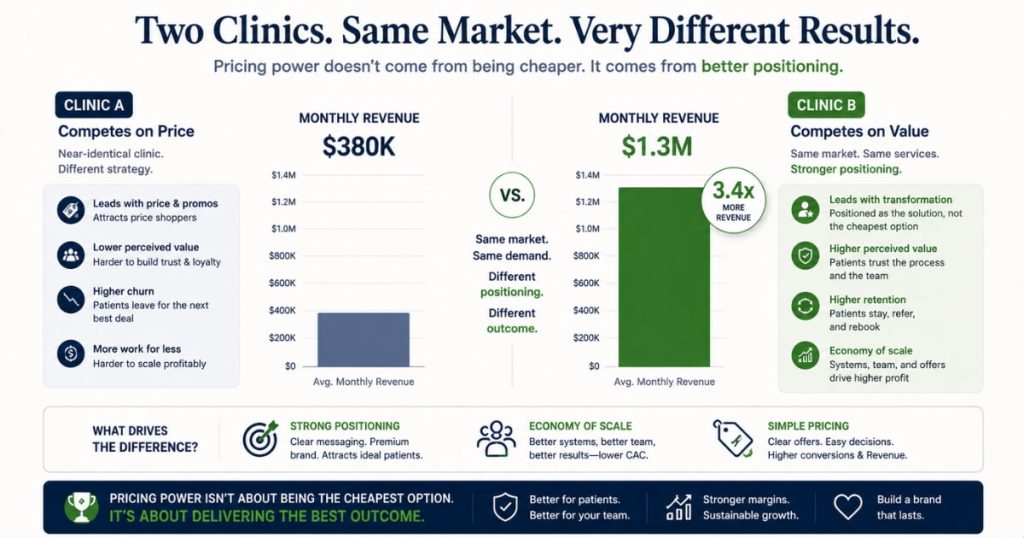
It reveals that pricing power comes from positioning and operations, not from being the cheapest.
On a recent consulting call, we compared a growing clinic against NuLevel Wellness.
NuLevel Wellness is a clinic with a nearly identical model that does far more revenue.
NuLevel did about $1.3 million in a single month.
It had roughly 1,850 weight-loss refills.
And $800,000 to $900,000 of that came from weight loss alone.
That was essentially all from one location that crossed $1 million a month before it ever opened a second.
NuLevel does not win on price.
It wins on a med-spa positioning that makes patients feel hope and excitement the moment they walk in.
It wins on economy of scale through a long-standing single compounding-pharmacy relationship that lowers its cost basis.
And it wins on dead-simple pricing:
- Semaglutide starting at $225
- Tirzepatide at $325
- Retatrutide at $425
- A flat $50 added for each dose increase
That pricing was kept round on purpose so the team never fumbles a quote.
The clinic we were comparing had actually dropped its price and was still priced higher than NuLevel.
That was because its cost basis was higher, not because it was greedy.
That is the whole lesson.
The bigger clinic’s advantage is not a lower sticker price.
It is volume, positioning, and supply-chain leverage that let it charge confidently.
You cannot copy a competitor’s price without copying the operation underneath it.
That is why benchmarking the number alone is a trap.
Should an HRT clinic sell a membership or a program?
Sell a managed monthly program priced on the care, not the molecule.
And resist quarterly prepay unless your operation genuinely supports it.
Hormone care is recurring by nature.
So a per-month structure aligns the price with how the patient actually experiences the relationship.
What the patient is buying is:
- Ongoing access to a provider
- Labs
- Dose management
- Refills
They are not buying a $5 estradiol pill.
They want managed care and the confidence that someone is watching their numbers.
That is why a clinic can charge $300 a month for hormones when the underlying medication costs a few dollars.
The value is the management, the access, and the outcome.
None of that is something the patient can buy off a pharmacy shelf.
Some clinics run quarterly programs at roughly $400 a month, billed as $1,200 a quarter.
But front-loaded prepay raises the bar on your fulfillment and follow-up.
It is worth doing only when your operation can carry it.
Whether you call it a membership or a program matters less than the structure.
The structure should be:
- Recurring managed care
- Priced as a relationship rather than a drug
- Simple enough that your team quotes it without hesitation
A clinic that built exactly this kind of recurring model is Eternity Health Partners, which grew from $1M to $4M with 250 members paying $1,000 a month.
That is proof that a clean recurring program priced on value scales far past a transactional one.
What is the right way to price HRT when the medication itself is cheap?
Price the managed care and the access, not the cost of the pill.
Stop anchoring your number to what the drug costs you.
An estradiol tablet might cost you about $5.
A patient could find a generic at a pharmacy for $30.
But that is irrelevant.
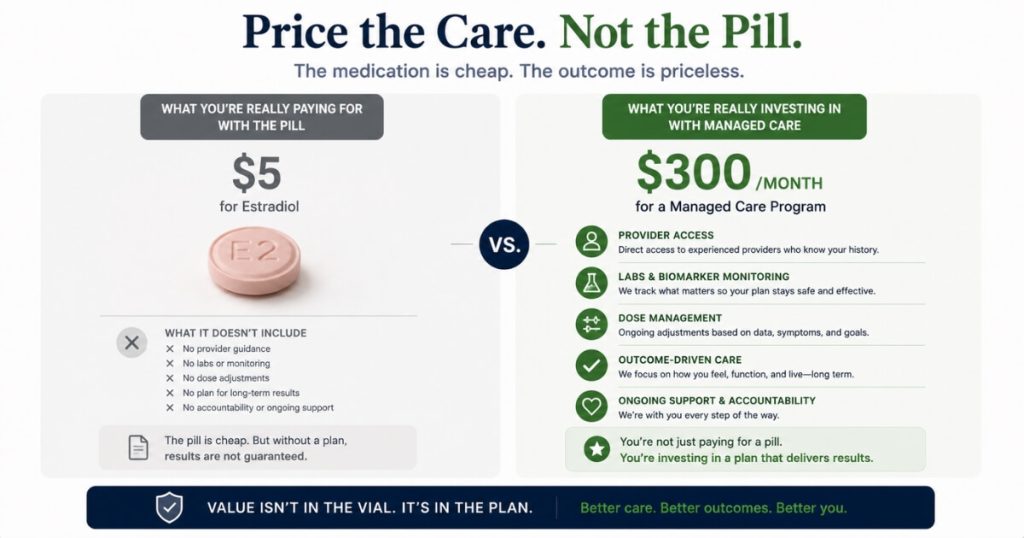
The patient is not paying for the molecule.
They almost never know the retail cost.
How would a regular consumer ever figure that out?
They are paying for:
- A provider who manages their hormones
- The ability to book a consult
- The ability to call the office
- The outcome
Clinics charge $300 a month for hormones all day long for exactly this reason.
Using compounded medication from a pharmacy like Strive raises both the perceived value and the cost basis.
That is part of why established clinics charge more, not less.
Two operating realities push the right price higher still.
First, a 50 percent product margin is not a 50 percent business margin.
Once you subtract staff, taxes, and what the owners need to earn, real margins often land closer to 15 to 20 percent.
So a price that feels high on the product can still lose money on the business.
Second, demand for this care is not price-elastic in the way owners fear.
Patients who feel cared for keep paying.
Price the care.
Charge for the outcome.
Let the medication be a line item rather than the anchor.
How do you set a price that captures value without scaring patients away?
Anchor to the value leaders in your category.
Keep the structure simple.
Price near the top of what a confident patient will pay, not the floor.
A useful internal gut-check is to price it just under the number where you would laugh if someone actually paid it.
Then watch how often they pay it anyway.
Patients consistently pay more than clinic owners expect.
That is because owners anchor to their own cost.
Patients anchor to the outcome and the relationship.
Keep the tiers round and obvious.
Use a starting price and a flat step for each dose increase.
That way, your team can quote it without hesitation.
Patients also perceive it as straightforward rather than nickel-and-dimed.
Then couple the number with the positioning that justifies it:
- Hope
- Expertise
- Managed care
- A brand that feels like a destination rather than a discounter
When the experience matches the price, the price stops being a barrier.
Demand follows positioning.
That is why a well-positioned clinic like VYVE Wellness drives 100-plus inbound calls a month without competing on cheap.
When you compete on price instead, every patient becomes a price shopper.
And you have given away the one thing that makes recurring cash-pay medicine profitable.
FAQ’s About Benchmarking HRT Clinic Pricing
How should an HRT clinic benchmark its pricing against competitors?
Benchmark against clinics that share your model and your patient experience, not the cheapest clinic in your zip code.
Pull the actual monthly price a handful of comparable hormone clinics charge.
Then map yourself against the top of that range rather than the bottom.
A managed-hormone program from a real clinic commonly runs $300 to $450 a month per patient.
For example:
- Eternity Health Partners in Santa Barbara averages $350 to $450 for both men and women.
- Guard Wellness in Palm Beach runs $350 a month.
- Rewind Anti-Aging in Miami runs roughly $400 a month on a quarterly program.
If you are pricing estradiol at $115 and adding $30 for progesterone to land around $165, you are roughly half of what the market already pays.
Benchmarking is not about finding the average and matching it.
It is about confirming that buyers in your category already pay a premium for managed care.
Then you price yourself into that band with confidence.
The clinic that benchmarks against the discounter prices itself out of a sustainable business.
The clinic that benchmarks against the value leaders prices itself into one.
Why does racing to the bottom on price destroy an HRT or weight-loss clinic?
Because cheap front-end offers attract patients with no lifetime value.
And lifetime value is the entire business.
The clearest proof is the $99 skinny shot.
One of the highest-revenue clinics we work with ran ads for a single $99 weight-loss injection over and over.
It never once converted into a retained patient.
Those buyers came in for one, two, or three shots and disappeared.
There was no LTV behind them.
Another clinic ran the same play at $84 and got the same result.
A discount offer trains the market to see you as a commodity.
It pulls in exactly the buyers who will leave the moment someone undercuts you.
Recurring cash-pay medicine — hormones, weight loss, TRT — lives and dies on patients who stay for months and years.
You cannot acquire a long-term patient with a one-time bargain.
Price low and you fill your schedule with churn.
Price on value and you fill it with the patients who actually carry the practice.
What does comparing two real clinics’ revenue reveal about pricing power?
It reveals that pricing power comes from positioning and operations, not from being the cheapest.
We compared a growing clinic against NuLevel Wellness, a clinic with a nearly identical model that does far more revenue.
NuLevel did about $1.3 million in a single month.
It had roughly 1,850 weight-loss refills.
And $800,000 to $900,000 of that came from weight loss alone.
That was all from essentially one location that crossed $1 million a month before it ever opened a second.
NuLevel does not win on price.
It wins on med-spa positioning that makes patients feel hope and excitement.
It wins on economy of scale through a single compounding pharmacy relationship that lowers its cost basis.
And it wins on dead-simple pricing:
- Semaglutide starting at $225
- Tirzepatide at $325
- Retatrutide at $425
- Plus $50 for each dose increase
The other clinic had actually dropped its price and was still priced higher.
That was because its cost basis was higher.
The lesson is that the bigger clinic’s advantage is not a lower sticker price.
It is volume, positioning, and supply-chain leverage that let it charge confidently.
You cannot copy a competitor’s price without copying the operation underneath it.
Should an HRT clinic sell a membership or a program?
Sell a managed monthly program priced on the care, not the molecule.
And resist quarterly prepay unless your operation genuinely supports it.
Hormone care is recurring by nature.
So a per-month structure aligns the price with how the patient actually experiences the relationship.
The patient is buying:
- Ongoing access to a provider
- Labs
- Dose management
- Refills
They are not buying a $5 estradiol pill.
They are buying managed care and the confidence that someone is watching their numbers.
That is why a clinic can charge $300 a month for hormones when the underlying medication costs a few dollars.
The value is the management, the access, and the outcome.
Some clinics run quarterly programs at roughly $400 a month, billed as $1,200 a quarter.
But front-loaded prepay raises the bar on your fulfillment and follow-up.
Whether you call it a membership or a program matters less than this:
Structure it as recurring managed care.
Price the relationship rather than the drug.
And keep the pricing simple enough that your team never fumbles it.
What is the right way to price HRT when the medication itself is cheap?
Price the managed care and the access, not the cost of the pill.
Stop anchoring your number to what the drug costs you.
An estradiol tablet might cost you about $5.
A patient might find a generic at a pharmacy for $30.
But that is irrelevant.
The patient is not paying for the molecule.
They almost never know the retail cost.
They are paying for a provider who manages their hormones, the ability to book a consult or call the office, and the outcome.
Clinics charge $300 a month for hormones all day long for exactly this reason.
Compounded medication from a pharmacy like Strive also raises the perceived value and the cost basis.
That is part of why established clinics charge more.
Two operating realities push the right price higher still.
First, a 50 percent product margin is not a 50 percent business margin.
Once you subtract staff, taxes, and what the owners need to earn, real margins often land closer to 15 to 20 percent.
So a price that feels high on the product can still lose money on the business.
Price the care.
Charge for the outcome.
Let the medication be a line item rather than the anchor.
How do you set a price that captures value without scaring patients away?
Anchor to the value leaders in your category.
Keep the structure simple.
Price near the top of what a confident patient will pay, not the floor.
A useful gut-check we have used internally is to price it just under the number where you would laugh if someone actually paid it.
Then watch how often they pay it anyway.
Patients consistently pay more than clinic owners expect.
Owners anchor to their own cost.
Patients anchor to the outcome and the relationship.
Keep the tiers round and obvious.
Use a starting price and a flat step for each dose increase.
That way, your team can quote it without hesitation.
Patients also perceive it as straightforward rather than nickel-and-dimed.
Couple the number with the positioning that justifies it:
- Hope
- Expertise
- Managed care
- A brand that feels like a destination rather than a discounter
When the experience matches the price, the price stops being a barrier.
When you compete on cheap, every patient becomes a price shopper.
And you have given away the one thing that makes recurring cash-pay medicine profitable.