
How a Cash-Pay Clinic Books Its First $13,000 Longevity Patient (And Why Adding TRT Stops Lead Drought)
A cash-pay clinic we work with had a quiet stretch on the lead board. Then they added TRT, peptides, and longevity to the public service menu. Within one week the inbound queue showed two testosterone leads (“we get very few of those,” the founder said), a peptide lead, and the practice’s first ever longevity inquiry — booked into a $13,000 program on the first call. Here is the operational lesson and how a cash-pay practice can copy the move.
How does a cash-pay clinic generate its first longevity patient?
A cash-pay clinic generates its first longevity patient by listing longevity as an explicit service option on the website, the Google Business Profile, and the new patient coordinator’s phone script.
Patients shopping for longevity care use the word “longevity” — they do not search for “functional medicine” or “preventive health” or “concierge wellness.”
When the word is not visible on your service menu, those patients land on a competitor’s site.
When it is visible, they call you.
The first call our client took on this strategy converted directly to a $13,000 longevity program.
Founder’s words on the strategy review:
“That’s our first ever longevity lead. So I’m going to call her and book her for the $13,000 path right now.”
Why does adding new services produce more leads at a cash-pay practice?
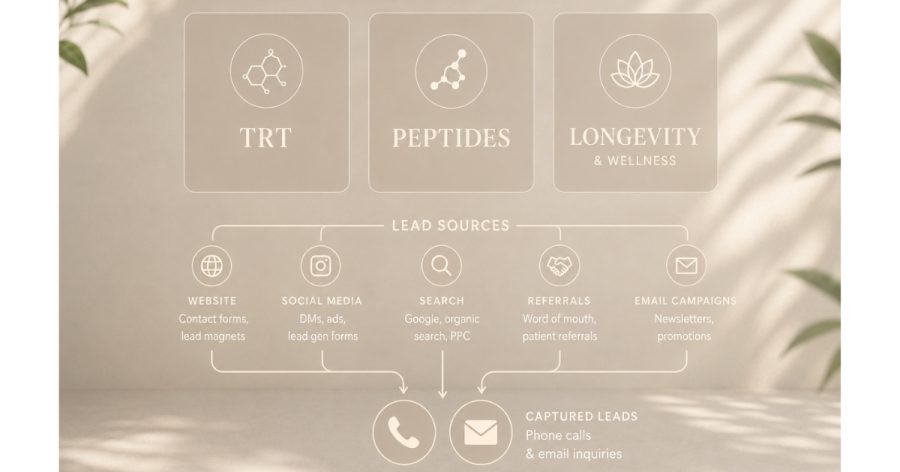
Adding new services produces more leads at a cash-pay practice because each named service is a separate entry point in the patient’s mind, in search results, and in word-of-mouth referrals.
A practice listed as “TRT clinic” attracts TRT searchers.
The same practice listed as “TRT, peptides, and longevity clinic” attracts three populations.
Founder’s framing:
“Just offering the option for people looks like it’s making a difference for you.”
The mechanism is not that you do anything different clinically — it is that the patients who already wanted those services finally see your name when they search.
How much should a cash-pay clinic charge for a longevity program?
A cash-pay clinic should charge $9,000 to $15,000 for a longevity program with a 6-12 month commitment.
Our client’s flagship longevity path is $13,000.
The pricing reflects the bundled diagnostics (advanced lipid panels, hormone panels, body composition, cardiovascular and metabolic baselining), the provider’s protocol-design time, and 12 months of follow-up.
Patients shopping for longevity are not price-shopping the way TRT-only patients are — the longevity buyer compares your $13,000 program to a Peter Attia-adjacent competitor at $15-$25K, not to a $200/month TRT membership.
What service categories should a cash-pay clinic add to capture more cash-pay leads?
A cash-pay clinic should add four service categories to capture more cash-pay leads, in this order of expected demand and revenue:
(1) TRT/men’s hormone optimization — highest call volume;
(2) peptides (sermorelin, ipamorelin, BPC-157) — lower volume, fastest close;
(3) longevity programs — lowest volume, highest LTV per patient;
(4) GLP-1/weight loss memberships — high volume, 12-18 month average tenure.
Each new service category should have its own page on the website, its own Google Business Profile attribute, and its own line in the new patient coordinator’s quoting script.
How quickly can a cash-pay clinic see results from adding new service options?
A cash-pay clinic can see results from adding new service options within 7-14 days.
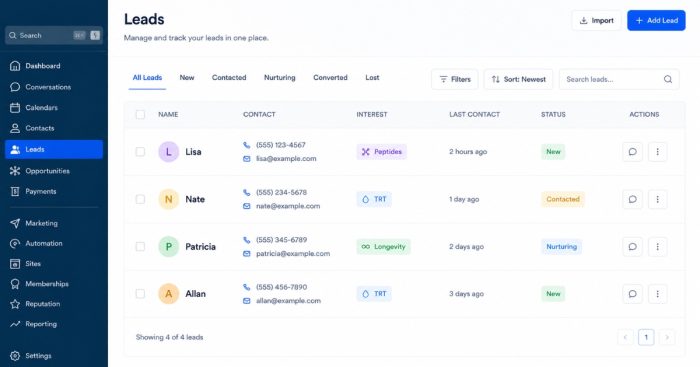
Our client added new service language to the website and saw two testosterone leads (a vertical they normally get very few of), a peptide lead, and the first-ever longevity lead in the same week.
The leads do not wait for SEO authority to compound — patients who are already searching land immediately.
Inbound by name from the same week:
“Lisa who said she’s interested in peptides. You’ve got Nate who said TRT. You’ve got Patricia who said longevity. And you’ve got Allan who said TRT.”
Four leads in four service categories in one week.
How do you sell a $13,000 longevity program on the first phone call?
You sell a $13,000 longevity program on the first phone call by leading with the program’s outcome — the 12-month longevity baseline, follow-up cadence, and protocol design — not the price.
Quote the price last, after the patient has nodded along to the program description.
Anchor the price against what the patient has likely already seen (“Peter Attia-style longevity programs run $15-$25K per year; our 12-month longevity path is $13,000 with the same diagnostic depth”).
The longevity buyer is buying years of life, not a service line item — frame accordingly.
For an example of how a similar practice scales longevity-adjacent care, see how a longevity and functional medicine clinic increased website leads by 900% and added 100+ inbound calls per month in just four months — service-menu expansion is part of why that lead-volume curve looks the way it does.
When should a cash-pay clinic NOT add new service categories?
A cash-pay clinic should not add new service categories when the existing services are not yet at provider capacity, when the new category requires significant new credentialing or equipment without a clear demand signal, or when the practice does not yet have a new patient coordinator who can quote the new service confidently on the phone.
The lead-generation upside is real, but a service that the front desk fumbles on the first call is worse than no service at all.
The rule of thumb: add a service to the public menu the same week the new patient coordinator can recite its pricing, time horizon, and one paragraph of clinical rationale without notes.
For another example of how matched-vertical service expansion drives organic lead growth, see how a regenerative medicine clinic generated $309,590 in cash-pay revenue in 10 months without paid ads — the menu of regenerative options on the site was the front door.
What should a cash-pay clinic do this week to copy this lead-mix lesson?
A cash-pay clinic that wants to copy this lead-mix lesson should do four things this week:
(1) audit the current website’s service pages and add explicit pages for any service category the practice already provides but does not advertise (TRT, peptides, longevity, GLP-1);
(2) update the Google Business Profile services to match;
(3) train the new patient coordinator to ask “what brought you in today?” on every inbound call and tag the response in the CRM by service category;
(4) build a short pricing-and-protocol script for each service so every new lead gets a clean answer on the first call.
If you want help auditing the service menu, building the scripts, and tracking the lead-mix shift, that is exactly the work we do every day for cash-pay practices.