
How Do You Train Hospitality and Empathy at a Cash-Pay Medical Practice? (The “Enlightened Hospitality” Patient System That Creates Raving Fans)
Cash-pay patients are not buying a transaction. They are buying the entire experience that surrounds the clinical result — and the entire experience is hospitality plus empathy.
Insurance-based practices optimize for throughput because the billing code is the unit of revenue. Cash-pay practices optimize for experience because the patient’s choice to return is the unit of revenue.
This is the FAQ on how a cash-pay clinic actually trains its front desk and its patient coordinator to deliver “enlightened hospitality” — the Danny Meyer concept adapted for medical practice — and the five concrete moves that produce a referral lift inside 90 days.
Why does hospitality matter so much at a cash-pay medical practice?
Because cash-pay patients are not buying a transaction — they are buying the entire experience that surrounds the clinical result, and the entire experience is hospitality plus empathy.
Why Experience Becomes the Product
A cash-pay HRT patient pays out of pocket every month for a service that insurance would cover at zero.
They will only do that if they are getting clinical results and being treated like a person who matters.
Of those two, hospitality is the harder one to copy and the easier one to lose.
Clinics that can produce clinical results without hospitality plateau and decay because patients leave for the friendlier competitor.
Conversely, clinics that can produce hospitality without clinical results never get to scale.
What Happens When Clinics Get Both Right
Clinics that produce both are the ones that charge 3 to 5x the local market average, hold a 60+ percent membership conversion rate, and pull 8+ patient-sourced new patients a month.
The hospitality work is unglamorous — names remembered, drinks offered, allergies noted in the CRM, follow-up calls that don’t feel like sales calls — but it is what makes the rest of the business work.
What does “enlightened hospitality” mean in the context of a cash-pay medical clinic?
The phrase comes from restaurateur Danny Meyer.
His insight was that hospitality stops being a personality trait and starts being a system when every host or staff member has access to the same notes about every regular customer — their family, work, hobbies, favorite dishes, favorite drinks, the special nuances that make them feel known.
Bringing the Concept Into Healthcare
A cash-pay clinic runs the same play in its CRM.
The patient’s children’s names, the spouse’s job, the upcoming vacation, the specific symptom phrasing they used, the time of day they prefer to be called back, the lab markers they care about most — all of it lives in the CRM.
Every team member who interacts with the patient sees the same notes.
How Personalization Creates Loyalty
So the front desk greets the patient by name when they walk in.
The patient coordinator references the upcoming vacation when scheduling the next follow-up.
The provider opens the visit with the specific symptom the patient cares most about.
As a result, the patient feels like a regular at a high-end restaurant — like everyone in the building knows who they are.
Over time, that experience compounds into referrals and renewals.
How does a cash-pay clinic train its front desk and patient coordinator to practice empathy on every call?
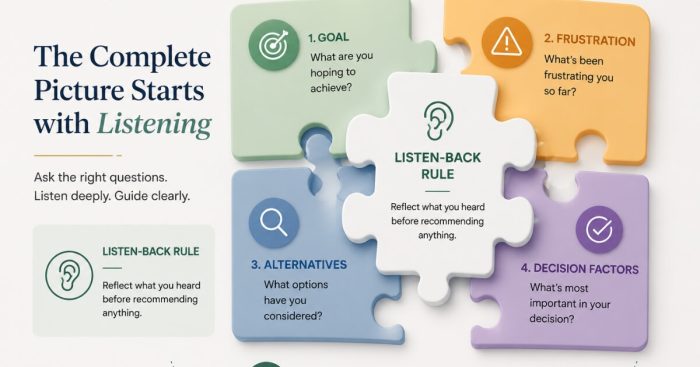
Train them on the four-question discovery script and the listen-back rule.
The Four-Question Discovery Framework
The four questions:
- What is the problem you are trying to solve?
- How is it affecting your daily life?
- What have you tried to fix it so far?
- How long has this been going on?
The questions are not a script to be read from — they are a frame for an actual conversation.
The Listen-Back Rule
The listen-back rule is that after the patient answers, the team member repeats back the most important phrase the patient used, in the patient’s own words, before continuing.
“You said the brain fog is the thing that’s costing you the most at work — let me make sure I understood that right.”
The repetition signals two things to the patient:
- I was listening.
- What you said matters.
Why This Approach Works
That is what empathy feels like on the phone.
The script logs every detail into the CRM under the patient record so the next interaction can build on it rather than start over.
Five reasons this works at a cash-pay clinic:
- Patients remember how the call made them feel.
- The clinic stands out from competitors who treat patients as transactions.
- The discovery surfaces whether the patient is ready to buy or needs more nurturing.
- The information makes the provider’s first-visit close rate higher.
- The better questions on call two are only possible because of the answers logged on call one.
A regenerative medicine clinic we worked with hit a 79.4 percent conversion rate from lead to booked appointment running exactly this discipline.
What’s the difference between hospitality at a cash-pay clinic and at an insurance-based practice?
Insurance-based practices are paid the same whether the patient has a great experience or a terrible one.
Cash-pay practices are paid only if the patient chooses to keep paying.
Different Revenue Models Create Different Behaviors
That difference shows up in every staffing decision, every script, every CRM note, and every minute of clinical time.
The insurance-based clinic optimizes for throughput because the billing code is the unit of revenue.
Meanwhile, the cash-pay clinic optimizes for experience because the patient’s choice to return is the unit of revenue.
Hospitality as an Operating System
Hospitality is not a soft skill in this context — it is the operating system.
A cash-pay clinic that runs insurance-based hospitality (rushed greeting, generic scripts, no CRM personalization, no follow-up that doesn’t sell) will produce insurance-based retention and insurance-based revenue per patient.
By contrast, a cash-pay clinic that runs hospitality the way a high-end restaurant runs it will produce membership conversion, recurring revenue, and a 3 to 5x revenue-per-patient lift over the same vertical run on insurance discipline.
How does hospitality and empathy connect to word-of-mouth referrals at a cash-pay clinic?
People do not remember what you said, they remember how you made them feel — and they tell their friends about how you made them feel.
Why Experiences Become Stories
Hospitality and empathy are the only inputs in a cash-pay clinic that scale word of mouth, because the patient leaves every appointment with a story to tell, and the story is either remarkable or it is not.
A clinic that remembers the patient’s spouse’s name produces the story:
“My doctor’s office asked about my wife yesterday — like, the front desk actually asked.”
A clinic that doesn’t, doesn’t.
The Referral Economics of Hospitality
The math is uneven and people underestimate it.
One patient referring three friends a year is a $30K to $50K patient-LTV contribution at concierge HRT or longevity prices.
A clinic that hits 8 patient-sourced new patients a month from hospitality alone is generating $250K to $500K a year of recurring revenue from zero ad spend.
The training cost is somewhere between one weekend and one $200 reservation system upgrade.
The return is the highest-margin acquisition channel in the business.
An HRT clinic we grew from $1M to $4M in 4 years ran the same hospitality system end to end across its 250+ active members.
What concrete hospitality and empathy moves should a cash-pay clinic implement first?
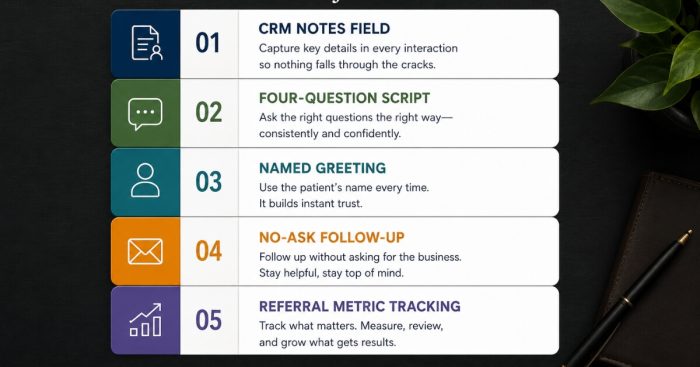
Five moves to install inside 30 days.
Move #1: Create a CRM Personalization Standard
One — add a notes field to every patient record in the CRM and require every team member to log one personal detail after every interaction (family member name, hobby, upcoming event, specific symptom phrasing).
Move #2: Implement the Discovery Script
Two — implement the four-question discovery script and the listen-back rule on every inbound call, and listen to one recorded call per team member per week to coach against the rubric.
Move #3: Create a Named-Greeting Standard
Three — install the named-greeting standard: every patient is greeted by first name within 10 seconds of walking in and offered a specific drink (the one they had last time, if logged).
Move #4: Redesign Follow-Up Calls
Four — write follow-up calls that are not sales calls; the rule is the call ends without an ask 60 percent of the time, and the team member references something personal from the CRM log every time.
Move #5: Measure the Lift
Five — measure the lift: track the patient-sourced referral count and the testimonial collection rate month over month.
The clinics that install these five moves see a measurable hospitality-driven referral lift inside 90 days.
What’s the next step?
If you run a cash-pay medical practice and your front desk, patient coordinator, and provider are all delivering hospitality that varies day to day, person to person, or shift to shift — that variance is costing you membership conversions and referrals every week.
Start With the Highest-Leverage Fix
Book a strategy call.
On the call we audit your CRM logging discipline, the front-desk greeting standard, the patient coordinator discovery script, and the follow-up cadence — and identify the one hospitality move that will produce the biggest referral lift inside 90 days for your specific vertical and team size.
Hospitality at a cash-pay clinic is built in a sequence, not in a single training.
The call is where you find out which step in that sequence to install first.