
What Should a Hormone Clinic’s Symptom-Quiz Lead Funnel Capture? (And How to Turn Those Social Leads Into Booked Patients)
Most hormone clinics run social ads straight to a “book your appointment” button and wonder why the cost per booked patient is brutal.
The problem isn’t the platform — it’s the ask.
A woman who just watched a 30-second video about her symptoms isn’t ready to commit to an appointment, but she’ll absolutely answer a few questions about what she’s experiencing.
That’s the whole secret to a hormone clinic’s social funnel.
Here’s the FAQ on what your symptom-quiz funnel should capture and how the front desk turns those leads into booked patients.
What’s the best funnel for turning social media views into hormone-clinic patients?
A four-step path:
- Educational video
- Symptom quiz
- Inbound lead delivered to your team
- Fast phone callback
Not a direct “book now” ask.
The sequence is the strategy.
The ad runs to a landing page with an embedded educational video the viewer can turn the sound on for.
After the video, instead of a calendar, they hit a short symptom quiz.
Completing the quiz creates a full lead record that’s sent to your clinic.
Then your front desk calls that lead back to convert.
Ad → Quiz → Inbound Lead → Phone Close
Why this beats running straight to a booking page:
A cold social viewer is not in “schedule a $300 visit” mode.
But she is willing to engage with content about her own body.
The quiz captures her while she’s interested, hands your team a warm, qualified lead with context, and lets a human do the actual closing — which is where hormone patients convert anyway.
The funnel’s job isn’t to close.
It’s to capture the right person and hand them to a closer.
What should my hormone clinic’s symptom quiz actually capture?
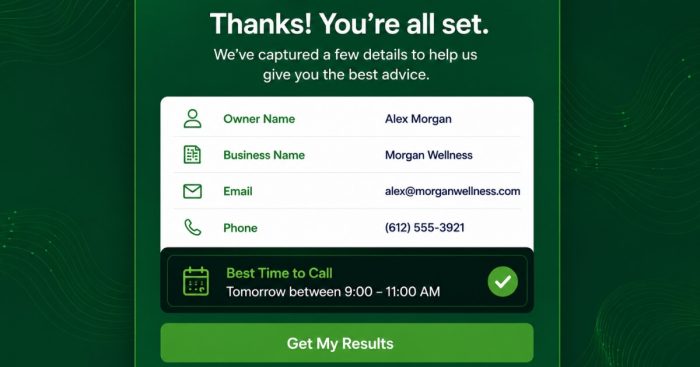
Two things above all:
- The symptoms she’s experiencing
- The best time to call her
Plus the basics your team needs to follow up:
- Name
- Phone
- Date of birth
The two questions that matter most are:
“What have you been experiencing?”
and
“What’s the best time of day to connect with you about your results?”
The first qualifies the lead and arms your team with the exact pain points to speak to on the callback.
The second is the one most clinics forget.
And it quietly doubles your connect rate because you’re calling when she actually said she’s reachable instead of cold-dialing into voicemail.
Round it out with:
- Name
- Phone
- Date of birth
So the record is complete enough to follow up and start intake.
That’s it.
Keep it short.
Every extra field is friction that costs you completed quizzes.
Capture:
- Symptoms
- Callback window
- Contact information
And your front desk has everything it needs to make a confident, relevant first call.
Why use a quiz instead of asking people to book directly?
Because people will share what they’re experiencing far more readily than they’ll commit to an appointment — so a quiz captures leads a booking page loses.
A “book now” button asks a stranger for a big commitment:
- Time
- Money
- The vulnerability of a hormone consult
Before she trusts you at all.
Most won’t.
A symptom quiz asks for something she’s happy to give:
- A description of how she’s feeling
- A good time to talk
The bar to engage is low.
So far more people complete it.
And you capture leads that a booking page would have let bounce.
The quiz also does silent qualification.
By the time the lead reaches your team, you already know:
- Her symptoms
- Her preferred callback time
So the first conversation starts warm and specific instead of cold.
You’re trading:
High-friction, low-yield
for
Low-friction, high-yield
And then letting your people convert.
That’s the trade that lowers cost per booked patient.
What kind of social creative converts for a cash-pay hormone clinic?
Educational video that teaches, not a hard pitch — with the sound on and warm, on-brand visuals that signal exactly who it’s for.
For a hormone audience, the creative that works is a short educational video about hormones:
- What’s happening in the body
- Why the symptoms show up
Delivered in a credible, human way rather than as a sales ad.
Make sure the viewer can enable sound.
Because the teaching is in the talking.
Use warm, intentional visuals that signal the audience you’re speaking to.
The goal of the video is to earn enough trust that she’ll take the quiz.
Not to close her on the spot.
This is also why the funnel and the creative work together:
- The educational video lowers her guard.
- The quiz captures her while she’s engaged.
- The callback closes her.
A polished, salesy brand ad that runs to a booking page does none of those jobs well.
Teach first. Capture second. Close third.
How do I keep my hormone clinic’s ads from dying out?
Plan for ad fatigue from day one — even a winning creative eventually wears out, so have backup variations scripted and ready to rotate in before performance drops.
A good ad will work.
Then it will stop working.
That’s not a failure.
It’s the nature of paid social.
Audiences see the same creative too many times and stop responding.
The clinics that keep results steady don’t scramble when the first ad fatigues.
They already have the next two or three variations written and ready to test.
Build a small library of educational-video angles up front so you’re rotating fresh creative in rather than going dark while you produce a replacement.
Treat creative as an ongoing pipeline, not a one-time launch.
Schedule regular sessions to script new ad variations with whoever films them.
That way there’s always a backup queued.
The funnel mechanics stay the same:
- Educational video
- Symptom quiz
- Callback
But the top-of-funnel creative needs constant refreshing to keep feeding it.
How do I make sure my front desk can actually handle these new leads?
Brief the team before the ads go live — show them exactly how a lead arrives and what it contains — and have them call back fast, leading with the symptoms the lead already told you.
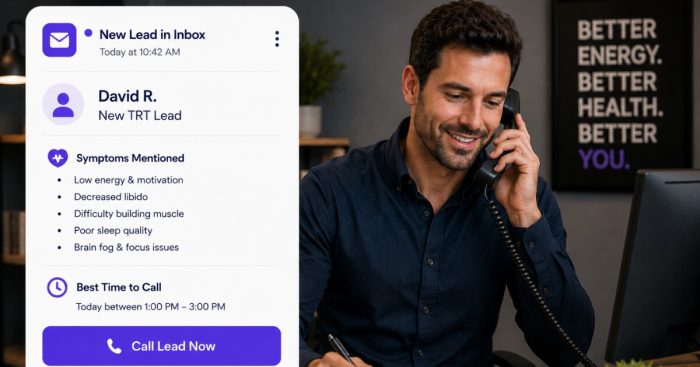
New inbound leads from this funnel arrive as notifications with:
- The patient’s symptoms
- Preferred callback time
Attached.
If your front desk doesn’t know that’s coming, the first leads land out of nowhere and sit.
So before you flip the campaign on, send the team a written overview:
- Here’s the new ad
- Here’s how a lead comes in
- Here’s the information you’ll have
- Here’s what to do with it
No one should be surprised by the first lead.
Then call back fast and use what the quiz captured.
You already know:
- Her symptoms
- The time she said to reach her
So the first call is:
- Warm
- Specific
- Timed correctly
Not a cold dial.
An HRT clinic we grew from $1M to $4M a year ran on exactly this kind of disciplined lead flow — dozens of inbound calls and website leads a month, all worked by a team that knew precisely how to handle them.
The funnel fills the pipeline.
A briefed, fast front desk turns it into booked patients.
FAQ’s About a Hormone Clinic’s Symptom-Quiz Funnel
What is the best lead funnel for a hormone clinic running social ads?
Run the ad to:
- An educational video
- A symptom quiz
- An inbound lead delivered to your team
- A front-desk callback
Going straight to a “book now” page wastes cold social traffic that isn’t ready to commit yet.
What should a hormone clinic’s symptom quiz ask?
Capture:
- Symptoms she’s experiencing
- Best time of day to call
- Name
- Phone
- Date of birth
The symptoms qualify the lead and arm the callback.
The preferred callback time sharply raises your connect rate.
Keep it short.
Every extra field costs completed quizzes.
Why is a quiz better than a booking page for cold leads?
People share what they’re experiencing far more readily than they commit to an appointment.
So a quiz captures leads a booking page loses.
It also qualifies the lead silently.
By the time your team calls, they already know:
- Her symptoms
- Her preferred time
And the conversation starts warm.
What kind of social creative converts for a hormone clinic?
A short educational video about hormones.
With:
- Sound on
- Warm visuals
- On-brand visuals
That teaches rather than hard-sells.
Its job is to earn enough trust for the viewer to take the quiz.
Not to close her immediately.
Teach first. Capture second. Close third.
How do I keep my hormone ads from fatiguing?
Assume every winning creative eventually wears out.
Have two or three backup video variations scripted and ready to rotate before performance drops.
Treat creative as an ongoing pipeline with regular scripting sessions.
Not a one-time launch.
What’s the next step?
If your hormone clinic is running social ads to a booking page and bleeding money on cost per booked patient, the fix is the funnel:
- Educational video
- Symptom quiz
- Inbound lead
- Fast callback
Capture the symptoms and the best time to call.
Keep the quiz short.
Refresh your creative before it fatigues.
Brief the front desk so no lead is a surprise.
On a strategy call we’ll map your full funnel:
- The creative angle
- The exact quiz
- The lead routing
- The callback script
For your market and your offer.
We’ve built these social-to-booked funnels for hormone and weight-loss clinics that scaled into seven figures, including a clinic where a tightened lead funnel and inbound-call system helped add $6.7M in a single year across 3,727 new patients.