
Which Marketing Channel Brings the Highest-LTV Patient to a Cash-Pay Medical Practice? (Channel-by-Channel Patient Quality Ranking)
Every clinic owner wants the same thing: the channel that delivers the patient who stays the longest, spends the most, and refers the most. The honest answer is that LTV doesn’t live in the channel — it lives in three things the channel determines: the patient’s stage of awareness when they arrived, the trust gap they crossed to book, and the program they’re a fit for. Some channels deliver patients who already know your name, your reviews, and your offer. Others deliver curious clickers who need to be sold from scratch.
The first group has dramatically higher LTV than the second, even when the cost per lead looks identical on a spreadsheet. This article ranks every major channel by the LTV of the patient it typically delivers. After running every major patient-acquisition channel across 40 of the fastest-growing cash-pay medical clinics in the country, this is the FAQ on which channel actually brings the highest-LTV patient — and how to use that ranking when you build your 2026 marketing mix.
Which marketing channel brings the highest-LTV patient to a cash-pay medical practice — and why?
Organic social media and SEO tie for the highest-LTV patient, with warm referrals close behind — because all three deliver a patient who is already at the “Most Aware” stage and has crossed a real trust gap before they ever booked.
The three variables that determine LTV-by-channel
LTV-by-channel is decided by:
- Stage of awareness when they arrived
- Unaware
- Problem Aware
- Solution Aware
- Product Aware
- Most Aware
- The size of the trust gap they crossed to book
- Cold click
- Referral
- Months of consuming your content
- The program they’re a fit for
- A $300 botox patient
- A $1,000/month HRT member
- A $20K+ pain program
Channels that hand you:
- A Most Aware patient
- Who already trusts you
- On a recurring or high-ticket program
…will outperform channels that hand you:
- A Solution Aware patient
- On a one-shot offer
…every single time.
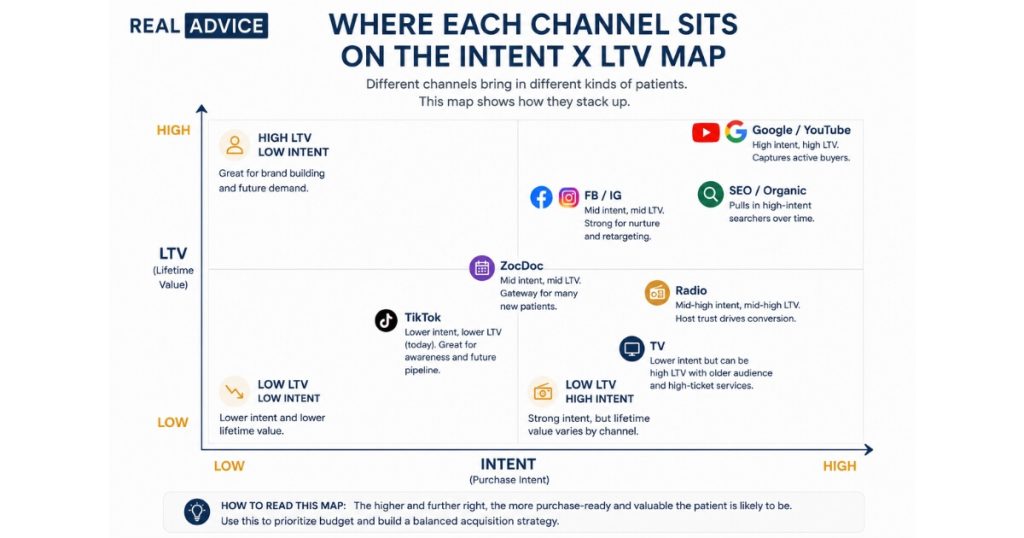
Typical LTV ranking by channel
Highest LTV
- Organic social
- SEO
- Warm referrals
These are:
- Most Aware
- High-trust
- Ready-to-book patients
Mid LTV
- Google Ads
- YouTube Ads
These are:
- Intent-driven
- Paid-trust channels
Variable LTV
- Facebook Ads
- Instagram Ads
- TikTok Ads
These depend entirely on:
- The offer
- The funnel
- How the prospect arrived
Offline / specialty channels
- Radio
- TV
- Events / booths
- Local Service Ads
- ZocDoc
Each behaves differently depending on:
- Trust transfer
- Audience age
- Program size
- Cross-sell structure
Why are SEO and organic-social leads consistently the highest-quality patients at a cash-pay clinic?
Because both channels do the trust-building work before the lead form ever loads — by the time the patient books, they’ve already decided you’re the right provider, which is the textbook definition of a high-LTV patient.
For clinic owners trying to determine which channel brings the highest-LTV patient, the answer usually comes down to trust rather than traffic source alone. Channels that educate prospects, build familiarity, and reduce skepticism before the first consultation consistently produce people who stay longer, accept more recommendations, and generate more referrals over time.
Why organic-social leads convert so hard
Anton’s exact phrasing on organic social:
“the highest quality leads that you can generate because people are looking to book with you now.”
That is not a marketing claim.
It is a stage-of-awareness observation.
A patient who:
- Watched three months of your short-form videos
- Saw how you treat people
- Heard you explain your protocols
- Followed your stories and patient cases
…is NOT the same patient as:
- A cold Facebook click
- A random discount seeker
- Someone who tapped a $99 offer
The first patient is:
- Most Aware
- Already trusting you
- Already emotionally bought in
They do not need to be sold.
They need to be scheduled.
That’s why they:
- Show up more often
- Accept recommendations faster
- Stay enrolled longer
- Refer more people
…which are all the ingredients of LTV.
Why SEO patients behave similarly
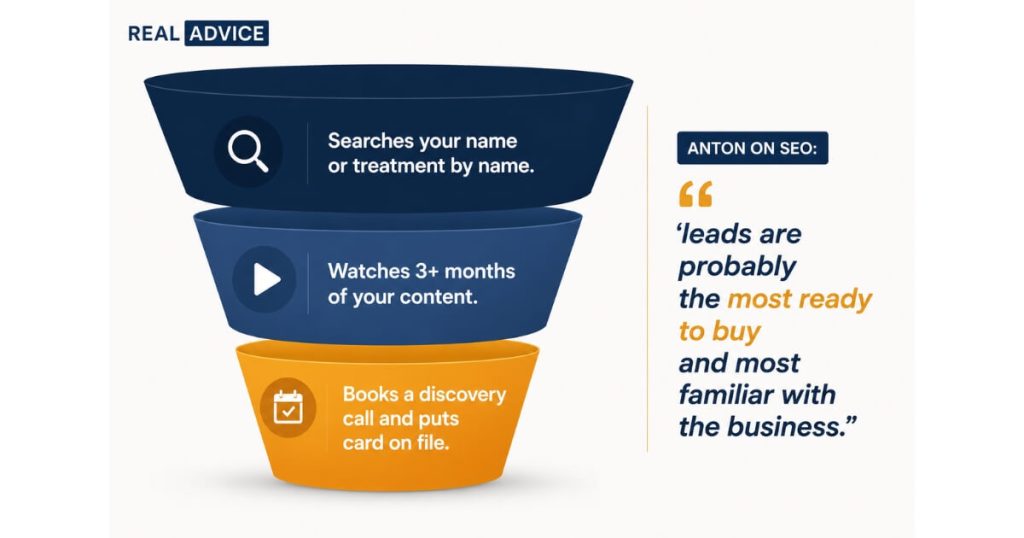
Anton described SEO leads this way:
“the leads are probably the most ready to buy and most familiar with the business.”
Someone searching:
- “best HRT clinic [city]”
- “TRT near me”
- “stem cell therapy for knee pain”
…already told Google exactly what they want.
Then they:
- Read your service pages
- Checked your Google reviews
- Looked at your providers
- Compared you to competitors
…before they ever submitted the form.
The trust gap was crossed before the call.
We saw this play out clearly at:
an HRT clinic we grew from $1M to $4M in 4 years
SEO-driven HRT patients enrolled into a recurring membership model and became the highest-LTV patient cohort in the practice because their stage of awareness on arrival was already at the buy line.
That’s the LTV math working in your favor.
Where do Google, YouTube, and Facebook/Instagram rank on patient LTV — and what determines whether they’re high or mid?
Google and YouTube ads sit firmly in the mid-LTV band — Anton’s words: “the leads have a bit higher intent” — while Facebook and Instagram swing from mid to low depending entirely on the offer.
Why Google and YouTube sit in the mid-LTV category
The reason is simple:
- Intent
Someone searching:
- “GLP-1 weight loss clinic”
- “TRT doctor near me”
…is already:
- Solution Aware
- Often Product Aware
They’re searching for the treatment by name.
That creates:
- A smaller trust gap
- Better lead quality
- Higher booking intent
Anton described the funnel this way:
“I pretty much always run them to a landing page because I want to be able to track conversions, I’ll do a quiz if I want to make them more quality and then after the quiz I really want to gauge intent I’ll go to a scheduling page with a credit card on it.”
That funnel:
- Filters intent
- Escalates commitment
- Raises LTV
Why Facebook and Instagram are more volatile
Anton framed it this way:
“any offer can work on FB but it does require testing and generally a FB / IG ads expert if you want to have any chance of scaling it”
…and:
“anything over $3000 in front end cash collected can work here.”
That $3,000 threshold matters because:
- FB/IG traffic is cold
- Trust is low at entry
- The offer must recover CAC fast
When FB/IG produces decent LTV
FB/IG works best for:
- Joint pain programs
- Neuropathy programs
- Body contouring
- High-ticket aesthetics
These offers:
- Collect enough upfront cash
- Support a real sales process
- Justify the acquisition cost
The patient is rarely Most Aware when they arrive.
So the clinic that wins on FB/IG is:
- The clinic with the better funnel
- The clinic with the better sales process
- The clinic with the better trust-building system
How does TikTok’s “lower CPL/CAC” actually translate to LTV at a cash-pay clinic?
TikTok delivers efficient lead acquisition — Anton’s words: “Historically its been a lower CPL and CAC than other platforms for me” — but the LTV is variable and depends almost entirely on what offer you’re pointing the traffic at.
Why TikTok acquires leads cheaply
TikTok skews:
- Female
- Aesthetic-focused
- Hormone-curious
- GLP-1 curious
That makes it efficient for:
- Filler
- Lasers
- Body contouring
- GLP-1
- Hormone offers
The real issue is trust gap
TikTok patients are rarely:
- Most Aware
Usually they:
- Saw a testimonial
- Saw a transformation
- Saw a procedure clip
…and clicked.
The trust gap is still large.
That is why Anton’s funnel progression matters:
“to a lead form for more volume, if I want more quality I go to a landing page, if I want more quality I go to a scheduling page with a credit card field to hold the appointment.”
Each added step:
- Lowers volume
- Raises commitment
- Raises LTV
The honest TikTok read
Low CPL does NOT equal high LTV.
It equals:
- Affordable top-of-funnel traffic
TikTok works when:
- There is recurrence
- There is cross-sell
- There is ascension into higher-value care
Examples:
- Hormones → longevity
- GLP-1 → functional medicine
- Aesthetics → memberships
Without recurrence:
- The LTV stays where the CPL is
- Low
How do offline channels (radio, TV, events/booths) rank on patient LTV at a cash-pay medical practice?
Offline channels rank surprisingly high on LTV when you match them to the right audience and offer — because each one carries a trust premium that paid digital doesn’t get on the first impression.
Radio
Radio works because of:
- Host endorsement
- Borrowed trust
Anton explained it this way:
“I’ve seen this work really well on any type of talk radio — conservative talk radio Low T offer does really well. Anything where you can get the host of the show to talk about or recommend your service that’s the way to do it.”
That recommendation acts as:
- Trust transfer
The patient arrives:
- Pre-sold
- Familiar
- Closer to Most Aware
The same dynamic applies to:
- Podcast host reads
Which Anton noted are:
“a little bit more expensive but it does work for sure.”
TV
TV works best for:
- Programs over $20K
Anton’s framing:
“anything that is over 20 grand you can run long form stuff on.”
This works especially well for:
- Neuropathy
- Knee pain
- Chronic-care programs
Why?
- Older audience
- Longer attention span
- High-ticket tolerance
Events, booths, and community setups
Anton described these as channels that:
“expedite your referrals and your local customers.”
Best locations:
- Gyms
- Marathons
- Pilates studios
- Boot camps
Best offers:
- Free labs
- B12 shots
- IVs on the spot
These leads tend to:
- Be local
- Refer heavily
- Convert into long relationships
…because they met you in person first.
Local Service Ads (LSAs)
LSAs produce:
- Extremely high-intent callers
Anton’s read:
“If you can navigate the policies to get approved this is a fantastic way to get business because most people can’t navigate the policies.”
These are:
- Calling now
- Ready to buy
- Near Most Aware
The barrier is:
- Approval
- Not LTV
ZocDoc
Anton called ZocDoc:
“The attendance rate’s pretty good and all the appointments are paid.”
ZocDoc is:
- A gateway channel
The LTV depends on:
- Cross-sell ability
Examples:
- Primary care → hormones
- ADHD → longevity
- Weight loss → functional medicine
How should a cash-pay clinic owner actually use this channel-LTV ranking when building the 2026 marketing mix?
Treat the ranking as a sequencing plan, not a menu — build the highest-LTV channels first because they compound, then layer paid channels on top once the brand foundation exists.
The biggest mistake clinics make
The common mistake:
- Buying paid traffic before building trust assets
Then they complain:
- Lead quality is low
- Close rates are weak
- Patients don’t stick
Why SEO and organic social come first
Organic social and SEO:
- Raise the LTV of every channel afterward
Anton said it directly:
“I wouldn’t run Facebook Instagram TikTok ads unless I had an established brand first.”
Why?
Because after clicking your ad:
- Patients Google you
- Patients check reviews
- Patients scan your social presence
If they find:
- No content
- No reviews
- No proof
…the trust gap stays open.
LTV stays low.
The same paid ad performs differently depending on brand strength
Weak brand
- Weak trust
- Weak retention
- Weak LTV
Strong brand
- Higher conversion
- Better retention
- Better patient quality
The channel did not change.
The trust environment did.
Recommended 2026 sequencing
Phase 1 — Foundation
Build:
- SEO (GMB + on-page)
- Organic social
Run both for:
- At least six months
Phase 2 — Intent paid traffic
Add:
- Google Ads
- YouTube Ads
After:
- Reviews are strong
- SEO base exists
Phase 3 — Cold paid traffic
Layer:
- Facebook Ads
- Instagram Ads
- TikTok Ads
ONLY on offers that clear:
- Anton’s “$3,000 front-end cash collected” threshold
Phase 4 — Offline and expansion channels
Add:
- Events
- LSAs
- Radio
Once:
- Brand trust exists
Phase 5 — TV
Reserve TV for:
- Programs over $20K
Phase 6 — Gateway channels
Use:
- ZocDoc
…when you have:
- A deliberate cross-sell path
What’s the next step?
The fastest LTV lift most cash-pay clinics can make in 2026 isn’t a new channel — it’s reallocating budget away from low-LTV cold paid traffic and into the foundational channels that raise the ceiling on every other channel.
Build:
- The SEO base
- The organic social brand
Then:
- Add paid traffic on top of the foundation
- Not in place of it
That’s how you stop paying for patients who were never going to stick.
If your cash-pay medical practice is ready to map your current channel mix against the LTV ranking and figure out where to reallocate first, we can help.
At:
…the lift came from sequencing channels in the right order around a high-LTV functional medicine offer, not from spending more on any single channel.