
What’s the Highest-LTV Marketing Channel for a Regenerative Medicine Clinic?
Regenerative medicine does not sell on impulse. The patient who pays cash for stem-cell, PRP, or orthobiologic care is making a high-ticket decision they have thought about for weeks. More importantly, they choose a clinic they already trust before they ever pick up the phone. That single fact determines which marketing channel returns the most lifetime value — and it is not the one most clinics spend the most on. After running every major patient-acquisition channel across the fastest-growing cash-pay regenerative practices in the country, the answer is consistent: the highest-LTV channel for a regenerative medicine clinic is SEO paired with Google Business Profile. Here is why, tied to the ideal patient avatar, the ticket size, and the consideration window.
The highest-LTV channel is SEO plus Google Business Profile — not paid
The short answer is SEO paired with Google Business Profile.
Paid advertising can generate volume quickly. However, it does not typically produce the highest-lifetime-value regenerative patient.
The patient who finds your clinic through search has already self-qualified. They have read your content, reviewed your expertise, and evaluated your reputation. As a result, they arrive with a higher level of trust.
That trust matters because high-ticket regenerative care depends on it.
The numbers reflect this reality.
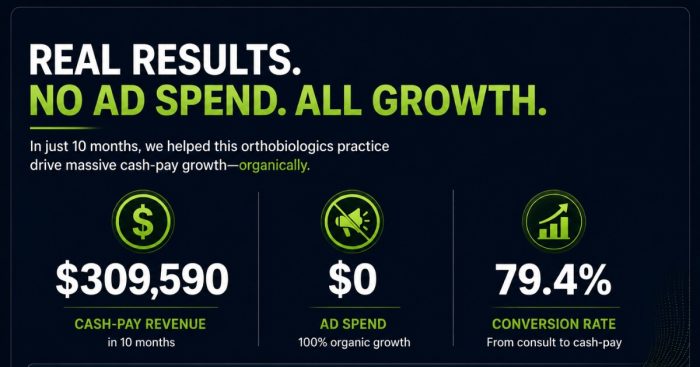
An orthobiologics practice generated $309,590 in cash-pay revenue in 10 months from SEO alone with zero ad spend and a 79.4% consult-to-conversion rate.
In addition, a pain-management and regenerative clinic built to $2,095,039 in 10 months while averaging just 26 organic leads per month.
When patients arrive this warm, the sales process requires far less effort.
Paid advertising acts as the accelerant. Meanwhile, SEO and Google Business Profile become the asset that compounds over time and carries the lifetime value.
The ideal patient avatar is a search behavior
The ideal regenerative patient is defined by their values, not just their symptoms.
They want to avoid drugs. They want to avoid surgery. They care about longevity, performance, and proactive medicine.
Because of that mindset, they naturally research before making a decision.
They do not want to be sold. Instead, they want to educate themselves and choose the best option.
That is exactly why this avatar produces the highest lifetime value.
When your lead magnets, educational content, nurture sequences, and patient experience are built around this person, they stay longer and spend more than other patient types.
Most importantly, this avatar lives inside search.
They search symptoms. They search treatment names. They search locations. Then they compare options.
Ultimately, they choose the clinic that appears consistently across blog content, Google Business Profile, and review signals.
SEO is the only channel that meets them at the precise moment they are deepest in their research.
As a result, it consistently produces the leads most ready to buy.
Ticket size and the consideration window both point to search
Two structural realities of regenerative care determine which channel wins.
The first is ticket size.
When a stem-cell or orthobiologics program costs several thousand dollars—or even five figures—patients do not make decisions after a single social media scroll.
Instead, they investigate.
They compare providers. They read reviews. They study outcomes.
High-ticket purchases require trust before the transaction. Therefore, the channel that builds trust on the patient’s timeline wins.
The second reality is the consideration window.
Most regenerative patients spend weeks comparing clinics before committing.
Because of that, the practice that earns trust throughout the research process gains a significant advantage.
That trust comes from deep educational content, an authoritative Google Business Profile, and reviews that mention the exact treatments you want to rank for.
Paid social can still introduce a problem-aware patient to a solution.
However, for the product-aware, high-ticket buyer who is already searching, search-driven channels capture the most qualified demand at the lowest cost per acquisition over time.
Why paid still earns a place in the stack
SEO winning the lifetime-value conversation does not make paid advertising useless.
Instead, it makes paid the accelerant rather than the foundation.
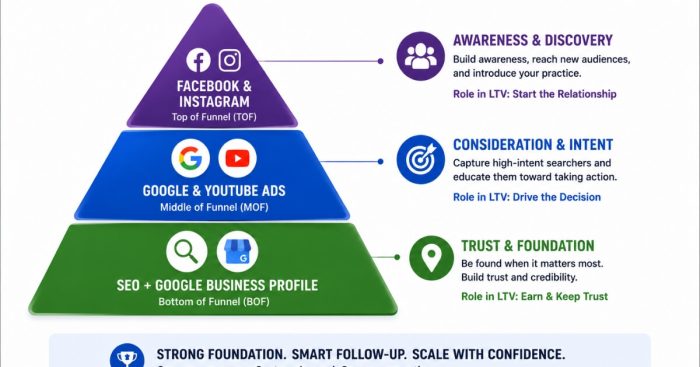
Google Ads and YouTube Ads capture product-aware demand from patients already searching by treatment name.
At the same time, Facebook and Instagram can interrupt problem-aware joint-pain and neuropathy patients who have not started searching yet.
This is especially useful for offers under five figures.
The key is sequence.
Maximize one lead channel before you stack a second.
For regenerative clinics, that lead channel should be SEO and Google Business Profile because it owns the lifetime value.
Once that foundation is producing, paid advertising can fill a specific gap.
For example, you may need more reach, faster results, or access to a demographic search engines are not reaching effectively.
The deeper playbook for sequencing every channel in this category lives in our stem cell clinic marketing hub.
What the highest-LTV stack actually looks like
The stack that produces the highest-lifetime-value regenerative patients is highly repeatable.
SEO and Google Business Profile serve as the always-on foundation.
This is the asset that owns the lifetime value.
On-page SEO rewards search-intent alignment, content depth, internal linking, and site speed.
Meanwhile, Google Business Profile rewards accurate service listings, keyword-rich descriptions, and frequent reviews that mention the treatments you want to rank for.
Google and YouTube ads come next.
These channels help capture product-aware search demand after the organic foundation is producing consistently.
Facebook and Instagram support the problem-aware joint-pain and neuropathy audience under five figures.
With a strong offer and fast follow-up process, these channels can turn attention into consultations.
Reviews and consistent local-search signals act as the multiplier.
They improve conversion rates across every channel in the stack.
Throughout the process, the principle remains the same: depth before width.
Build the channel that carries the lifetime value first.
Then accelerate growth with additional channels.
FAQ’s About the Highest-LTV Channel for Regenerative Clinics
Is SEO or paid advertising the highest-LTV channel for a regenerative medicine clinic?
SEO paired with Google Business Profile is the highest-LTV channel for a regenerative medicine clinic.
Paid advertising can generate volume quickly. However, the patient who finds your clinic through search has already self-qualified, consumed your content, and reviewed your reputation.
As a result, they arrive with significantly more trust.
That trust leads to better conversion rates and higher lifetime value.
An orthobiologics practice generated $309,590 in cash-pay revenue in 10 months from SEO alone, with zero ad spend and a 79.4% conversion rate.
Likewise, a pain-management and regenerative clinic built to $2,095,039 in 10 months while averaging 26 organic leads per month.
Paid is the accelerant. SEO and Google Business Profile are the asset that carries the lifetime value.
Why does the ideal patient avatar make SEO the highest-LTV channel for stem-cell and regenerative clinics?
The ideal regenerative patient is driven by values rather than symptoms alone.
They want alternatives to drugs and surgery. They care about longevity and proactive health.
Because of that, they spend weeks researching before making a decision.
That behavior naturally leads them to search engines.
They search symptoms, treatments, and local providers. Then they compare content, reviews, and authority signals.
The same patient also tends to generate the highest lifetime value because the practice is designed around their goals.
SEO captures this patient during the most important stage of the buying process.
Therefore, it consistently produces highly qualified leads at the lowest long-term acquisition cost.
How does ticket size and the consideration window change which channel wins for regenerative medicine?
Regenerative care is both high-ticket and long-consideration.
Because of that, patients rarely make impulse decisions.
Instead, they research extensively before committing.
When treatment costs reach several thousand dollars or more, trust becomes a prerequisite for conversion.
A long consideration window also means the clinic that earns trust during research gains a substantial advantage.
SEO, Google Business Profile, and reviews work together to build that trust.
Paid social can create awareness.
However, search-driven channels capture patients who are already looking for solutions, making them more qualified and more likely to convert.
Does paid advertising have any role for a regenerative medicine clinic?
Yes.
Paid advertising plays an important role, but it should not be the foundation.
Google and YouTube ads capture product-aware demand from patients searching for treatment options.
Meanwhile, Facebook and Instagram can reach problem-aware patients who have not started searching yet.
The key is sequencing.
Regenerative clinics should maximize SEO and Google Business Profile first because they own the lifetime value.
After that foundation is established, paid advertising can increase reach, speed, and volume.
Clinics that skip the organic foundation often struggle to generate efficient returns.
Clinics that build the SEO asset first create long-term growth.
How long does SEO take to pay off for a regenerative medicine clinic?
The answer is often faster than clinics expect.
The orthobiologics practice reached $309,590 in cash-pay revenue within 10 months from SEO alone.
Similarly, the pain-management and regenerative clinic reached $2,095,039 during the same period.
SEO is a compounding asset.
Initially, growth can feel slow.
However, content depth, Google Business Profile authority, and review velocity reinforce one another over time.
Unlike paid advertising, leads do not stop when spending stops.
The asset continues producing high-LTV patients for years.
That long-term compounding effect is what makes SEO such a strong investment.
What does the highest-LTV channel stack look like for a regenerative clinic?
The highest-LTV stack begins with SEO and Google Business Profile as the foundation.
Next, Google and YouTube ads capture product-aware demand.
Then, Facebook and Instagram support problem-aware joint-pain and neuropathy audiences under five figures.
Reviews and local-search signals strengthen every channel in the system.
The principle is simple: depth before width.
Maximize SEO first.
Allow it to compound.
Then add the second channel based on the specific gap you need to fill, whether that is reach, speed, or audience expansion.
Build the asset that owns the lifetime value first, and accelerate from there.
What’s the next step?
If you have been pouring budget into paid advertising and wondering why the lifetime value is not there, the problem is usually channel sequence—not ad spend.
The highest-LTV patient in this category is a researcher who buys based on trust.
SEO paired with Google Business Profile is the channel that earns that trust on the patient’s timeline.
Build the asset first.
Prove the model the same way the orthobiologics practice generated $309,590 in cash-pay revenue in 10 months from SEO alone.
Then accelerate growth with paid advertising.
If your clinic needs someone to evaluate your offers, ideal patient avatar, and channel mix together—and identify where the highest-LTV leverage exists—that is the conversation to book.
We will map the channel strategy for your practice on the call.