
How Does a Cash-Pay Medical Practice Get Approved for Google Local Service Ads When Weight Loss, Hormone, and Gynecology Keywords Are Flagged?
Google Local Service Ads sit above every other paid result on the search engine results page, every call is screened for intent, and the leads ride a “Google Guarantee” trust badge that nothing else on the SERP gets. The catch: most cash-pay medical practices that try to run LSAs on hormone, GLP-1, weight loss, or even some gynecology keywords get rejected outright. Anton’s exact phrasing: “If you can navigate the policies to get approved this is a fantastic way to get business because most people can’t navigate the policies.” That “if” is the entire moat.
Clinics that figure out which categories actually approve, which softer-sounding service is the top-of-funnel, and how to upsell that LSA call into a hormone or GLP-1 program get a channel almost no competitor can copy. Clinics that don’t, burn budget testing campaigns that never go live. After running every major patient-acquisition channel across 40 of the fastest-growing cash-pay medical clinics in the country, this is the FAQ on Google Local Service Ads for cash-pay practices in 2026.
What are Google Local Service Ads (LSAs) — and why are they such a powerful channel for a cash-pay medical practice that can actually get approved?
Local Service Ads are Google’s pay-per-lead format that places approved, vetted local businesses above every standard text ad on the search results page and stamps each listing with a green “Google Guaranteed” checkmark.
Why LSAs are different from traditional paid search
The unit economics are unlike anything else in paid search.
You don’t:
- Pay per click
You do:
- Pay per call
- Pay per lead that Google routes to you
Google handles:
- Background checks
- License verification
…on the front end, then places the Google Guarantee badge on your listing, which functions as third-party trust before the caller has spoken to anyone at your clinic.
For a cash-pay medical practice, that combination creates:
- Top-of-page placement
- Pay-per-lead pricing
- A trust badge competitors don’t have
…which makes LSAs feel closer to a curated referral source than a normal ad channel.
Why this matters specifically for cash-pay clinics
The asymmetry is the moat.
Nobody else in your market can appear there unless they also passed the approval process.
Anton put it directly in his field notes:
“If you can navigate the policies to get approved this is a fantastic way to get business because most people can’t navigate the policies.”
Most clinics can’t.
That means:
- The auction stays sparse
- Competition stays lower
- Cost per lead stays sane
The leads themselves are also extremely high intent.
A patient searching:
- “weight loss clinic near me”
- “functional medicine doctor near me”
…is already:
- Product Aware
- Most Aware
…inside the 5 Stages of Awareness framework.
That’s the buying end of the funnel.
Why does Google reject cash-pay medical practices that try to run LSAs on hormone, weight loss, or GLP-1 keywords?
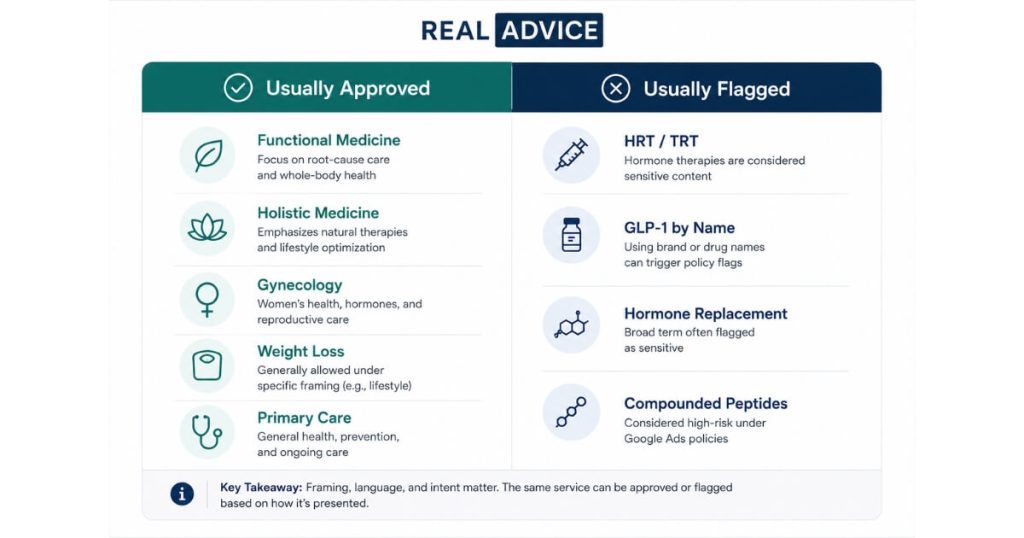
Google rejects most hormone, TRT, HRT, and GLP-1-by-name campaigns because its healthcare advertising policy treats those service categories — and the controlled or prescription substances behind them — as restricted, and Local Service Ads are gated by a stricter vertical-category list that simply doesn’t include “hormone clinic” or “GLP-1 weight loss” as approvable verticals.
The rejection pattern is consistent
Across almost every stalled LSA application we’ve reviewed, the clinic:
- Typed “TRT” or “hormone replacement” into the business description
- Listed “GLP-1 weight loss” as a service
- Applied under categories like “men’s health” that Google does not recognize for LSAs
The result:
- The application will not submit
- The application stalls in manual review
- The application gets declined with a vague policy violation
What’s actually getting flagged?
It is usually NOT:
- Your clinic
- Your license
- Your insurance
It IS:
- The wording
- The categories
- The treatment names
Google’s LSA review system is:
- Keyword-driven
- Category-driven
- Human-reviewed afterward
If your services list reads like:
- A compounding pharmacy menu
- A peptide catalog
- A hormone storefront
…the system flags it.
Examples:
- Semaglutide
- Tirzepatide
- Testosterone cypionate
- Estradiol
If instead your profile reads like:
- A primary care office
- A specialty medical office
- A functional medicine clinic
…the system routes you into the correct approval queue.
Which medical practice categories actually get approved for Google LSAs (functional medicine, holistic medicine, gynecology, weight loss)?
The categories that actually get approved are the broader, recognized medical office types — functional medicine, holistic medicine, gynecology, weight loss clinic (framed as a medical weight loss practice, not a GLP-1 dispensary), primary care, and concierge medicine — not the compound-and-treatment-name categories that scream “we sell controlled substances online.”
The categories that commonly work
Approved-style categories typically include:
- Functional medicine
- Holistic medicine
- Gynecology
- Medical weight loss
- Primary care
- Concierge medicine
The categories that commonly fail
What usually does NOT get approved:
- TRT clinic
- HRT clinic
- GLP-1 clinic
- Men’s hormone clinic
The category is the wrapper.
The hormone or GLP-1 program is what happens after the patient enters the practice.
This is the exact pattern Anton flagged:
“This can work well for weight loss, this can work well for functional medicine, holistic medicine, this can work well for gynecologists and you can upsell people into hormone programs.”
The operational setup matters too
Google verifies:
- Licenses
- Insurance
- Entity structure
…against the category you apply under.
Examples:
Likely to pass
- A board-certified gynecologist applying under gynecology
- A weight-loss clinic with a medical director and real protocols
- A functional medicine practice with a real office and active practitioners
Likely to fail
- A virtual-only telehealth GLP-1 storefront
- A nurse practitioner applying as a gynecology clinic without supervising OB-GYN structure
- A hormone clinic whose licenses and categories don’t match
The fastest approvals happen when:
- Entity name
- Malpractice insurance
- Medical licenses
- Google Business Profile
…all align cleanly.
We saw this play out clearly at:
…the LSA piece was one input into the multi-channel mix, but it only worked because the underlying medical entity was structured cleanly enough to pass policy review.
How do you use a gynecology, functional, or holistic Local Service Ad as a top-of-funnel for a hormone or GLP-1 program upsell?
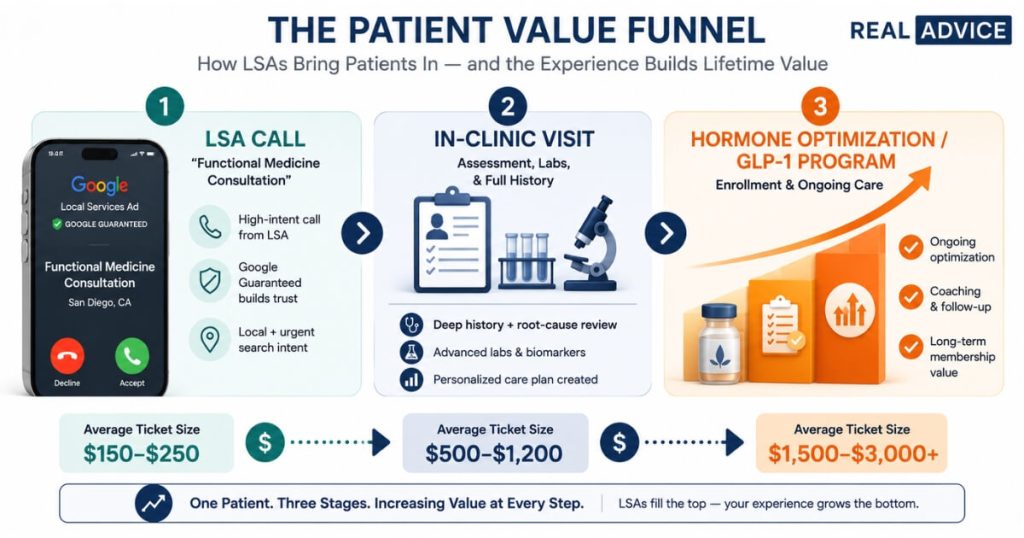
You run the LSA under the softer-sounding approved category — gynecology, functional medicine, holistic medicine, or medical weight loss — and treat that first appointment as the diagnostic intake, then prescribe and enroll the patient into the hormone or GLP-1 program once they’re a patient of record.
The strategy is simple
The LSA is:
- The front door
The hormone or GLP-1 program is:
- The back-end offer
Anton called this out directly:
“you can upsell people into hormone programs. This is actually a great way to get new patients if you can navigate the policies.”
What happens operationally
Step 1 — The LSA generates the consult
The patient books:
- A functional medicine consult
- A gynecology visit
- A medical weight-loss intake
Step 2 — The clinic performs a legitimate workup
That includes:
- Symptoms
- Labs
- Medical history
- Diagnostic evaluation
Step 3 — The actual indication surfaces
Examples:
- Low testosterone
- Perimenopausal hormone shifts
- Metabolic dysfunction
- GLP-1 eligibility
Step 4 — Enrollment happens inside a doctor-patient relationship
That is where:
- Hormone optimization
- HRT
- GLP-1 treatment
…are appropriately discussed and prescribed.
Why the economics work
You are:
- Paying per qualified lead
- Not paying per hormone-program enrollee
The upsell occurs at:
- The highest-trust moment in the patient journey
…face-to-face with the provider who already ordered the labs.
The approved categories create clean entry lanes:
| Approved Category | Natural Upsell Path |
|---|---|
| Gynecology | Female hormone optimization / HRT |
| Functional Medicine | Hormones, GLP-1, peptides |
| Holistic Medicine | Hormones, metabolic care |
| Medical Weight Loss | GLP-1 programs |
The LSA buys the front door.
Your clinical program is what happens behind it.
What does the approval process actually look like (background check, license verification, insurance) — and how long does it take for a cash-pay clinic?
The approval process is a three-part check — business and owner background check, professional license verification against the category you applied under, and proof of active general liability and malpractice insurance — and it typically takes anywhere from one to six weeks for a cash-pay medical clinic depending on how clean your paperwork is and which third-party vendor Google routes the verification through.
Step 1 — Background check
Google’s vendor checks:
- The business entity
- The listed owner(s)
This stage often stalls when:
- The DBA doesn’t match the license
- The entity is under a holding company
- The owner-of-record has flagged history
Clinics pass faster when:
- Entity name
- License name
- Insurance name
- Google Business Profile name
…all match before applying.
Step 2 — Professional license verification
Google checks:
- State board status
- License standing
- Category alignment
This is where:
- “Men’s health” applications die
- “Gynecology” or “family medicine” applications pass
The license must:
- Be active
- Be in good standing
- Match the category
Step 3 — Insurance verification
Google requires:
- General liability insurance
- Malpractice insurance for medical categories
The certificate must:
- Be current
- Match the legal business name
- Meet required coverage limits
Timeline expectations
Fast approvals
- 1–3 weeks
- Clean paperwork
- Matching entities and licenses
Slow or failed approvals
- 6+ weeks
- Mismatched names
- Expired certificates
- Wrong categories
The fix is usually upstream:
- Clean up the entity
- Clean up the paperwork
- Reapply under the correct category
When does the LSA channel break a cash-pay practice’s front desk — and how do you size capacity before flipping it on?
LSAs break a front desk when the lead flow outruns your answer rate, because every LSA call you miss or send to voicemail is a lead you paid for that never converts — and Google demotes you in the ranking the next day.
Why answer rate matters so much
LSAs are:
- Call-driven
- Response-driven
- Ranking-sensitive
Google actively scores:
- Answer rate
- Response time
- Caller satisfaction
If your front desk misses calls:
- Ranking softens
- Cost per lead rises
- Performance degrades quickly
What happens operationally
A front desk built for yesterday’s call volume can get overwhelmed immediately after approval.
We’ve seen clinics:
- Double inbound call volume in the first week
If nobody answers by:
- Ring three
…the campaign starts losing money fast.
Capacity planning before launch
Before turning LSAs on, calculate:
- Current peak-hour call volume
Then assume LSAs add:
- 30% to 100% more calls
…within the first 30 days.
The staffing rule
If your front desk is already running hot, you likely need:
- A second receptionist
- A trained virtual receptionist service
- An AI voice intake agent
…before launching.
The reference case here is:
an HRT clinic we grew from $1M to $4M in 4 years
…the growth wasn’t just a marketing-channel story — it was a:
- Front-desk-capacity story
- Follow-up story
- Conversion story
The clinics that scale LSAs are the clinics that built the answer infrastructure first.
What’s the next step?
If you’ve ever opened your Google Ads or LSA account, seen the policy warning on TRT or GLP-1, and assumed this channel wasn’t for cash-pay clinics like yours — you were half right.
It is NOT for clinics that:
- Advertise hormones by name
- Advertise GLP-1 by name
- Apply under restricted categories
It IS a fantastic channel for clinics that:
- Apply under gynecology
- Apply under functional medicine
- Apply under holistic medicine
- Apply under medical weight loss
…then run a legitimate medical practice behind the scenes that appropriately diagnoses and treats hormone and metabolic conditions.
The moat is the approval.
Most competitors will never get through it.
If your cash-pay medical practice wants to know whether your:
- Entity
- License
- Category
- Front-desk capacity
…are actually set up to pass LSA review and convert the leads once they arrive, we should talk.
Real ADvice mapped the full LSA approval and upsell playbook against what worked at:
an HRT clinic we grew from $1M to $4M in 4 years
…and we’ll tell you in 30 minutes whether LSAs are the next channel for you or whether you should focus somewhere else first.