
How Do You Optimize Google My Business for a Cash-Pay Medical Practice? (Setup, Reviews, Services, and Posts That Actually Rank)
If you run a cash-pay medical practice and you want a steady stream of “ready to buy” patients without lighting cash on fire, Google My Business is the highest-leverage free channel you have. It is the local-pack engine for TRT, HRT, GLP-1, regen, and functional medicine queries — the patient is already searching for what you sell, they just need to be convinced you are the right clinic. The frustrating part is that GMB rewards momentum: a half-built profile with sporadic reviews and no posts will sit invisible while a competitor with a tight setup and a steady review cadence eats every local search in your zip code. The good news is the lever is pullable, and the rules are stable.
After running every major patient-acquisition channel across 40 of the fastest-growing cash-pay medical clinics in the country, this is the FAQ on how to optimize Google My Business for a cash-pay medical practice.
Why is Google My Business the most important free patient-acquisition channel for a cash-pay medical practice?
Because for cash-pay treatments your patients are already searching by name and the GMB local pack is the first thing they see — beating your website, ads, and social to the click.
By the time someone types:
- “TRT clinic near me”
- “GLP-1 weight loss [city]”
…they are Most Aware in Anton’s 5 Stages of Awareness framework:
- They know the solution
- They know they want it
- They are picking who to buy from
GMB is where that pick happens.
There is:
- No media spend
- No ad approval
- No policy risk
Google My Business is your business listing on Google, and it ranks based on:
- Relevance
- Engagement
- Relevant posts
- Reviews
- Descriptions
- Services listed
Every one of those is a lever you control from a free dashboard.
That is a rare gift for a cash-pay clinic — most of your other channels (Meta, Google Ads, TikTok) require either spend, approvals, or both.
It also compounds with everything else you are doing.
SEO has proven to be the favorite way to build sustainable lead flow in clinics, and when you couple GMB with:
- Good Google reviews
- An established brand on social media
…conversion rates lift across every channel — paid and organic.
The cash-pay patient who is comparing you to three other clinics in their saved Maps list is reading your reviews before they ever click your ad.
What does a “strong setup” look like on Google My Business for a cash-pay clinic?
A strong setup means every single field that Google offers is filled out, accurate, and aligned with the cash-pay services you actually want to rank for.
If you want to rank your Google My Business profile better you first need a really strong setup — this is non-negotiable and it is the part most clinics skip.
That means:
- A verified business with a real address (not a UPS box)
- Exact NAP (name, address, phone) that matches your website footer and citations byte-for-byte
- The correct primary category (e.g., “Medical Clinic,” “Wellness Center,” or the closest fit to your offer)
- Every relevant secondary category (e.g., “Weight loss service,” “Sports medicine clinic,” “Endocrinologist”)
Hours must be current.
Photos must be real and recent.
The website link must point to a page that matches what people clicked for — not a generic homepage.
If someone searched TRT and landed on a generic “About” page, they bounce.
Then layer in the rest:
- Appointment URL
- Booking link
- Products and services
- Q&A populated with the questions you actually get on consults
Photos of:
- The office
- The providers
- The treatment rooms
…not stock.
Owner-posted Q&As that pre-answer:
- The price
- The protocol
- The timeline
A profile that looks abandoned ranks like one.
How do you write a Google My Business description and services list that actually ranks for cash-pay treatments (TRT, HRT, GLP-1, regen, functional)?
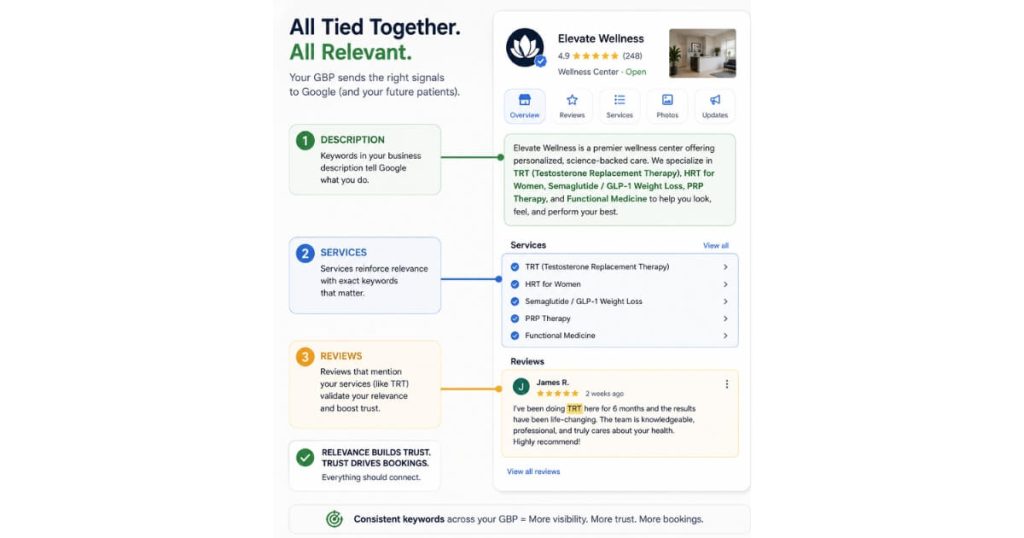
You write them using the exact words your patients type into Google, and you make sure the description, the services, the posts, and the reviews all reinforce the same keyword set.
You need:
- An accurate description with keywords
- Keywords people actually type in
- Accurate services that mirror those same keywords back
Start with the description.
Open it with your strongest cash-pay keyword positioned naturally:
“Cash-pay TRT clinic in [city] offering testosterone replacement therapy, HRT for women, semaglutide weight loss, and PRP regenerative medicine.”
Then state:
- Who you serve
- The outcomes you produce
- The offer
Skip the:
“Established in 1997, we provide compassionate care”
…filler.
Google reads it as noise and patients skim past it.
Write like a search result, not a brochure.
For the services list:
Do not just dump generic categories.
Add every cash-pay service you want to rank for as its own entry, with both the clinical name and the common name:
- “TRT (Testosterone Replacement Therapy)”
- “HRT for Women (Bioidentical Hormones)”
- “Semaglutide / GLP-1 Weight Loss”
- “PRP Therapy”
- “Stem Cell / Regenerative Medicine”
- “Functional Medicine Consult”
Then write a 1–2 sentence description under each that:
- Uses the same keyword phrase one more time
- Names the patient outcome
This is where most clinics leave huge ranking territory on the table — they list “Hormone Therapy” once and stop.
That keyword alignment is exactly how an HRT clinic we grew from $1M to $4M in 4 years built the SEO foundation that took them from 80 monthly organic visitors to 1,000+ and unlocked $1.7M/yr in membership revenue from search alone.
The principle is the same on GMB:
- Pick the keyword set
- Make the description repeat it
- Make the services list repeat it
- Make the posts repeat it
- Make the reviews repeat it
How do you generate Google reviews that mention the specific services your cash-pay clinic wants to rank for?
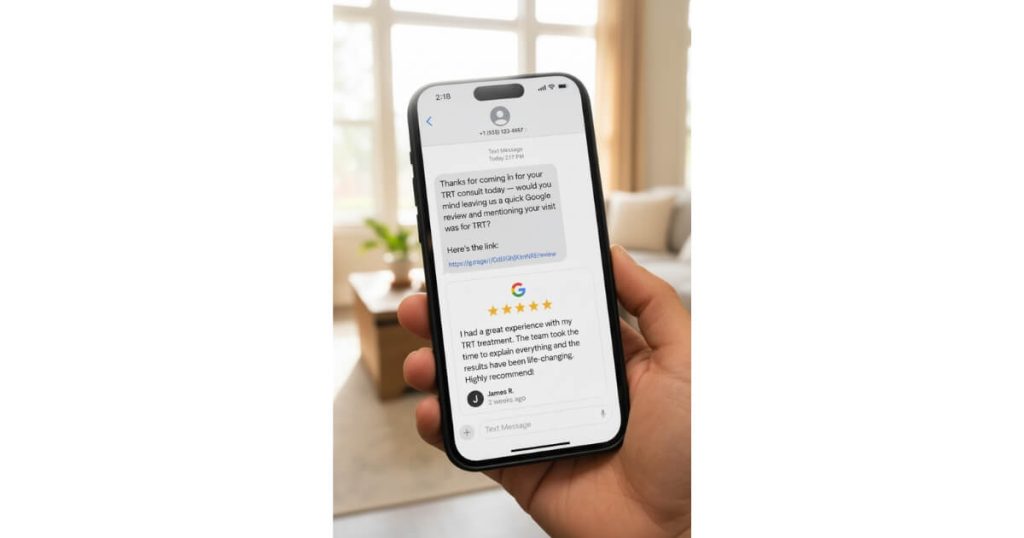
You ask for them on purpose, by name, at the moment the patient is happiest — and you tell the patient exactly what to mention.
You need:
- Reviews frequently
- Reviews that talk about the services people are looking for
- Reviews tied to the keywords you want to rank for
Generic “great staff” reviews do almost nothing for GMB ranking.
Service-named reviews move the needle.
The mechanism:
Build a simple post-visit text message and email sequence that fires after every paid visit.
Inside it:
- Link to your Google review URL
- Include one specific sentence
Examples:
“Would you mind mentioning your visit was for TRT in the review?”
“If you’re comfortable, please mention you came in for semaglutide weight loss.”
Patients are not offended by this.
They want to help.
They just need to be told what to say.
The clinics that do this consistently get reviews that read like keyword-rich landing pages.
Cadence matters as much as wording.
A clinic doing:
- 20 paid visits a week
- With a 25% review conversion
…is adding five Google reviews per week — 250 a year.
That is a velocity Google reads as:
“Active and trusted.”
A clinic that asks once a quarter and gets two reviews per month reads as dormant.
Once you build momentum here it’s an exceptional way to get new business but without momentum it can be difficult — the gap between an asking culture and a not-asking culture is the difference between owning your local pack and watching a competitor own it.
Operationally:
- Assign one person to own review velocity
- Bake the ask into the visit checklist
- Print the review QR code on the receipt
- Use your EMR or CRM to auto-fire the text
- Rotate which service you ask the patient to mention based on what you want to rank for that month
How often should a cash-pay medical practice post Google My Business updates — and what should those posts say?
At minimum once a week, ideally twice — and every post should reinforce the same services and keywords your description, services list, and reviews are already pushing.
You also want to do Google my business posts that are talking about the same things — make it all tied together and relevant.
If your:
- Description sells TRT
- Services list TRT
- Reviews mention TRT
…your posts should be naming TRT every week, too.
Use three post types in rotation.
Offer posts
A specific cash-pay offer with:
- A price
- A deadline
- A booking link
Example:
“First consult + labs for $99 this month, TRT optimization for men 35+.”
Update posts
Practice news, new providers, new treatment availability, written with the same keywords.
Example:
“Now offering GLP-1 weight loss programs starting at $349/mo.”
Educational posts
Short answers to the questions patients actually ask on consults.
Example:
“How fast does TRT start working?”
…with a 3–4 sentence answer and a CTA to book.
Keep them short:
- 4 to 6 sentences
- Real photo
- Booking link included
Use:
- Provider photos
- Treatment room photos
- Branded graphics
…not stock.
And write the first line of every post so it could be the first line of a 30-second short-form video — this is how you compound the work and pump the same content into Instagram, TikTok, and YouTube Shorts without rewriting.
Why does GMB momentum compound — and what does Anton mean by “without momentum it can be difficult”?
Because Google’s local-pack algorithm rewards velocity and consistency, not effort spikes.
A profile that gets:
- Three reviews this week
- Two posts
- A fresh photo
…signals:
“Active business serving patients right now.”
And Google ranks it accordingly.
A profile that did all of that six months ago and went quiet signals dormant — and ranks like it.
Momentum is the asset; once you build momentum here it’s an exceptional way to get new business but without momentum it can be difficult.
The compounding kicks in three ways.
First: Reviews beget reviews
A 4.9-star profile with 240 reviews converts the click into a call at a much higher rate than the 4.7 profile with 38 reviews next to it.
That higher call rate produces:
- More visits
- More review requests
- More reviews
Second: Posts feed the freshness signal
The clinic posting weekly outranks the clinic posting quarterly even when the quarterly clinic has more total content.
Third: Engagement itself is a ranking signal
Google tracks:
- Calls
- Direction requests
- Website clicks
- Photo views
A well-set-up profile gets more of all four.
That earns more visibility.
That produces more engagement.
That earns more visibility again.
The flip side is the bootstrapping problem.
A brand-new profile with:
- 11 reviews
- No posts
…will not rank in week one no matter how perfectly you set it up.
You have to push hard for 90 days:
- Hard review-velocity push
- Two posts a week
- Photo updates monthly
- Services expanded
- Q&A populated
After that, the curve bends and the profile starts producing leads on autopilot.
The clinics that quit at week six never see it.
The clinics that grind through the first 90 days own the local pack.
How does GMB work alongside brand, reviews, and social to make all marketing convert better?
GMB is the conversion floor for everything else you do.
The better your brand is on social platforms the better everything else will convert, and the better your Google reviews and GMB profile are the better every paid ad you run converts — because the patient who clicks your Meta or Google ad is going to:
- Open another tab
- Search your clinic name
- Check your reviews before they book
If your profile is strong, the ad converts.
If your profile is weak, the ad burns money.
That is the operator-level reason cash-pay clinics that win at scale are usually not winning on one channel — they are stacking:
- GMB
- Organic social
- Paid ads
- A real brand
…so that every channel makes every other channel work harder.
SEO has proven to be the favorite way to build sustainable lead flow, and when you couple this with:
- Good Google reviews
- An established brand on social media
…you can do exceptionally well with SEO.
GMB sits at the intersection of all three.
What’s the next step?
If your Google Business Profile is:
- Half-built
- Full of generic reviews
- Missing posts for six months
…you are leaving the easiest free patient-acquisition lever in cash-pay medicine on the floor.
The fix is mechanical, not creative:
- Fill every field
- Rewrite the description and services with the keywords your patients actually type
- Build an asking culture for service-named reviews
- Post weekly
- Push hard for 90 days until the momentum curve bends
Then it produces leads on autopilot.
If your cash-pay medical practice wants the same SEO-led growth we built for a regenerative medicine clinic where we generated $309,590 in cash-pay revenue in 10 months without paid ads, with a 79.4% lead-to-booked conversion rate, the next step is a strategy call.
We will:
- Audit your GMB
- Audit your reviews
- Audit your local-pack visibility
…and lay out the exact 90-day push your clinic needs to own its zip code.