
What Happens When a GLP-1 or Weight-Loss Patient Hits Their Goal Weight? (The Maintenance Program That Stops the Membership Cliff)
There is a moment in every weight-loss program that quietly decides whether your membership grows or shrinks: the day a patient hits their goal weight. They came to lose the weight. They lost it. And if you have not built anything for them to do next, the rational move is to cancel. One concierge clinic we work with watched its memberships decrease month-over-month for the first time ever — not because the marketing broke, but because too many successful patients had nowhere to go after they won. Here is the FAQ on the goal-weight cliff and the two specific fixes that turn a finish line into a retained, paying patient.
What happens when a GLP-1 or weight-loss patient hits their goal weight?
Without a maintenance program waiting for them, they cancel — because they got exactly what they paid for and you gave them no reason to stay.
This is the single most predictable churn event in a weight-loss membership, and most clinics never plan for it.
The patient enrolled to lose weight, the program worked, and now the original reason for the membership is gone.
From the patient’s point of view, cancelling is not disloyalty; it is logic. The product did its job and the job is done.
The fix is to build a maintenance program and pre-sell the transition into it from day one — so that hitting the goal is not the end of the relationship but a planned step into the next phase.
When the finish line is actually a doorway, the patient walks through it instead of walking out.
Why is the goal-weight moment the biggest churn risk in a weight-loss membership?
Because it is the one moment when a happy, successful patient has a perfectly rational reason to leave — and success-driven churn is the kind clinics never see coming.
Most churn analysis focuses on unhappy patients: the ones who did not get results, did not feel cared for, or balked at the price.
The goal-weight cliff is the opposite.
These are your best outcomes — the patients who hit their target — and they are exactly the ones at risk, because the better your program works, the faster they reach the point where they no longer “need” it.
A clinic can have a great product and still watch memberships decline for the first time, purely because its winners keep graduating out.
That is why you cannot treat retention as only a satisfaction problem.
You have to treat it as a lifecycle problem. The patient who succeeds needs a defined next phase, or your success rate becomes your churn rate.
What is a maintenance program, and how do you pre-sell it?
A maintenance program is a lower-intensity ongoing plan that keeps a goal-weight patient on a relationship with the clinic — and you pre-sell it by setting the expectation at enrollment that maintenance is the plan, not an upsell.
The mechanics are simple, but the timing is everything.
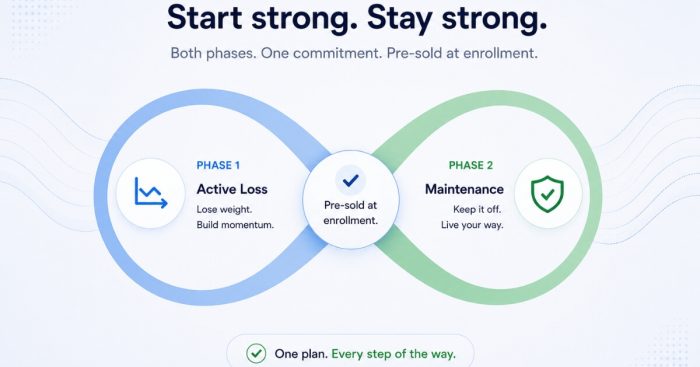
From the moment a patient joins, frame the journey in two phases: active loss, then maintenance.
When you set that expectation up front, transitioning to maintenance at goal weight feels like the natural completion of the plan rather than a surprise ask to keep paying.
This is the foundation of the GLP-1 maintenance program — creating a structured second phase that protects the patient’s results while giving them a clear path forward after active weight loss. When maintenance is positioned as part of the original treatment plan instead of a separate offer, patients are far more likely to continue their care and maintain long-term success.
The patient is, in effect, pre-sold on staying before they have even started losing.
That reframe is what converts a cancellation into a continuation.
A patient who was told on day one that “the goal is to get you to your target and then keep you there” is ready for the maintenance conversation when it arrives.
A patient who was never told steps off the cliff.
We have watched this kind of lifecycle thinking compound at a weight-loss and medspa clinic where we added $6.7M in revenue in one year across 3,727 new patients — the patients who stay through maintenance are what make those numbers durable rather than one-time.
How should the refill form double as a clinical check-in?
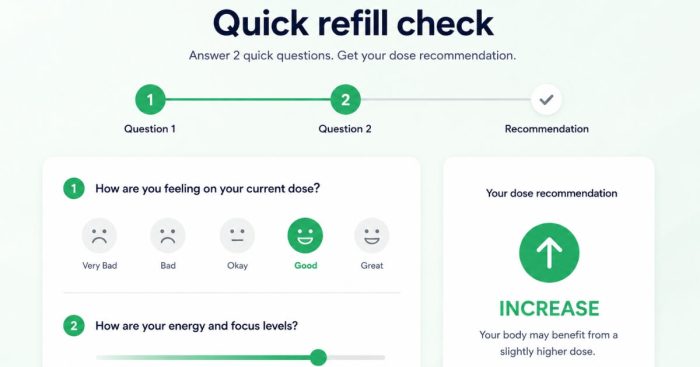
Turn the routine refill form into a progress tracker by adding two questions — how many pounds the patient has lost in the last 30 days, and how many more they want to lose — so the team can see whether to adjust the dose.
This is the second fix, and it is a small change with outsized effect.
A standard refill request just reorders medication.
By adding those two questions, every refill becomes a clinical touchpoint: the team can see what dose the patient is on, how they are progressing, and whether the dose should go up, hold, or come down.
The form stops being a transaction and starts being care.
That ongoing visibility does two things at once.
It keeps the clinical plan accurate, which produces better outcomes, and it keeps the patient feeling actively managed rather than left on autopilot — both of which directly reduce the odds they drift away.
The patients who feel seen at every refill are the patients who are still there at goal weight, ready for the maintenance conversation.
How do you make weight-loss patients feel they have to stay?
By getting them a result so good that staying feels necessary — if a patient does not feel well enough to want to keep going, that is a sign the clinic did not finish the job.
The standard the clinic held itself to was blunt and worth adopting: if we are not getting patients to feel good enough that they feel like they need to stay on this, we did not do our job.
Retention, framed that way, is not a marketing tactic — it is a measure of whether the care actually changed the patient’s life enough to be worth keeping.
The same principle drives successful GLP-1 & weight loss clinic marketing, where sustainable growth depends as much on patient retention and lifetime value as it does on attracting new leads.
A patient who feels dramatically better is not looking for the exit.
This reframes the whole churn problem.
Instead of asking “how do we stop people from leaving,” ask “are we delivering an outcome so good that leaving would feel like a loss.”
The same principle applies across recurring-care models. We have seen it work at an HRT clinic we grew from $1M to $4M a year on recurring memberships, where long-term patient relationships became the foundation for sustained growth.
When the answer is yes, the maintenance program and the refill check-in have something real to retain.
When the answer is no, no retention tactic will save it — because the patient has nothing worth holding onto.
FAQ’s About the GLP-1 Goal-Weight Maintenance Cliff
Why do weight-loss patients cancel after reaching their goal?
Because they got exactly what they paid for and the clinic gave them no defined next step.
Cancelling at goal weight is rational, not disloyal — the original reason for the membership is gone.
The fix is a maintenance program the patient was pre-sold on at enrollment.
What is a weight-loss maintenance program?
A lower-intensity ongoing plan that keeps a goal-weight patient in a relationship with the clinic after active weight loss ends.
It works best when framed from day one as the second phase of a two-phase journey, so transitioning into it feels like completing the plan rather than a surprise upsell.
How do I pre-sell maintenance to a weight-loss patient?
Set the expectation at enrollment that the journey has two phases — active loss, then maintenance to keep the results.
When the patient is told up front that maintenance is the plan, the transition at goal weight feels natural and they are effectively pre-sold on staying before they begin.
How can a refill form reduce churn?
Add two questions to it — how many pounds lost in the last 30 days and how many more to go — so every refill becomes a clinical check-in.
That lets the team adjust the dose and keeps the patient feeling actively managed rather than left on autopilot, which directly lowers churn.
Is retention a marketing problem or a clinical one?
Mostly clinical.
If a patient doesn’t feel good enough to want to keep going, no retention tactic will hold them.
The standard to hold is getting an outcome so strong that leaving would feel like a loss — then the maintenance program and refill check-in have something real to retain.
What’s the next step?
If your weight-loss or GLP-1 membership is plateauing or declining even though patients are getting results, the goal-weight cliff is the first place to look.
Build a maintenance program, pre-sell the two-phase journey at enrollment, turn your refill form into a clinical check-in, and hold the standard that patients should feel too good to leave.
Those changes convert your best outcomes from churn risks into retained, recurring revenue.
If you want someone to build the maintenance program, the enrollment framing, and the refill check-in with you, that is the conversation to book.
We will map your weight-loss patient journey from first injection to long-term maintenance on the call.