
What Should I Say on a GLP-1 Weight-Loss Consult Call to Actually Close? (The Verbatim 15-Minute Script)
INTRO:
Most cash-pay clinics lose GLP-1 patients not because of price, but because the consult call has no structure — the staff member answers questions, quotes a number, and hopes. The clinics that convert run the same 15-minute call every time: set an agenda, diagnose fit, present the program as three steps, and only then talk money. Here’s the FAQ on exactly what to say, in the order to say it, to turn a weight-loss inquiry into a booked, paid blood draw.
What should I say on a GLP-1 weight-loss consult call to actually close?
Run a structured 15-minute consult that diagnoses fit first and presents the program as three steps, not a price.
The call flows the same whether or not the patient pre-booked:
- Confirm they requested information
- Set an agenda
- Ask discovery questions
- Qualify them on recent bloodwork
- Walk them through the three-step path
The three-step path:
- Comprehensive labs
- A consult to review results
- A personalized membership
Price comes last, after the patient can see the plan they’re buying.
The mistake that kills conversion is leading with the medication and the number; the fix is leading with the patient’s goal and the process that gets them there.
How should I open a GLP-1 weight-loss consult call?
Introduce yourself, confirm the request, and set a clear agenda in the first 30 seconds.
Use a line close to this:
“My goal during the next 15 minutes is to help you discover if weight-loss injections are right for you, or if there might be a better way for you to accomplish your health goals — either way, I’ll make some recommendations and you can choose what you believe is best.”
This does three things at once:
- Lowers the patient’s guard
- Frames you as an advisor rather than a salesperson
- Sets the expectation that this is a focused 15-minute conversation
Then transition straight into discovery.
What discovery questions qualify a GLP-1 patient?
Ask how they heard about you, how much weight they want to lose, what they’ve already tried, and what their recent bloodwork shows.
The sequence matters:
Rapport and Lead Source
- “How did you hear about us — did you see an ad or were you referred?”
Goal
- “How much weight are you looking to lose right now?”
Previous Attempts
- “What else have you tried recently?”
Then repeat their answers back to confirm you heard them.
Clinical Qualification
- “Have you had any bloodwork done in the last six months?”
- “Why was it done?”
- “Can you send it to us?”
- “Any pre-existing conditions you’ve been seeing a provider about?”
This is the moment you separate yourself from the telehealth mills — you’re screening for candidacy, responsibly.
How do I present GLP-1 pricing without scaring the patient off?
Present the program as three steps before you present a number, then anchor and reduce.
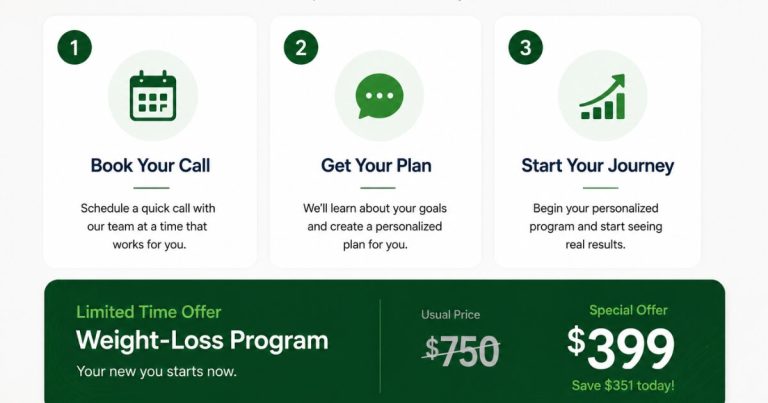
Walk through it plainly:
Step 1
Comprehensive bloodwork to get a baseline of what’s stopping you from losing the weight and keeping it off.
Step 2
A consultation — virtual or in person — to review that bloodwork with our doctor.
Step 3
A personalized membership program you’ll review together and choose.
Then explain:
“Generally our members invest between $300 and $1,000 per month depending on what your panels show.”
Notice the patient now sees a plan, not a prescription.
Only after this do you quote price.
We’ve watched this program-first framing compound at a weight-loss and medspa clinic where we added $6.7M in revenue in one year across 3,727 new patients — the structure, not the discount, is what carries the close.
How do I handle “sure, how much does it cost?”
Anchor the usual investment, offer the lower weight-loss-specific price, pause, and ask to schedule.
Say it like this:
“The investment for the bloodwork and the initial consult is usually $750. For patients interested specifically in weight loss right now, we’re offering that same level of care for $399. If you’re local, you can come to the clinic for your bloodwork and skip the line at the lab.”
Then pause.
Let the number land.
Follow with:
“So the total investment today would be $399. Do you have any questions for me, or are you ready to schedule your blood draw?”
The anchor makes $399 feel like a decision they’re lucky to get, and the assumptive close moves them straight to scheduling.
How do I close the call and what information do I collect?
Use an assumptive close to book the blood draw, then collect the exact details you need to start care.
Once they say yes, don’t celebrate — collect.
“Great, let me help you get scheduled, I just need to collect some information from you.”
Gather:
- Name
- Phone
- State
- Date of birth
- Who referred them
- Mobile provider for text reminders
- Credit card to secure the appointment
Set the expectation that you’ll achieve their goal weight in 90 to 120 days, granted their labs say they’re a good candidate.
That timeline frames the membership as a program with an outcome, which is exactly what turns a one-time weight-loss patient into the kind of recurring member behind an HRT and membership clinic we grew from $1M to $4M a year.
FAQ’s About GLP-1 Weight-Loss Consult Calls
How long should the GLP-1 consult call be?
Fifteen minutes.
Announcing the length up front keeps the patient focused and keeps your team’s calendar predictable; the structured agenda is what makes 15 minutes enough to qualify, present, and close.
Should the consult be free or paid?
The consult call itself is the free discovery step; what the patient pays for is the baseline labs and the doctor’s review.
Charging for labs and the consult-with-the-doctor — not for the phone call — keeps the front-end friction low while still filtering for committed patients.
What do I say when a patient says “I’ll think about it”?
Go back to their goal and the cost of waiting:
“Totally fair — what’s the one thing you’d want to be sure of before you start?”
Surface the real objection rather than letting a vague “think about it” end the call, then address it and re-offer the scheduling step.
Why require bloodwork before prescribing?
It protects the patient and your license, and it positions you as the responsible, physician-led alternative to online mills that prescribe blind.
It also creates the baseline-labs step that anchors your program and justifies a membership instead of a one-off script.
What’s the next step?
If your GLP-1 inquiries aren’t converting, the leak is almost always the consult call:
- No agenda
- No discovery
- Price quoted too early
A repeatable 15-minute script fixes it faster than more ad spend.
On a free strategy call we’ll pressure-test:
- Your consult script
- Your pricing anchor
- Your close
and map the exact words your team should use for your offer.