
How Do You Write a GLP-1 Weight-Loss Ad That Converts Without Getting Flagged?
Every med spa running GLP-1 wants the same thing: a weight-loss ad that prints leads.
And almost every one of them writes the ad that gets the account banned — the drug name in the headline, a number on the scale in the subhead, and a before/after photo for proof.
It converts for a week. Then Meta or Google flags it, the account goes into review, and the spend evaporates.
The clinics that actually scale GLP-1 figured out the opposite move: you sell the program, the story, and the medical oversight — never the molecule and never the body.
This is the playbook for writing a GLP-1 weight-loss ad that converts and survives the policy review, pulled from the scripts that built real weight-loss programs.
Can I run GLP-1 ads on Facebook and Google at all?
Yes — you can advertise a weight-loss or GLP-1 program on both Meta and Google.
But you cannot advertise it the way most clinics instinctively want to.
The platforms do not ban the category.
They ban the execution.
What gets accounts flagged is:
- Naming the drug as the headline product
- Promising a number on the scale
- Using before/after imagery
- Writing copy that implies the platform knows the viewer is overweight
None of those are the medication’s fault.
They are copywriting choices.
And they are choices you can avoid without losing a single lead.
Advertise the program, the consultation, the lab testing, and the provider oversight instead of the molecule.
Both platforms will run the ad day after day.
The clinics that get shut down are almost always the ones treating a prescription medication like a direct-to-consumer supplement offer.
Big claim, Big promise.
And a Big photo.
Reframe the offer as clinical care with a real intake process, and the entire risk profile changes.
GLP-1 sits inside the broader med spa marketing motion.
The same compliance discipline that protects your filler and hormone ads protects your weight-loss ads too.
Advertise the care, not the compound, and you stay on the platform.
Why do before-and-after weight-loss photos get my ads banned?
Because Meta and Google both explicitly prohibit ads that depict an idealized body or imply a negative self-perception to sell a health outcome.
Before/after weight-loss imagery is the textbook example of both.
A side-by-side of a smaller body after treatment tells the viewer their current body is the problem.
That is precisely the personal-attribute and body-image rule the platforms enforce.
It is one of the fastest ways to get a weight-loss ad rejected.
It is also one of the fastest ways to get the whole ad account restricted if you keep resubmitting it.
Even cropped, even tasteful, even with the patient’s consent, the before/after pattern trips the same policy filter every time.
The fix is not weaker creative.
It is different creative.
Replace the side-by-side with:
- A real patient telling a story about energy, focus, and feeling like herself again
- Footage of the clinical experience
- The lab draw
- The provider consult
- The quick in-and-out visit
The source scripts that built these programs never showed a body at all.
They opened on a mom pouring her third coffee at 2pm, rubbing her eyes, “tired before the day’s even half over.”
That hook outperforms a before/after because it sells the emotional outcome the patient actually wants.
She wants to feel like herself.
And it does that without ever touching the body-image rule.
Story and process convert as well or better.
They also keep the account alive.
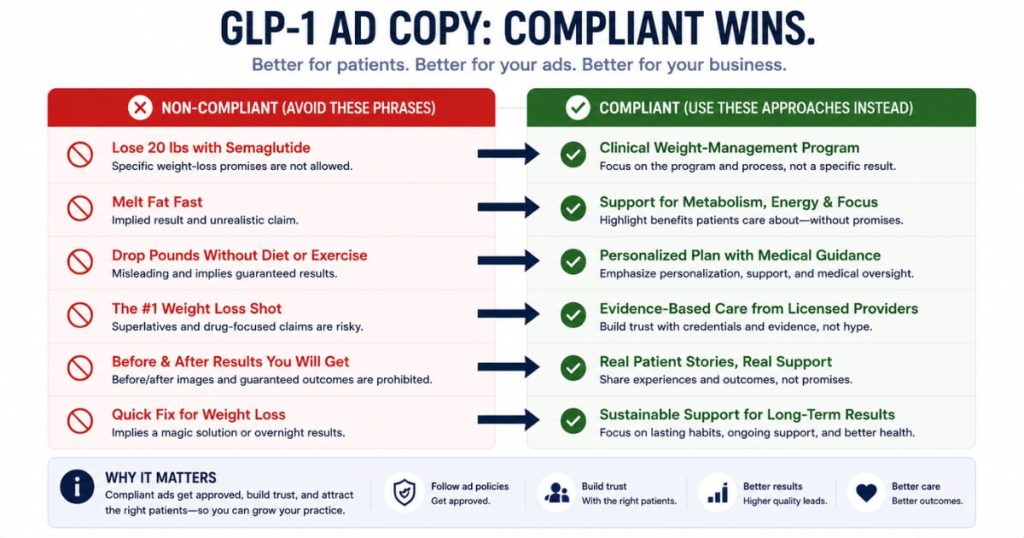
What does compliant GLP-1 ad copy actually look like?
Compliant copy describes support, not transformation.
It talks about a program, not a drug.
That single substitution — support for guarantee, program for molecule — is the difference between an ad that runs and an ad that gets pulled.
Instead of:
“Lose 20 pounds with semaglutide”
you write:
“A clinical weight-management program with lab testing and provider oversight.”
Instead of:
“Melt fat fast”
you write:
“Support for metabolism, energy, and focus.”
The winning scripts in this space lean on phrases like:
- “Lipotropic injections to support fat metabolism and energy”
- “Personalized lab testing”
- “Fast, expert-led care that works with your schedule”
Notice that every claim is framed as support and structure.
Never as a promised number.
That is not a compliance compromise.
It is what makes the offer feel clinical instead of gimmicky.
That is exactly why it converts a higher-quality lead.
Two rules carry most of the weight.
First, never use second-person language that assumes the reader’s weight.
Avoid:
- “Are you overweight?”
- “Tired of being heavy?”
Reframe the same emotional truth without the personal callout.
Use lines like:
“You’re the CEO of your family, but your energy’s on empty.”
Or:
“You’re not lazy — you’re just running on fumes.”
That lands the burnout and self-blame without violating the personal-attribute rule.
Second, anchor credibility in real proof you can substantiate.
For example:
“We’ve helped over 20,000 patients and earned 1,500 five-star reviews from women just like you.”
That is a volume-and-trust claim.
It is not a health-outcome promise.
So it passes review and still moves the lead.
The pattern is consistent:
- Support language
- Program framing
- No scale promises
- No you-are-overweight implication
What ad angles and hooks convert weight-loss leads while staying compliant?
The hooks that convert are emotional and identity-based, not body-based.
They sell the exhaustion of doing everything for everyone else, not the size of anyone’s jeans.
That reframe is what makes them both high-converting and policy-safe at the same time.
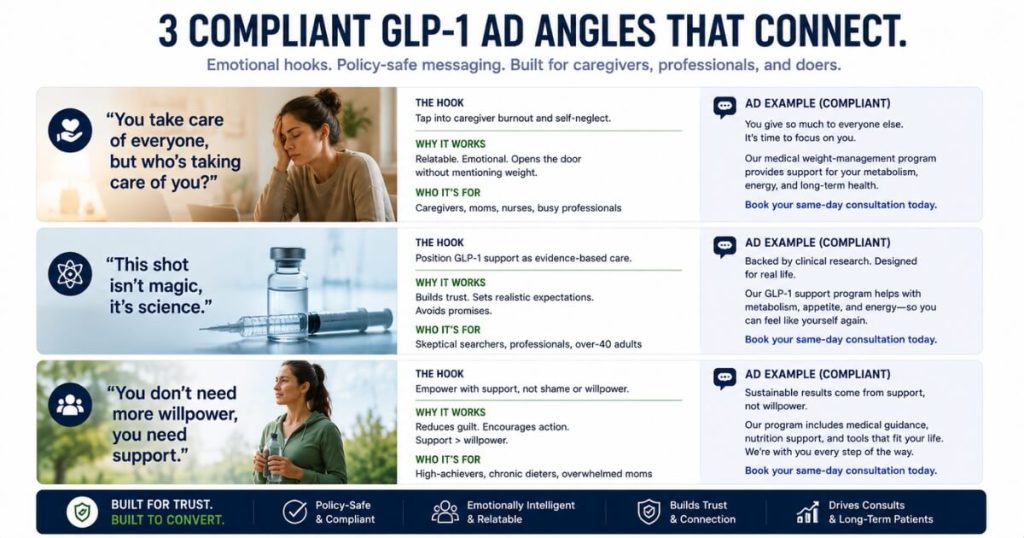
Three angles do the heavy lifting.
1. The caretaker-burnout angle
“You take care of everyone — but who’s taking care of you?”
It opens on a mom juggling drop-off, work emails, and dinner.
It sells a reset for her energy and mood.
2. The it’s-not-your-fault angle
“This shot isn’t magic — it’s science.”
It speaks to the woman who’s tracking every calorie and dragging herself to the gym, but still feeling stuck.
Then it reframes the problem as metabolism and lab-level answers rather than willpower.
3. The support-over-willpower angle
“You don’t need more willpower — you need support.”
It validates the patient who’s doing everything right.
Then it gives her a clinical reason it isn’t working.
Each of these can run as a quick voiceover ad or as a longer patient-story ad.
The story version is the one that scales.
A provider or a real patient narrating “a mom in her late 30s who used to feel sharp and energized, but lately she’s exhausted before noon” builds more trust than any claim.
It also self-selects the right audience without a single targeted health interest.
Close every angle on the same low-friction CTA the scripts use:
“Curious if this is what you’ve been missing? Schedule your same-day consultation today.”
You are selling the consult, not the drug.
That keeps the ad compliant and routes the lead straight into a conversation your team can close.
How do I target weight-loss patients without violating personal-health rules?
You target the lifestyle and life-stage of the buyer, never their health condition.
Meta removed weight-loss and health-related detailed targeting.
Google never allowed personal-hardship targeting in the first place.
You cannot target “overweight” or “interested in weight loss” as a health attribute anymore.
Trying to reconstruct those audiences through workarounds is how clinics walk themselves into a restriction.
Instead, target the demographic and behavior that correlates with your buyer:
- Busy women in a specific life stage
- Parents
- People who follow wellness, fitness, and nutrition creators
- Broad lookalike audiences built off your existing patient list and lead list
Lookalikes off your real buyers are the single most powerful and most compliant targeting tool you have.
The platform finds the pattern without you ever naming a health condition.
Then let the creative do the qualifying.
This is the part most clinics miss.
A story-led ad about a burned-out mom in her late 30s self-selects the right audience far more accurately than any banned health interest ever did.
The people who stop scrolling are the people who see themselves in the story.
They raise their hand by clicking.
You get tighter qualification, a lower cost per quality lead, and zero personal-health targeting exposure from the same asset.
The creative is your targeting layer.
The audience settings are just the delivery vehicle.
What’s the single biggest mistake clinics make with GLP-1 ads?
Leading with the drug name and a scale promise instead of the program and the patient story.
It feels like it should convert.
But it is the fastest path to a rejected ad, a restricted account, and eventually a permanent ban.
The instinct is understandable.
“Semaglutide, lose 20 pounds in 30 days” is concrete and aggressive.
Aggression usually wins in paid media.
But in this category, it loses twice.
It loses with the platform because it stacks:
- A prescription-drug callout
- A guaranteed outcome
- An implied body-image judgment
all into one headline.
And it loses with the lead.
The people who respond to a pure price-and-pounds promise are the lowest-quality, most price-shopping, hardest-to-close buyers you can attract.
The aggressive ad does not just risk the account.
It fills your calendar with leads that never convert at cash-pay margins.
The clinics that scale GLP-1 do the exact opposite.
The results are not subtle.
We helped NuLevel Wellness Medspa add $6.7M in revenue in one year and bring in 3,727 new patients across multi-channel paid ads by running this kind of compliant, story-led, program-framed creative.
Not by shouting the drug name.
- They lead with a relatable story.
- They frame the offer as a clinical program with consultation and lab testing.
- They use support language.
- They route every click to a same-day consult.
- They convert better and they never get flagged because the entire ad is built around the experience and the medical oversight rather than the compound.
FAQ’s About Writing Compliant GLP-1 Weight-Loss Ads
Can I run GLP-1 ads on Facebook and Google at all?
Yes — you can advertise a weight-loss or GLP-1 program on both Meta and Google.
But you cannot advertise it the way most clinics instinctively want to.
The platforms do not ban the category.
They ban the execution.
What gets accounts flagged is:
- Naming the drug as the headline product
- Promising a number on the scale
- Using before/after imagery
- Writing copy that implies the platform knows the viewer is overweight
Advertise the program, the consultation, the lab testing, and the medical oversight instead of the molecule.
Both platforms will run the ad.
The clinics that get shut down are almost always the ones treating a prescription medication like a direct-to-consumer supplement offer.
Advertise the care, not the compound, and you stay on the platform.
Why do before-and-after weight-loss photos get my ads banned?
Because Meta and Google both explicitly prohibit ads that depict an idealized body or imply a negative self-perception to sell a health outcome.
Before/after weight-loss imagery is the textbook example of both.
A side-by-side of a smaller body after treatment tells the viewer their current body is the problem.
That is exactly the personal-attribute and body-image rule the platforms enforce.
It is one of the fastest ways to get a weight-loss ad rejected.
It is also one of the fastest ways to get an ad account restricted if you keep doing it.
Replace the before/after with:
- A real patient telling a story about energy, focus, and feeling like themselves again
- Footage of the clinical experience
- The lab draw
- The provider consult
- The visit
Story and process convert as well or better.
They also keep the account alive.
What does compliant GLP-1 ad copy actually look like?
Compliant copy describes support, not transformation.
It talks about a program, not a drug.
Instead of:
“Lose 20 pounds with semaglutide”
you write:
“A clinical weight-management program with lab testing and provider oversight.”
Instead of:
“Melt fat fast”
you write:
“Support for metabolism, energy, and focus.”
Use the word support rather than guarantee.
Describe the experience and the medical structure rather than a promised result.
Never use second-person language that assumes the reader’s weight.
Avoid:
- “Are you overweight?”
- “Tired of being heavy?”
Reframe the same emotional truth without the personal callout:
“You do everything for everyone else, and your energy is on empty.”
That lands the burnout without violating policy.
The pattern is simple:
- Support language
- Program framing
- No scale promises
- No you-are-overweight implication
How do I target weight-loss patients without violating personal-health rules?
You target the lifestyle and life-stage of the buyer, never their health condition.
Meta removed weight-loss and health-related detailed targeting.
Google never allowed personal-hardship targeting in the first place.
You cannot target “overweight” or “interested in weight loss” as a health attribute anymore.
You should not try.
Instead, target the demographic and behavior that correlates:
- Busy women in a life stage
- Parents
- People who follow wellness and fitness creators
- Broad lookalikes built off your existing patient list
Let the creative do the qualifying.
A story-led ad about a burned-out mom in her late 30s self-selects the right audience far more accurately than any banned health interest ever did.
It does that without putting the ad account at risk.
What’s the single biggest mistake clinics make with GLP-1 ads?
Leading with the drug name and a scale promise instead of the program and the patient story.
The instinct is to shout “semaglutide” and “lose 20 pounds in 30 days” because it feels like it will convert.
But that headline is the fastest path to:
- A rejected ad
- A restricted account
- Eventually a permanent ban
It also attracts the lowest-quality, most price-shopping lead even when it does run.
The clinics that scale GLP-1 do the opposite.
- They lead with a relatable story.
- They frame the offer as a clinical program with consultation and labs.
- They use support language.
- They route to a same-day consult.
- They convert better and they never get flagged because the entire ad is built around the experience and the medical oversight rather than the compound.