
What Does the GLP-1 Patient Journey Look Like at a Cash-Pay Medical Practice?
A GLP-1 patient who arrives for weight loss alone is worth one number. A GLP-1 patient routed through a four-stage journey that ends in a TRT or HRT cross-sell is worth 4–5×. Here’s the Real ADvice playbook for the four milestones — initial sale, 90-day, 6-month, 9-month — that turn semaglutide into a lifetime-value gateway.
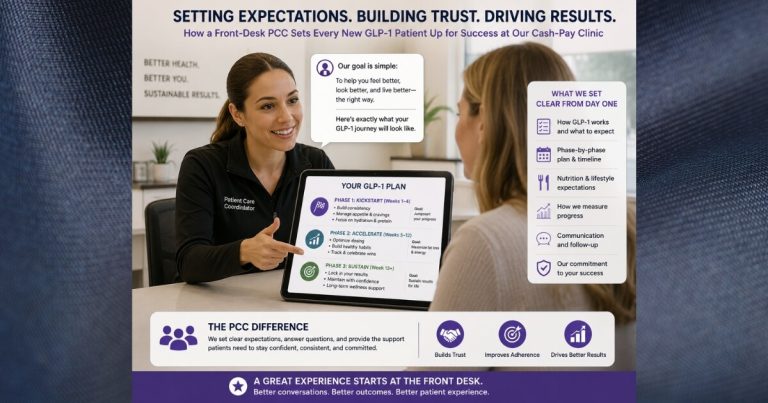
What does the typical GLP-1 / weight loss patient journey look like at a cash-pay clinic?
A four-stage journey, anchored to specific dates from enrollment.
Stage 1 — Initial Sale
The patient signs up, gets onboarded, and starts dosing.
Stage 2 — 90-Day Mark
First meaningful weight loss and the first chance to recommit.
Stage 3 — 6-Month Milestone
The patient typically hits their first weight-loss target and the question of “what’s next” gets real.
Stage 4 — 9-Month Mark
The cross-sell window into TRT, HRT, or a maintenance program that extends the patient relationship past the weight-loss arc.
Most clinics treat GLP-1 as a transaction.
The ones generating real LTV treat it as a four-stage onboarding into a longer relationship.
What expectations should I set with a GLP-1 patient before they enroll?
The expectations you set at sale are everything.
The single biggest predictor of GLP-1 retention is whether the patient understood the timeline, the side-effect profile, and the cost trajectory before they swiped their card.
Patients who feel ambushed at week three by a side effect they weren’t told about cancel.
Patients who heard:
“You’ll likely feel queasy on day one, that’s normal, here’s how we handle it”
…stay.
Three expectations to set explicitly:
1. Weight-loss timeline
4–8 lb in month one is normal, not a slow start.
2. The dosing escalation schedule
And what each step typically feels like.
3. The long game
This is a 12-month relationship at minimum, ideally a multi-year relationship via TRT or HRT after the weight-loss phase.
What happens at the GLP-1 initial sale / sign-up?
Four things have to happen on day one.
1. Payment processed and program enrolled in the CRM
2. Intake forms completed
Built in GoHighLevel or the equivalent, not on paper.
3. Welcome video from the patient care coordinator
Explaining week one:
- First dose timing
- What to eat
- What to text if symptoms hit
4. The next two appointments scheduled before the patient leaves the consult room
- The 30-day check
- The 90-day milestone
The clinics that win at GLP-1 don’t sell a vial.
They enroll a relationship.
The initial sale loads the CRM with every touchpoint that follows.
What does the 90-day mark look like in a GLP-1 patient journey?
The 90-day milestone is where the clinic re-earns the next 9 months of the relationship.
The patient comes in for:
- A body composition recheck
- A brief provider visit
- A structured progress conversation built off the goals they wrote at intake
Compliance, dose tolerance, and emerging side-effect patterns get reviewed.
Two operational moves matter most.
1. Reflect the patient’s intake language back to them
Not generic platitudes.
2. Schedule the next appointments before they leave
The patient leaves with:
- The month 6 milestone booked
- A 30-day micro check-in scheduled
The patient who leaves with nothing scheduled is the patient who churns at month four.
What does the 6-month mark look like in a GLP-1 patient journey?
By month six, the average GLP-1 patient has lost 15–20% of body weight and is approaching the question of “what now?”
The clinic uses this milestone to:
- Recap results
- Reset the next 90 days of dosing
- Pre-frame the 9-month cross-sell
Inside NuLevel Wellness Medspa, where Real ADvice added $6.7M in revenue in 1 year and 3,727 new patients, the 6-month milestone is the bridge that converts GLP-1-only patients into multi-service patients.
The clinic shows the patient what hormone optimization could do for the energy, sleep, and libido improvements they’re already starting to notice.
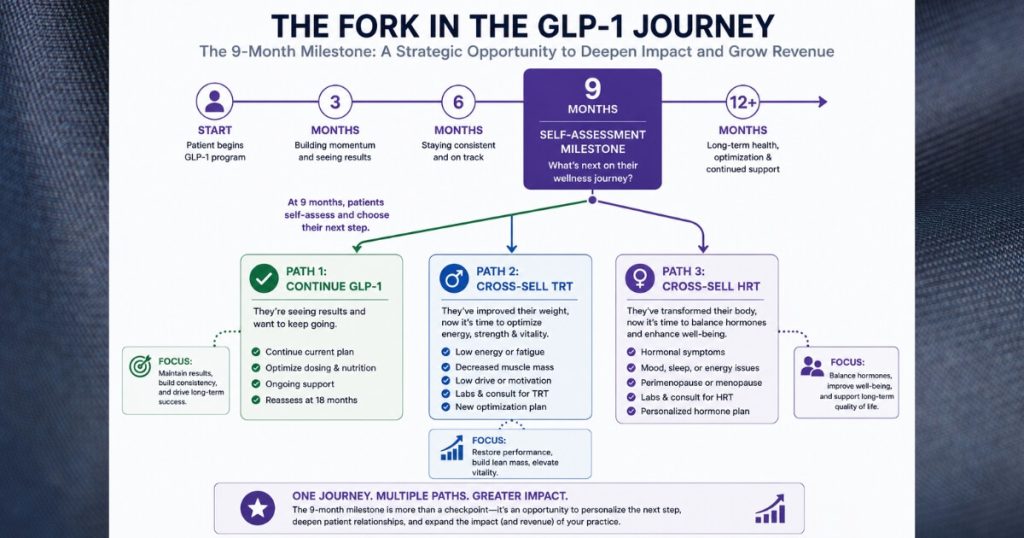
What does the 9-month mark look like, and when do I cross-sell to TRT or HRT?
Month 9 is the cross-sell window.
By this point the patient has experienced enough transformation to be open to “what’s the next level” — and the clinic has earned enough trust to recommend something beyond the initial weight-loss arc.
The cross-sell isn’t a pitch.
It’s a self-assessment.
The 9-month self-assessment asks the patient to rate:
- Energy
- Sleep
- Mood
- Libido
- Recovery
…on a 1–10 scale, then maps low scores to TRT (for men) or HRT (for women) as the logical next step.
The conversion math is brutal in your favor:
- GLP-1 patients have already proven they’re willing to pay cash for self-improvement
- They’re already in the CRM
- They’re already showing up
A TRT or HRT cross-sell at month 9 typically converts at 35–50% — versus 10–15% on cold acquisition.
That cross-sell is the difference between a $4,000 GLP-1 LTV and a $15,000–$25,000 multi-program LTV.
Inside an HRT clinic Real ADvice grew from $1M to $4M with 250 active members paying $1,000/month, the patient base is heavily fed by exactly this kind of cross-sell, not by cold HRT acquisition.
Do I need a CRM to run a GLP-1 patient journey at scale?
Yes — and it’s non-negotiable.
The four-stage journey is impossible to run reliably without a CRM that:
- Owns the patient timeline
- Schedules automated touches off enrollment date
- Surfaces missed milestones to the patient care coordinator
GoHighLevel is the most common stack at the cash-pay GLP-1 clinics Real ADvice works with, but the principle holds across any CRM with appointment and SMS automation.
Without a CRM, the journey collapses back into:
“We sold them a vial.”
With one, you build a compound LTV machine.
- Intake forms in the CRM
- Automated 30/60/90 touches in the CRM
- Cross-sell self-assessment in the CRM
Everything anchored to enrollment date.
If you want Real ADvice to install the four-stage GLP-1 journey, build the CRM automations, and walk you through the 9-month cross-sell self-assessment,