
How Should a Functional Medicine Clinic Present Its Program and Price to Enroll a New Patient? (The Baseline-Labs Consult Script)
Functional medicine patients don’t object to the price — they object to a price with no plan attached. The clinics that enroll members consistently never lead with the number. They run discovery, explain why a real plan starts with a real baseline, present the program as three clear steps, and only then talk money. Here’s the FAQ on the baseline-labs consult script that turns a stuck, frustrated inquiry into an enrolled functional medicine member.
How Should a Functional Medicine Clinic Present Its Program and Price to Enroll a New Patient?
Structure the close as a three-step program — comprehensive baseline labs, a consult to review results, and a personalized membership — and present the price only after the patient can see the plan.
Run discovery first to surface the patient’s goals and what they’ve already tried, then explain that you always start with a baseline because a real plan requires real data.
Walk through the three steps:
- Comprehensive baseline labs
- A consult to review results
- A personalized membership
Then quote the investment.
When the patient understands they’re buying a roadmap to their goal rather than a single visit, the membership investment feels proportionate instead of shocking.
The order is the whole game: program first, price second.
What Discovery Questions Come Before the Price in a Functional Medicine Consult?
Ask:
- How they heard about you
- What they’re trying to accomplish
- How long they’ve felt this way
- What they’ve tried that did and didn’t work
Let the patient talk — they’ll tell you exactly what’s bothering them and what they’ve already failed at.
A useful technique when they ramble is:
“Hold on, you mentioned something there I want to ask you about…”
This lets you steer without interrupting.
Then offer three reasons people typically book:
- You’ve tried everything you know how to and you’re stuck.
- You just want to get there faster.
- You want a personalized plan instead of wasting time and money figuring it out alone.
Then ask:
“Which sounds most like you?”
Once they admit they lack a clear plan, you’ve earned the right to present one.
This consultative approach is what drives results like a longevity and functional medicine clinic where we increased website leads by 900% and added 100+ inbound calls a month.
How Do I Explain the Baseline-Labs Step So the Price Feels Worth It?
Describe the depth of what you measure, not just the cost.
Say it like this:
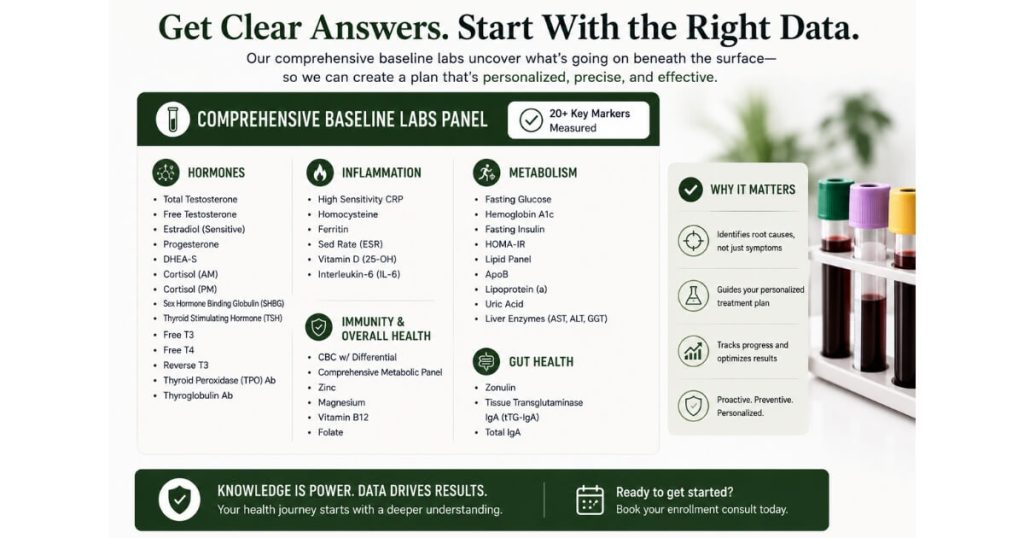
“The most important thing we can do is get a baseline of where we’re starting, so we can build a step-by-step personalized plan. Step one is comprehensive bloodwork — we measure hormones, testosterone, estrogen, inflammation markers, organ function, metabolism, immune markers, and insulin. It ends up being more than 20 panels and nine to ten pages of results.”
When the patient understands the labs are the foundation the entire program stands on — not a fee, but the data that makes the plan possible — an investment around $550 reads as serious medicine.
You can add the convenience lever too:
- A mobile phlebotomist who comes to their home
- No waiting in a lab line
How Do I Present the Membership Price?
Anchor it to outcomes and the patient’s panels, not to a flat sticker.
Explain that step three is a personalized membership program the patient reviews with the doctor and chooses together, and that members generally invest between $300 and $1,000 per month depending on:
- What their panels show
- What’s needed to reach their goal
The range matters:
- It signals that the plan is tailored, not one-size-fits-all.
- It lets the patient self-select into the level of care they want.
Because the membership is recurring, this is also where the real business is — the lifetime value of an enrolled functional medicine member dwarfs the first transaction, which is why the enrollment script is worth perfecting.
How Do I Handle “How Much Does It Cost?” and the Insurance Question?
Give the number plainly once the program is clear, and be honest about insurance.
“The investment for the bloodwork is $550, and if you’re local we can send a mobile phlebotomist to your home. The consultation itself is $300. So the total to get started today is $850, and once we collect a little information we’ll send your lab requisition.”
Then handle insurance head-on:
- Functional medicine generally isn’t covered.
- You can provide a superbill for possible reimbursement.
- You accept HSA.
- You accept FSA.
- You offer a financing option.
Don’t hide from the insurance question — answering it directly is what separates a trustworthy cash-pay practice from one that feels evasive, and trust is what closes the patient.
How Do I Move From the Script to a Booked, Paid Baseline?
Ask a simple closing question, then collect the information that starts care.
“Do you have any questions for me, or are you ready to schedule your bloodwork?”
If yes, move straight to collection:
- Name
- Phone
- State
- Date of birth
- Who referred them
- Mobile provider for reminders
- The card to secure the appointment
The momentum you built by presenting the program before the price carries the patient through the close — they’re not deciding whether to spend money, they’re starting a plan they already agreed they needed.
That conversion discipline is the same engine behind a clinic that converts 79.4% of its leads into booked appointments.
FAQs About Functional Medicine Enrollment
Should the Consult Be Free or Paid?
The discovery conversation is free; the baseline labs and the doctor’s review are paid. Charging for the labs and consult — not the initial call — filters for committed patients while keeping the first step low-friction.
Why Present the Program Before the Price?
Because a price with no plan attached always sounds expensive. Once the patient sees the three-step roadmap and understands the 20-plus-panel baseline, the same number reads as the cost of a serious plan rather than a fee for a visit.
What if the Patient Says It’s Too Expensive?
Return to the cost of staying stuck and the value of finally having a data-backed plan, then offer the financing, HSA/FSA, and superbill options. Often “too expensive” really means “I don’t yet see the plan,” so re-walk the three steps.
How Is This Different From an Outbound Call to a Web Lead?
The outbound call’s job is to re-engage and book; this enrollment script’s job is to present the program and price and close the baseline. They share discovery questions but diverge at the goal — re-engagement versus enrollment.
What’s the Next Step?
If functional medicine prospects keep saying they’ll “think about it,” the problem is almost never the price — it’s that the price arrived before the plan. Present the three-step program, frame the baseline, then quote the number.
On a free strategy call we’ll refine your enrollment script, your baseline-labs framing, and your membership pricing presentation so more consults end in a booked, paid baseline.