
How Should a Functional Medicine Clinic Price Its Program? (The Tiered Architecture That Replaced All-Inclusive Packages)
Functional medicine has a pricing problem that surgery and aesthetics don’t: you can’t predict a chronic patient’s true cost on day one. You discover problems mid-journey, and if you sold an all-inclusive package, you now have to go back and ask for more money — which is exactly how trust dies. The clinics that solved it stopped selling one big package and built a tiered architecture that separates the predictable from the unpredictable. Here’s how the model works.
How should a functional medicine clinic price its program?
Build a tiered ladder — typically four tiers running from about $349 to $1,200 a month — where only your top treatment tiers are shown to new patients and the lower tiers serve as step-down maintenance plans.
A clean version looks like this:
- new patients are presented the two higher treatment tiers
- the lowest tier (around $349/month, buying provider access plus annual labs) is where patients step down after they graduate from active treatment, becoming a recurring “functional concierge” base
- the second tier (around $549/month) adds hormone pellets and peptides — framed as “just $200 a month more” off the lower anchor
- the very top tier is built largely as a price anchor: its job is to make the middle tiers feel reasonable, not necessarily to sell in volume
The ladder does two things at once.
First, it gives every patient a place to land for the long term.
Second, it uses anchoring so the tier you most want patients to choose looks like the sensible middle.
This is the kind of pricing architecture that turns a functional medicine clinic into a durable recurring business rather than a series of one-off programs — the foundation of effective medical practice marketing in this vertical.
Why do all-inclusive functional medicine packages fail, and what should I do instead?
They fail because you can’t predict a chronic patient’s true cost upfront.
You uncover new problems mid-journey, then have to ask for more money, which destroys trust.
The fix is to separate the predictable from the unpredictable.
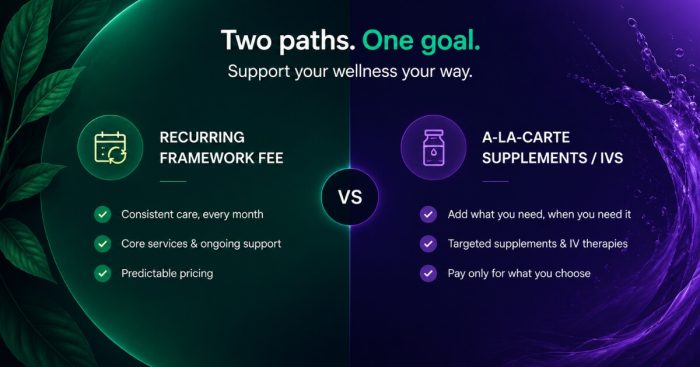
Charge a recurring program fee that covers the framework every patient needs:
- visits
- lifestyle and diet coaching
- ongoing access
Bill the unpredictable parts separately:
- supplements
- IVs
- additional modalities
Never bake them into the package.
This protects your margin on the items whose cost you can’t forecast.
It also protects the patient relationship from the blindside moment where someone who already paid a large package price is told they owe more.
That blindside is not hypothetical.
One functional medicine physician redesigned her entire model after watching cancer-survivor patients pour their life savings into a $7,500 all-inclusive package expecting to be saved.
Then treatment uncovered more that the package didn’t cover.
The patients felt betrayed.
The recurring-fee-plus-a-la-carte structure exists specifically to prevent that.
What should I charge for a functional medicine new-patient entry offer?
Bundle your diagnostics into a single front-end offer and anchor it against its true standalone value before you reveal the price — for example a complete intake (full labs, saliva test, live blood analysis, and a 60-minute consult) priced around $899 and purchased before the patient ever meets the doctor.
The structural win is collapsing the old multi-visit intake:
- schedule
- do labs
- come back for a separate “review of findings”
- then get pitched
into one paid product.
That shortens the sales cycle.
It frees up booking slots.
It gets patients into treatment faster.
The pricing-presentation win is the anchor:
- state what the components are genuinely worth on their own
- then reveal the $899
so the offer reads as a clear deal rather than a cold ask.
After that initial visit, the provider reviews results and invites the patient into the appropriate tier — softly, as a fit, not a hard sell.
The discovery of what the patient wants and has tried stays intact.
Only the offer presentation changes.
How long should functional medicine appointments be — new patient versus follow-up?
Give new patients a full 60-minute initial visit, but cap follow-ups at 30 minutes.
Hour-long follow-ups feel generous but are often counterproductive.
An overwhelmed chronic patient retains only a fraction — roughly 10% — of what’s covered in a long session.
The extra time produces diminishing returns.
The extra time clogs the schedule.
Thirty focused minutes, paired with in-clinic modalities and a clear plan, drives results without burning out the patient or the provider.
The initial 60 minutes earns its length because that’s where you:
- connect the dots
- set the relationship
- build the plan
Everything after that should be tighter.
Right-sizing visit length is a quiet lever on both clinical outcomes and scheduling capacity.

Should I call it a membership or a program?
Call it a “program,” not a “membership” — “membership” reads like an expensive gym and implies everything is included, which sets the wrong expectation the moment supplements and IVs are billed separately.
Words carry pricing expectations.
“Program” signals a personalized framework the patient is being guided through.
“Membership” signals all-you-can-eat.
Since your model deliberately bills the unpredictable parts separately, the language has to match the structure or you recreate the same betrayal problem the tiers were built to solve.
Reserve premium-feeling language like “Unlimited VIP access” for the access perk specifically.
Avoid “concierge,” which wrongly implies 24/7 availability you may not provide.
These look like cosmetic word choices.
They’re not.
They’re the labels that set the patient’s expectations before the first bill, which is exactly when expectation mismatches turn into refund requests.
How do I keep functional medicine visits on time without making patients feel rushed?
Set the time expectation verbally up front and open each visit by setting an agenda, rather than writing a hard time limit onto your materials.
Have the front team frame the appointment window when they schedule.
Then have the provider open the visit with something like:
“We have a full hour together today — that’s unusual — here’s what I’d love to accomplish.”
Framing the time as a generous gift makes patients listen more closely and keeps the schedule intact, without anyone feeling clock-watched.
It’s the difference between:
- a patient who feels rushed
- a patient who feels prioritized
using the exact same number of minutes.
The principle underneath all of it — tiers, entry offer, visit length, language — is that a functional medicine practice scales on structure, not heroics.
The most successful functional medicine & longevity clinic marketing mirrors that same structure by aligning patient education, provider authority, and program positioning into a consistent journey from first visit through long-term care.
Price the framework.
Bill the rest separately.
Set expectations before the patient ever sees a charge.
FAQ’s About Functional Medicine Program Pricing
How should a functional medicine clinic structure its pricing tiers?
Use a ladder of roughly four tiers from about $349 to $1,200 a month, showing new patients the top treatment tiers and using the lowest tiers as step-down maintenance plans.
The highest tier functions mainly as a price anchor that makes the middle tiers feel reasonable.
Why do all-inclusive functional medicine packages fail?
Because you can’t predict a chronic patient’s true cost upfront — you uncover more problems mid-journey, then have to ask for more money, which breaks trust.
The fix is to charge a recurring program fee for the predictable framework and bill supplements, IVs, and extra modalities separately.
What should a functional medicine new-patient offer cost?
Bundle diagnostics — full labs, saliva test, live blood analysis, and a 60-minute consult — into one front-end offer priced around $899, purchased before the patient meets the doctor.
Anchor it against the components’ true standalone value before revealing the price so it reads as a deal.
How long should functional medicine appointments be?
Give new patients a full 60 minutes and cap follow-ups at 30.
Overwhelmed chronic patients retain only about 10% of a long session, so focused 30-minute follow-ups plus in-clinic modalities drive better results without clogging the schedule.
Should I call it a membership or a program?
Call it a “program.”
“Membership” reads like a gym and implies everything is included, which clashes with billing supplements and IVs separately.
Reserve “Unlimited VIP access” for the access perk and avoid “concierge,” which wrongly implies 24/7 availability.
What’s the next step?
If your functional medicine clinic sells one big all-inclusive package and you keep running into the awkward mid-journey conversation where you have to ask a patient for more money, the structure is the problem — not your care.
A tiered ladder, a bundled entry offer, separate billing for the unpredictable parts, and language that sets the right expectation will fix the trust leak and make the practice scalable.
If you want help designing your tiers, your entry offer, and your new-patient flow, that’s the conversation to book.
It’s the same growth work behind clinics like VYVE Wellness, where we increased website leads by 900% and added 100+ inbound calls per month in just 4 months.
We’ll map your program architecture on the call — the backbone of durable medical practice marketing.