
Should I Hire a Front-End Setter at My Cash-Pay Clinic? (The Fix for a 50% Discovery-Call No-Show Rate)
On a June performance call with a cash-pay clinic we consult, one number dominated the hour: discovery-call attendance had slid from a 69% show rate in May to 58% — and one recent week ran at 50% canceled or no-showed. Twenty-three calls on the calendar, half of them gone. Our diagnosis: the reminders were working perfectly and being completely ignored. The prescription was a dedicated front-end setter. Here’s the FAQ on the role, the comp plan, and the recovery playbook — including the one hire that took a California clinic from $30K to $220K a month.
Why are patients no-showing my discovery calls even though I send automated reminders?
Automation blindness.
Patients have learned to ignore automated texts and emails, even the ones with reschedule links they genuinely need.
The clinic in this story had a flawless reminder sequence.
However, the results told a different story:
- 15 discovery calls marked as no-shows or canceled in just 15 days
- One tracked no-show lead with a pre-call prep video watch percentage of exactly zero
The automations fired.
Nobody read them.
That’s the modern baseline.
Patients receive dozens of automated messages every day from dentists, pharmacies, airlines, and countless other businesses.
Eventually, their brains filter yours into the same category.
As a result, two important conclusions follow.
First, assume new leads won’t read or watch anything until they’ve paid you money.
This is especially true for Google Ads leads.
They searched for a problem, found your clinic, booked the appointment, and mentally checked out.
Second, another automation won’t fix a declining show rate.
Instead, you need a human voice delivering a message that clearly feels different from a robot.
That’s exactly what a front-end setter is hired to do.
What is a front-end setter, and does my clinic need one?
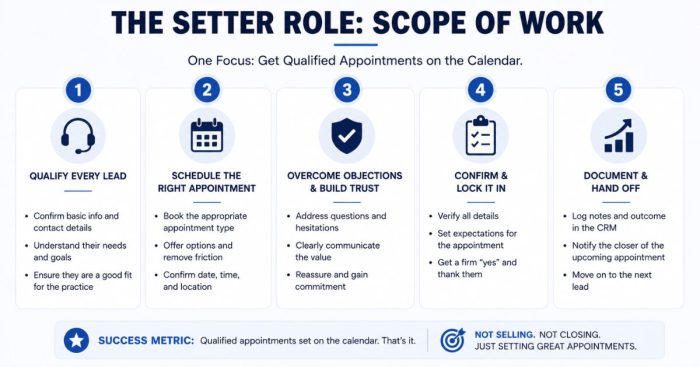
A front-end setter is a full-time employee whose entire job is filling and protecting your discovery-call calendar.
If your consults flow through one closer, you almost certainly need one.
The role is intentionally narrow.
As we outlined during the performance call, the setter should:
- Book new leads onto the calendar
- Reactivate old leads sitting in the CRM
- Call seminar and event registrants
- Chase every canceled or rescheduled appointment
- Keep discovery-call attendance above 90%
Nothing else belongs on their plate.
They shouldn’t answer insurance questions.
They shouldn’t manage checkout.
They shouldn’t perform clinical routing.
One person owns one number.
Why keep the role so focused?
Because in most cash-pay clinics, the front of the funnel depends on one closer—or even the owner.
Every hour that person spends chasing no-shows is another hour they aren’t closing new patients.
Now imagine the discovery-call calendar staying full every week.
Once you solve that single problem, everything downstream becomes easier:
- More consultations
- More enrollments
- More predictable revenue
During the call, we told the owner something simple:
If you did nothing else besides making this hire, your business would grow.
The setter also creates your patient’s first impression.
A clinic charging $8,000 for a treatment program should sound like the Four Seasons on the first phone call.
It shouldn’t sound like a voicemail box.
That’s the foundation of a working patient acquisition system.
Someone owns the calendar.
How much should I pay a setter — and how should the comp be structured?
Pay a salary.
Don’t pay hourly.
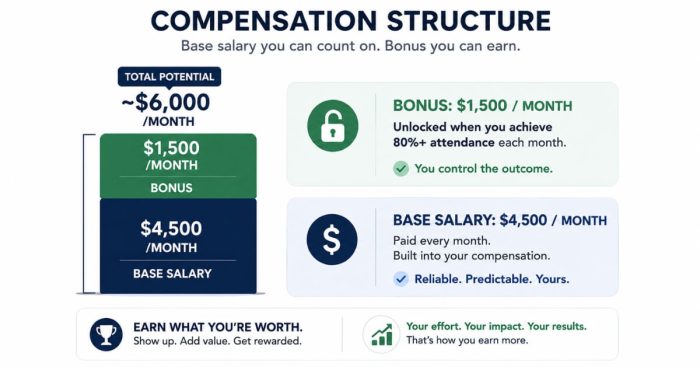
A strong compensation package looks like:
- Approximately $4,500 per month as a base salary
- Performance bonuses tied to attendance
- Around $6,000 total monthly compensation
- Roughly $75,000 annually for an A-player
The structure matters just as much as the dollar amount.
A salaried setter doesn’t stop working at 5:30.
They answer the 7:00 p.m. text that saves tomorrow’s consultation.
By contrast, an hourly employee is already off the clock.
Start with a base that equals roughly $28 per hour.
Then tie bonuses directly to the number the role exists to improve:
- Discovery-call attendance above 80% unlocks bonuses.
- Attendance above 90% becomes the standard.
At roughly $75,000 annually, you begin attracting true A-players instead of simply filling a seat.
For comparison, front-desk staff at this same clinic typically earn about $23 per hour.
That additional investment buys someone who owns a number—not another employee who simply completes tasks.
If the salary makes you hesitate, consider the story we shared during the call.
A California clinic called HealMD generated about $30,000 per month.
The physician was carrying the entire business personally.
Then they hired a front-end superstar named Shelby.
She earned about $30 per hour plus bonuses.
She required virtually no training.
Instead, she took complete ownership of the front end.
Eventually, the practice grew to approximately $220,000 per month.
Today, Shelby manages additional staff.
That single hire helped create nearly seven times the monthly revenue.
How do I recover the no-shows already sitting in my CRM?
Pick up the phone.
Then make every written follow-up feel personal by referencing the patient’s actual complaint.
Start with the most recent no-shows.
In this clinic’s case, there were 15 cancellations and no-shows in only 15 days.
Recovering even two or three of those appointments makes the outreach worthwhile.
Automated reschedule links already failed these patients.
Therefore, an outbound phone call becomes the one communication channel they haven’t completely tuned out.
Going forward, aim for verbal confirmation.
Call every new booking as soon as it comes in.
Then continue reaching out until you’ve confirmed the appointment by voice.
Busy dental practices have done this for years.
They call a week before the appointment.
Then they call again a couple of days before.
They keep calling until they reach someone.
Text messages also need to break the automation pattern.
We tested this ourselves.
Year-old dead leads had ignored automated campaigns for months.
However, one short message sent from a personal iPhone immediately generated responses:
“Hey, is this SJ? This is Anton with Real ADvice. You spoke with us a year ago. Are you still looking for a solution, or have you found one already?”
The same principle works for clinic leads.
Instead of sending another generic reminder, personalize the message.
For example:
“I saw you were experiencing fatigue and inflammation and were interested in our weight-loss program. Are you still looking for a solution, or have you already found one?”
Keep it:
- Personal
- Specific to their complaint
- Limited to one simple question
That’s the type of message that survives automation blindness.
Should I require a credit card to hold discovery-call slots?
Only after your calendar is consistently full.
Until then, the extra friction costs you more bookings than the no-shows themselves.
A credit-card hold is a rationing tool.
It works when demand exceeds supply.
Every flaky booking then takes a slot away from someone serious.
However, if you only have five discovery calls booked into twenty available appointments, requiring a credit card simply creates another reason for hesitant prospects not to schedule.
Instead, fix the problems in the proper order:
- Human confirmation calls
- Personalized follow-up
- Hire a front-end setter
- Introduce a credit-card hold only after the calendar stays full
Many owners try to solve attendance problems with policies.
However, policies filter.
People convert.
A premium functional medicine & longevity clinic builds relationships through trust—not paperwork.
Won’t AI and automation replace the setter role anyway?
Quite the opposite.
As more clinics move toward faceless automation, a genuinely human front end becomes a premium differentiator.
Automate the plumbing.
For example:
- Appointment reminders
- CRM pipeline stages
- Tracking
- Review requests
However, don’t automate human connection.
Clinics selling $8,000 treatment programs increasingly discover that patients prefer speaking with real people.
That preference becomes even stronger as AI-generated experiences become more common.
Think of it like Ferrari or Louis Vuitton.
People willingly pay premium prices for human service because it’s becoming increasingly rare.
A front-end setter isn’t a cost center waiting to disappear.
Instead, they’re the reason a premium patient’s first experience matches the premium price they’re about to pay.
A regenerative practice we work with converts 79.4% of leads into booked appointments using exactly this model.
Humans own the conversations.
Software handles the record-keeping.
FAQ’s About Hiring a Front-End Setter
What does a front-end setter do at a cash-pay clinic?
Their entire responsibility is protecting the discovery-call calendar.
That includes:
- Booking new leads
- Reactivating old CRM leads
- Calling seminar attendees
- Following up on reschedules
- Maintaining discovery-call attendance above 90%
Nothing else competes for their attention.
What show rate should a cash-pay clinic expect on discovery calls?
Most well-run clinics achieve:
- Around 70% or higher without a dedicated setter
- More than 90% with one
If your attendance has fallen to 58%—or worse—treat it as an emergency.
Every ten no-shows represent a significant amount of lost closer capacity.
How much does a clinic appointment setter cost?
Expect total compensation around:
- $4,500 monthly base salary
- Bonuses tied to attendance
- Approximately $6,000 per month total
- Around $75,000 annually
Pay a salary rather than hourly.
That structure encourages evening confirmations and ownership of the calendar.
It also attracts much stronger candidates.
Why don’t automated appointment reminders work anymore?
Patients experience automation blindness.
They routinely ignore messages that look automated, including reschedule links they genuinely need.
Instead, focus on:
- Outbound phone calls until you receive verbal confirmation
- Personal-looking text messages
- Messages referencing the patient’s specific complaint
- One clear question instead of a long reminder sequence
What’s the next step?
If your discovery-call calendar depends on automations nobody reads—and a closer who’s also responsible for chasing appointments—it’s time to change the system.
Book a strategy call.
In 60 minutes, we’ll:
- Audit your true discovery-call show rate
- Script recovery outreach for the no-shows already sitting in your CRM
- Build a setter scorecard
- Design the right compensation plan for your clinic