
Should a Regenerative Medicine Clinic Offer a Free or Paid Consultation?
The single biggest lever on who walks into a regenerative or pain practice isn’t the ad — it’s the consultation offer. Free or paid, evaluation or assessment, imaging-included or not: that decision filters the patients you attract before they ever meet your team. Get it wrong and you fill the schedule with tire-kickers or scare off serious patients. This is the FAQ on how a high-ticket regenerative or pain clinic should structure its consult offer to attract patients who actually pay.
Should a regenerative medicine clinic offer a free or paid consultation?
It depends on the traffic source, but the higher-ticket and more search-driven your patients are, the more a paid or value-anchored evaluation works in your favor.
A free consult maximizes volume.
A paid evaluation maximizes intent.
A free consultation lowers the barrier to booking, which means more people book.
That includes a lot who are price-shopping, curious, or hoping you’ll tell them insurance covers it.
A paid consultation or paid evaluation raises the barrier.
That thins the volume but concentrates it.
A patient who pays $100–$300 for a candidacy evaluation has already decided they’re serious.
For a high-ticket regenerative practice where the real money is in the treatment, not the consult, the question isn’t “how do I book the most consults.”
It’s “how do I book the most consults that turn into treatment.”
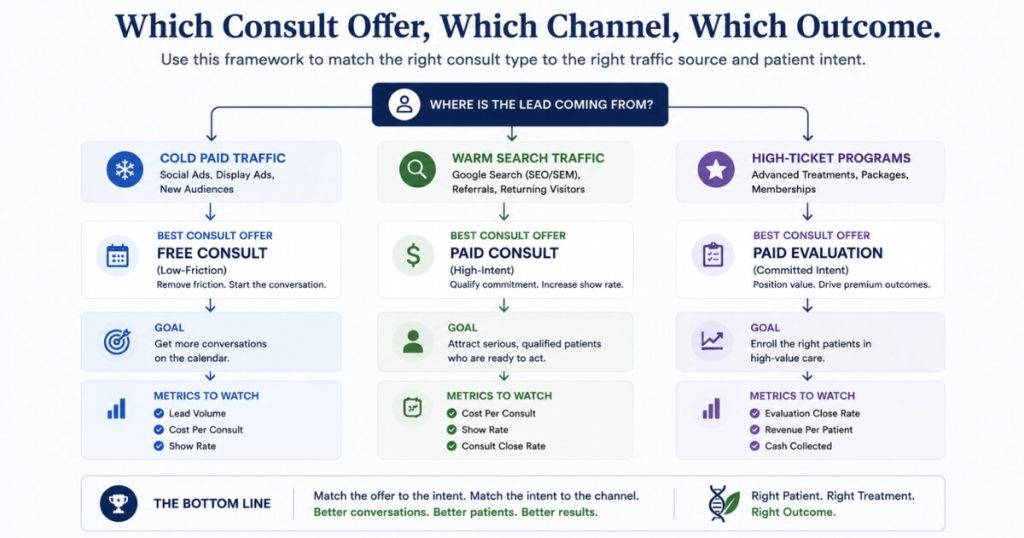
The clinics that get this right match the consult offer to the temperature of the traffic.
Cold paid-social traffic usually needs a lower-friction offer to convert at all.
Warm search traffic — patients already looking for regenerative knee treatment — will happily pay for a real evaluation because they’re further along in the decision.
A strong patient acquisition system uses the consult offer as a filter, not just a door.
Does a free consultation attract the wrong regenerative patients?
It can, if the free consult isn’t framed as a candidacy evaluation.
“Free consultation” attracts price-shoppers.
“Free candidacy evaluation to see if you qualify for regenerative treatment” attracts patients who want to solve their problem.
The word “free” isn’t the problem.
The framing is.
A free consult positioned as a sales meeting invites people who feel no commitment and no urgency.
The same offer positioned as a clinical evaluation — where the patient finds out whether they’re a candidate, what’s actually wrong, and whether regenerative treatment can help — attracts people who are trying to make a decision, not browse.
The cost of entry being zero is fine as long as the perceived value and seriousness are high.
If your free consults are full of no-shows and tire-kickers, the fix is usually framing and qualification, not switching to paid.
Add a short intake or candidacy question to the booking.
Frame the visit as an evaluation.
Confirm the appointment hard.
That alone can turn a free offer from a time-sink into a strong front door.
When does charging for a regenerative consultation make sense?
When your traffic is warm and search-driven.
When you offer a real diagnostic value on the visit.
When you want to protect provider time for serious patients only.
A paid evaluation works beautifully for search traffic because those patients already know what regenerative treatment is and are choosing where to get it.
Paying for a thorough evaluation signals quality, not a barrier.
It also makes sense when the consult itself delivers value the patient couldn’t get for free elsewhere.
A focused exam.
A review of prior imaging.
An honest candidacy determination.
And it protects your physician’s calendar, which matters most when the doctor is the bottleneck.
The clean move many clinics make is to credit the consult fee toward treatment if the patient enrolls.
The patient pays $200 to be evaluated.
If they move forward, the $200 comes off the treatment cost.
They self-select as serious.
You protect provider time.
The fee evaporates for the patients who actually convert, which is exactly the group you wanted.
How do I structure a regenerative consult offer that filters for serious patients?
Frame it as a candidacy evaluation.
Add a qualifying step to the booking.
Anchor the value of the visit.
Confirm the appointment aggressively.
Whether it’s free or paid matters less than these four moves.
Frame: the visit is an evaluation to determine if the patient is a candidate, not a sales pitch.
Qualify: a short intake or one screening question on the booking page filters out people who clearly aren’t candidates.
Anchor: tell the patient what they’ll get — exam, imaging review, candidacy answer, treatment plan — so the visit feels valuable.
Confirm: a confirmation call and reminder sequence between booking and appointment is what turns a booked consult into a kept one.
Do these four and a free consult performs like a paid one.
Skip them and even a paid consult fills with no-shows.
The offer structure is the filter.
The price is just one dial on it.
Will a paid consultation hurt my regenerative clinic’s lead volume?
Yes — it will lower raw lead volume, and that’s the point.
The question is whether it lowers paying-patient volume.
For warm, high-intent traffic, it usually doesn’t.
A paid consult will absolutely reduce the number of people who book because it filters out everyone who wasn’t serious.
But raw lead volume isn’t the goal.
Booked treatment is.
If 50 free consults produce 8 paying patients, and 20 paid consults produce 9 paying patients, the paid offer won the metric that matters while saving your team 30 appointments’ worth of time.
For a high-ticket regenerative practice, provider time is the scarce resource.
Concentrating it on serious patients is a profit decision, not just a quality one.
The test is simple.
Run the offer you’re unsure about against the one you use now.
Compare paying patients per provider hour, not leads per month.
The right consult offer for a regenerative or pain management marketing funnel is the one that produces the most treatment per hour of your physician’s time.
What did a clinic that fixed its consult offer actually see?
Tightening the consult and follow-up process — not just the price — is what turns a leaky front door into revenue.
The proof is in the conversion rate, not the lead count.
When the consult is framed as an evaluation, qualified at booking, and confirmed hard, conversion climbs because the people who arrive are the people who were going to buy.
That’s a number that’s only possible when the consult offer and process filter for serious patients rather than maximizing raw volume.
Whether you land on free or paid, the lesson is the same:
Design the consult offer as a filter.
The clinics that scale don’t chase the most consults.
They chase the consults most likely to become treatment.
Then they build the offer to attract exactly those patients.
FAQ’s About the Regenerative Consultation Offer
Is a free or paid consultation better for a regenerative medicine clinic?
Neither is universally better.
It depends on traffic temperature.
Cold paid-social traffic usually needs a lower-friction (often free) offer to convert.
Warm, search-driven patients will pay for a real candidacy evaluation because they’re further along in the decision.
The higher your ticket and the warmer your traffic, the more a paid or value-anchored evaluation works in your favor by filtering for serious patients.
Why are my free regenerative consultations full of no-shows?
Usually because of framing and weak confirmation, not because they’re free.
A consult positioned as a sales meeting attracts low-commitment bookings.
A consult framed as a candidacy evaluation attracts decision-makers.
Add a qualifying question at booking.
Anchor the value of the visit.
Run a hard confirmation-and-reminder sequence between booking and appointment.
Those changes can cut no-shows dramatically.
Should I credit the consultation fee toward treatment?
Often yes.
Charging a consult or evaluation fee and crediting it toward treatment if the patient enrolls lets you filter for serious patients while removing the cost for the ones who actually convert.
The patient self-selects as committed.
You protect provider time.
The fee disappears for the group you most wanted — the enrollers.
Will charging for consultations reduce my number of patients?
It will reduce raw lead volume but not necessarily paying-patient volume.
A paid consult filters out tire-kickers.
Fewer people book, but a higher percentage convert.
Measure paying patients per provider hour, not leads per month.
For a high-ticket regenerative practice where provider time is the constraint, concentrating that time on serious patients usually increases profit.
How do I make a regenerative consult attract serious patients?
Frame it as a candidacy evaluation rather than a sales pitch.
Add a short qualifying step to the booking.
Anchor the value the patient will receive.
That could include an exam, imaging review, candidacy answer, or treatment plan.
Confirm the appointment aggressively.
These four moves filter for serious patients whether the consult is free or paid.
The offer structure is the filter.
The price is just one dial.
What’s the next step?
The consult offer is the most underrated lever in a regenerative or pain practice.
It decides who walks in the door before anyone sees an ad budget.
Free maximizes volume.
Paid maximizes intent.
But the real win is framing the visit as a candidacy evaluation, qualifying at booking, and confirming hard.
That way, the people who arrive are the people who buy.
On a strategy call we’ll design the consult offer for your specialty and ticket — free, paid, or fee-credited — and benchmark it against the process that converted leads to booked appointments at 79.4% for a regenerative clinic we grew to $309,590 in cash-pay revenue in 10 months.