
Can Facebook Ads Actually Work for an Orthopedic Surgery Clinic? (We Did $2 Million Doing It)
Most orthopedic surgical clinic owners assume Facebook ads are a medspa channel. Wrong demographic. Wrong ticket size. Wrong intent. The agencies they hire tell them so.
However, the case study below says otherwise — we added $2 million in revenue to an orthopedic surgical practice from Facebook ads alone. Same demographic, same town, same procedure menu the practice was already offering. Different offer, different funnel, different follow-up.
So, here is the FAQ on what Facebook ads actually look like when they work for a cash-pay orthopedic surgery clinic, what they cost, and the four reasons most clinics never get this channel to fire.
Can Facebook ads actually work for a cash-pay orthopedic surgery clinic?
Yes — for joint-pain procedures, regenerative-pain protocols, and any high-ticket cash-pay offer in the $5K–$25K range that targets a patient who has been in pain long enough to actively look for alternatives to insurance-led care.
In reality, the bigger question is not whether Facebook works. The bigger question is whether the clinic has the right offer and follow-up structure behind it.
Why most clinics get the Facebook audience wrong
The framing that breaks most practices is the demographic stereotype — Facebook is for women, aesthetic offers, $300 filler.
That was true five years ago.
Today, however, it is no longer true.
The Facebook and Instagram audience that opens the app at 9 PM and scrolls for 40 minutes is dramatically more diverse than the medspa channel of 2019.
For example, the 55-year-old contractor with a bad knee, the 62-year-old former runner with shoulder pain, and the 48-year-old office worker whose hip has cost them their golf game are all on the platform.
More importantly, they are all problem-aware.
They are also open to an offer that promises an alternative to a knee replacement or a fusion.
As a result, Facebook reaches them at a cost-per-lead that, when paired with the right offer and follow-up, produces math that works on a $7K–$15K orthopedic protocol.
The proof point
The proof point we cite when this question comes up is an orthopedic surgical practice where we added $2 million in revenue from Facebook ads alone — not from search, not from referrals, not from a TV spot, not from radio.
Instead, the revenue came from Facebook and Instagram.
Same provider roster. Same procedure menu the clinic was already selling. Different funnel, different offer, different conversion machine behind the ad.
What kind of orthopedic offer actually works on Facebook?
A condition-specific, outcome-promised, packaged-as-a-program offer for a procedure the patient would otherwise be told they need surgery for — priced as a single decision, not a treatment plan.
Once the audience is identified, the next challenge is creating an offer that earns attention and drives action.
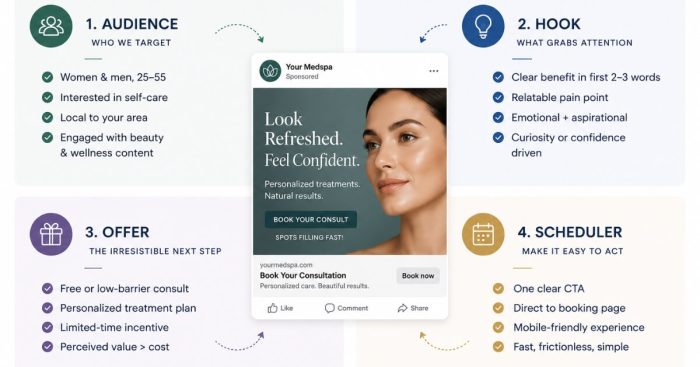
Element one: audience callout
The four-element structure is non-negotiable.
Element one is an audience callout in the first line of the ad copy and a corresponding visual hook.
“If your knee has been keeping you off the golf course for more than a year and you’ve been told surgery is the only option — read this.”
That sentence does the audience filtering before the click.
Patients who fit click. Meanwhile, patients who do not fit scroll past.
The cost per click does not change, but the cost per qualified lead drops by 5–10×.
Element two: condition-specific pain story
Element two is a condition-specific pain story — usually a real patient case, with permission.
“Steve, 58, had knee pain for three years. His orthopedic surgeon had recommended a knee replacement. He came to our clinic, completed our 12-week joint restoration protocol, and three months later he was back on the course.”
In addition, patient stories create trust before the first consultation ever takes place.
Static and video creative both work. However, video tends to convert at slightly higher rates for cold audiences. Static cycles faster for retargeting.
Element three: aggressive program offer
Element three is an aggressive program offer with a price anchor.
“Limited-availability 12-week joint restoration protocol, normally $8,500 — first 10 new patients this month get the intake screening and imaging review at no cost, $500 value.”
The discount is the imaging-and-screening intake, not the protocol price.
More importantly, discounting the protocol price tells the patient your sticker price is fake.
By contrast, discounting an intake or screening anchors the program value while reducing the cost of a first step.
Element four: intent-based scheduling
Element four is a scheduler with a credit-card hold or paid-intake screen — never a free-for-all calendar.
The credit card is what filters intent.
Free schedulers produce 35% show rates. However, credit-card-hold schedulers produce 85%+.
Same ad, same offer, dramatically different unit economics on the back end.
What does the funnel look like from Facebook ad to scheduled orthopedic surgery consult?
Ad → landing page or quiz → calendar with credit-card hold → automated SMS confirmation → human follow-up call from the Patient Coordinator within 5 minutes of the booking.
Even the best offer will struggle if the funnel behind it is weak.
Landing page or quiz
The funnel mechanics are where Facebook ad spend either compounds or burns.
Cold ad clicks land on either a long-form landing page or a quiz funnel.
A long-form landing page works if the offer can be explained in one scroll and the patient is ready to book.
However, a quiz funnel works better if the patient needs more diagnostic filtering before they will commit to a calendar.
For most orthopedic offers, the quiz works better.
Why the quiz works
Five questions about the condition, prior treatments, pain level, and timeline serve as both a clinical filter and a psychological commitment device.
Because of that commitment, patients become more likely to complete the scheduling process.
By the time the patient sees the calendar, they have invested two minutes thinking about their own case.
Consequently, the calendar booking rate is dramatically higher than a cold landing-page CTA.
Why the credit-card hold matters
The credit-card-hold step is the most-debated element of this funnel.
It is also the most important.
Practices that resist it produce a calendar full of unqualified consults at a 35% show rate.
By contrast, practices that embrace it produce a calendar full of qualified consults at an 85% show rate.
The clinic does not actually charge the card unless the patient no-shows or cancels inside 24 hours.
In other words, the card is not a fee. It is a filter.
Why the five-minute callback changes the math
The five-minute human callback is what most clinics never set up.
However, it is the single biggest source of upside in the funnel.
A real human voice calling within minutes of the booking confirmation triples consult show rate for first-time orthopedic patients.
The script is short:
“Hi Steve, this is Maria from the clinic — I saw you booked your knee consult for Thursday. I wanted to make sure you have everything you need before then. Do you have any questions about what to expect at the consult, or anything we should know about your case before Dr. Smith sees you?”
That call is the difference between a $200 cost per qualified consult and a $700 one.
Clinics that succeed with Facebook ads for an orthopedic surgery clinic often discover that operational follow-up has a bigger impact on ROI than the ad creative itself.
Same ad, same offer.
What ad spend should an orthopedic surgery clinic budget to test Facebook?
$8K–$15K per month for the first 90 days, allocated as ~70% to cold audience testing and ~30% to retargeting and lookalike audiences once data exists.
Before scaling, clinics need a realistic testing budget.
Why budgets below $8K usually fail
Below $8K/month the algorithm does not get enough conversion signal to optimize.
Facebook’s machine learning needs 30–50 conversion events per ad set per week to graduate from learning into stable optimization.
At $50–$150 cost per lead, that means roughly $1,500–$7,500/week of spend per ad set actively driving the algorithm.
Consequently, practices that budget $3K/month spread across five ad sets are starving every single ad set of the data it needs.
As a result, they often conclude incorrectly that Facebook does not work for their offer.
Why budgets above $15K are unnecessary early
Above $15K/month in the first 90 days is unnecessary.
The first phase is offer-funnel-creative testing.
At this stage, the clinic needs to see which audience callout, which pain story, which scheduler format, and which intake-screen anchor produces the lowest cost per qualified consult.
Fortunately, that learning happens at $8K–$15K of spend just as well as it would at $30K.
Save the higher spend for once the unit economics are proven.
How to scale after the test
Beyond 90 days, scale spend in proportion to provider capacity.
At that point, the conversation shifts from testing to capacity management.
The constraint that kills most orthopedic Facebook campaigns at scale is provider bandwidth.
In other words, the practice cannot consult and perform on enough new patients to absorb the volume the ads produce.
The clinic that did $2M from Facebook ads had a fully staffed Patient Coordinator seat and a defined consult-and-procedure cadence before they ever scaled spend.
That order matters.
Why do most orthopedic surgery clinics fail with Facebook ads?
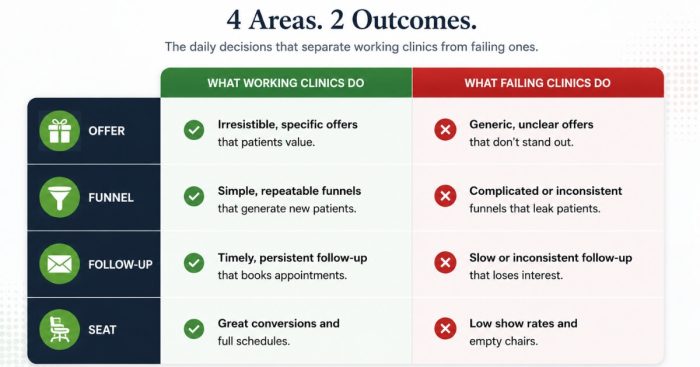
Four failure modes, every time: wrong offer, free scheduler, no five-minute follow-up, and no Patient Coordinator behind any of it.
Although Facebook can produce exceptional results, most clinics never make it past the early stages.
Failure one: wrong offer
Wrong offer is the most common.
The clinic agency writes an ad about “comprehensive joint care” or “premier orthopedic services” and points it at a clinic-overview landing page.
Nothing in that ad gives a 58-year-old with knee pain a reason to click.
Likewise, nothing on that landing page tells them what to do next.
Because of that, the Facebook algorithm cannot optimize for conversions on an offer that has no conversion event.
The clinic burns $5K, gets six form fills, and concludes Facebook does not work.
Failure two: free scheduler
Free scheduler is the second failure.
At first, the clinic gets the offer right.
Then the leads come in.
Soon after that, the calendar fills.
However, 65% of the booked consults never show up.
The provider’s calendar is full of empty 60-minute blocks.
Meanwhile, the clinic burns out the operational team trying to remind, confirm, and reschedule.
Eventually, the math collapses because the cost per booked consult was reasonable but the cost per attended consult is triple.
Switch to credit-card hold or paid intake and show rate jumps to 85%+ overnight.
Failure three: no five-minute follow-up
No five-minute follow-up is the third failure.
Same ad, same offer, same scheduler — but no human voice between booking and consult.
As a result, show rate drops 30%+.
Conversion at the consult also drops because patients arrive unprepared and skeptical.
Without that connection, patient confidence often drops before the appointment even happens.
The Coordinator’s five-minute call is what converts a Facebook click into a real medical visit.
Failure four: no Patient Coordinator
No Patient Coordinator behind any of it is the fourth and the underlying root cause for the first three.
Without a dedicated seat that owns lead-to-procedure conversion, every other element drifts.
The offer gets diluted because no one has the time to rewrite it.
The follow-up does not happen because the front desk is busy with check-ins.
Similarly, the credit-card hold gets removed because someone complained.
In fact, this pattern is not unique to orthopedic surgery.
Across healthcare, the practices that generate the strongest growth outcomes typically install the conversion infrastructure before they increase lead volume.
For example, Elite Pain Doctors added $2,095,039 in revenue in 10 months by installing the inside-sales seat before scaling marketing.
The lesson is the same in both specialties: marketing scales far more predictably when the operational layer is already in place.
Therefore, the operational layer should always be built before aggressive marketing campaigns begin.
Facebook ads at scale require an inside-sales seat.
The clinic that did $2M from Facebook ads had the seat before they ever ran a single ad.
By contrast, the clinics that fail tried to run the ads first and “figure out the operational layer later.”
Later does not come.
How long until Facebook ad spend produces predictable orthopedic surgery cases?
Sixty to ninety days to stable unit economics. Six months to a fully predictable monthly revenue lift.
Predictability does not happen immediately. Instead, it develops in stages.
First 30 days: setup and learning
Days 0–30 are setup and learning.
First, build the Patient Coordinator seat if it does not exist yet — non-negotiable.
Next, write the offer.
Then build the landing page or quiz funnel.
After that, stand up the scheduler with credit-card hold.
The practice also needs to document the five-minute follow-up script and set up the CRM workflow.
Finally, launch the first round of ad creative — 3–5 variants across audience hook, pain story, and visual format.
At the end of day 30, the practice has spent maybe $3K, has data on which creative is winning, and has the first 10–15 booked consults to validate the funnel mechanics.
Days 30–60: optimization and refinement
Days 30–60 are iteration.
During this phase, cut the losing creatives.
Then scale spend on the winners.
Next, tighten the audience targeting based on which lookalikes are converting.
Afterward, refine the qualification questions based on which booked patients are actually closing at the consult.
By day 60, the practice has stable cost-per-qualified-consult numbers, a real consult-to-procedure close rate, and the first procedure enrollments from the channel.
Days 60–90: scaling proven winners
Days 60–90 are scaling within the funnel’s proven economics.
At this point, add retargeting audiences.
Then add lookalikes from the converted-patient list.
Next, test a second offer variant if the first one is hitting its capacity ceiling.
By day 90, the channel should be producing 5–15 new procedure enrollments per month, depending on average ticket and provider capacity.
More importantly, the unit economics should be repeating month after month rather than fluctuating.
Months 4–6: revenue stabilization
Months 4–6 are scale-and-stabilize.
During this window, spend ramps in proportion to provider bandwidth.
Creative refreshes happen on a 30-day cadence to fight fatigue.
At the same time, the clinic decides whether to add a second offer or keep depth on the first one.
By month six, the channel is predictable monthly revenue.
As a result, most clinics start asking what other paid channels can stack on top of the Facebook foundation rather than whether Facebook works at all.
What’s the next step?
If you own a cash-pay orthopedic surgery clinic and you have written off Facebook ads because a previous attempt produced poor results, the previous attempt almost certainly failed on one or more of the four predictable failure modes — wrong offer, free scheduler, no five-minute follow-up, no Patient Coordinator.
The channel works. However, the execution is what was missing.
Ultimately, Facebook success is less about advertising and more about execution.
If you want a 60-minute walk-through of which offer fits your case mix, what your funnel and follow-up structure should look like, and what a realistic $8K–$15K/month test would produce, book a strategy call.
We will look at your existing procedure menu and tell you which case types should anchor the first ad set.