
Should Your DPC Clinic’s Initial Consult Cost as Much as the Membership? (The $300-to-$300 Price-Alignment Playbook)
Most direct primary care and functional medicine clinics price the initial consultation as an afterthought — $100 to get people in the door, then a $300-a-month membership pitch that lands like a price ambush. On a strategy call with a DPC and functional medicine practice, we rebuilt the pricing ladder so the consult, the membership, and the booking page all tell one coherent story. This is the FAQ on that playbook: the $300-to-$300 alignment, the two-option booking page, the free consult that never appears on the website, and the CRM move that gets patients off the owner’s personal cell phone.
How much should a DPC or functional medicine clinic charge for the initial consultation?
Match it to the monthly membership — if the membership is $300 a month, the 60-minute initial consult should be $300.
The exact reasoning from the call:
“we’ll have less pushback when it comes to presenting the programs and memberships because it won’t be like $100 consult to $300 a month. It’ll be $300 consult to $300 a month, and it makes more sense.”
Price coherence is the whole trick.
A patient who just paid $300 for an hour of a provider’s full attention experiences the $300-a-month program as:
- the same level of value continuing
- not a 3× escalation sprung at the end of a cheap visit
The cheap-consult model feels safer because it lowers the barrier to entry.
But it also:
- attracts price-anchored patients
- forces your provider to sell uphill in the enrollment conversation
Aligning the consult to the membership:
- pre-qualifies the buyer
- pays for the provider’s hour even when the patient doesn’t enroll
- makes the membership feel like the default next step instead of an upsell
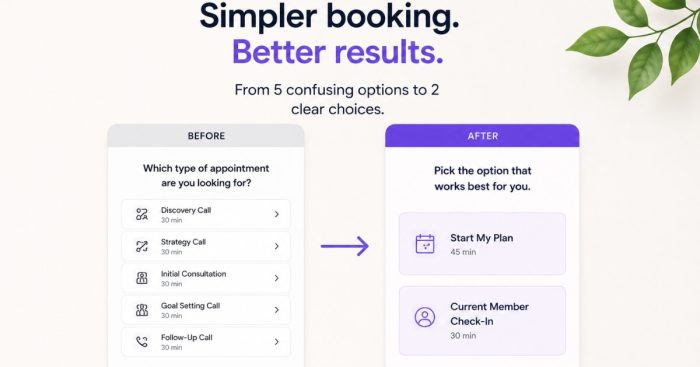
How many appointment types should a clinic’s booking page offer?
Two.
- A 60-minute initial consult
- A 30-minute follow-up
And the follow-up price follows the initial logically:
- $300 for the hour
- $150 for the half hour
The clinic’s booking page had accumulated appointment types the way every clinic’s does:
- initials
- follow-ups
- virtual urgent care visits
- legacy slots from the EHR migration
The advice was the “less is more” rule:
Cut to two patient-facing options.
Too many choices produce:
- decision paralysis
- mis-booked appointments
- front-desk cleanup work
(The analogy from the call: ask someone what they want for dinner with unlimited options and you get no decision at all.)
The math also has to stay legible.
$300 for 60 minutes and $150 for 30 minutes reads as one price logic.
Odd combinations — a $100 initial that’s longer than the $150 follow-up — make patients stop and puzzle over the menu.
And puzzled patients don’t book.
Clean pricing tiers are part of what makes a booking page convert, which is the front door of patient acquisition.
Should a free consultation be bookable on your website?
No — keep the free consult as an offer your staff extends live on inbound calls, not a self-service button anyone can click.
A free consult on the booking page gets treated like free customer support:
- tire-kickers book it
- no-shows pile up
- provider calendar time evaporates
As a staff-extended offer, the same free consult becomes a precision sales tool — deployed in the moment, on a phone call, for the caller who’s interested but hesitant.
The proof on this call came from the team’s own week:
A hesitant caller was offered a free initial visit by staff, came in, and converted.
“I just got a $400 a month membership because of that.”
The patient’s exit line says everything about why the free consult works when a human extends it.
He admitted he’d come in to:
- see how it went
- size up the doctor
and signed up anyway.
The free visit answered the trust question that no website page can answer, for exactly the patient who needed it — without being a standing invitation to everyone else.
How do you get patients to stop texting the owner’s personal cell phone?
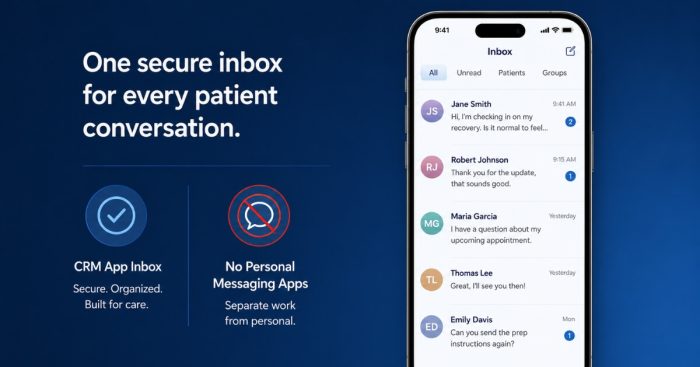
Move all patient calls and texts into the CRM’s mobile app — the number patients see is the office line, the conversation lives in the system, and any team member can pick up the thread.
The practice’s communication ran through personal phones, which is how every small clinic starts and how every growing clinic gets stuck.
The fix prescribed on the call:
- Install the GoHighLevel app.
- Place and answer patient calls through it.
- Route texts through it.
- Use the office number.
- Stop giving out personal numbers entirely.
Every conversation lands in one inbox with full history.
Automations can trigger off it.
Two-way messaging still feels personal to the patient.
This exact move was the first unlock at one of our longest-running clients.
The owner’s personal cell was the bottleneck for the whole practice, and routing those patient texts into the CRM — where an admin could triage them — was the change that let the business scale.
That practice became Eternity Health Partners, an HRT clinic that grew from $1M a year to $4M a year with 250 members paying monthly.
Owner-phone dependence isn’t a quirk.
It’s a growth ceiling.
How should a DPC clinic price GLP-1 medications as a membership add-on?
Set a standard markup of about $200 a month over your pharmacy cost, with a promo tier around $100.
On this clinic’s pharmacy pricing that landed at roughly:
- $249 a month for semaglutide
- $389 for tirzepatide at promo rates
Two principles sit under the numbers.
1. Own the medication transaction
The clinic coordinates the pharmacy relationship (the practice was moving to a new partner with better wholesale pricing), so the patient buys through the practice and the margin funds the clinical oversight.
2. Use the promo tier deliberately
A lower markup acts as:
- an acquisition lever
- a retention lever
Not a permanent discount that trains patients to wait for deals.
For a DPC or functional medicine membership, GLP-1s are the highest-demand add-on in the market right now.
They pull double duty:
- new-patient acquisition at the promo price
- added monthly revenue per existing member at standard markup
all inside the recurring model the practice already runs.
How should the EHR and the CRM split duties during the transition?
Run them in parallel with a clean division:
The EHR keeps:
- the clinical record
The CRM owns:
- communication
- booking
- scheduling
- payment requests
- follow-up automations
The booking page also gets rebuilt clean instead of inherited.
The practice kept its EHR for charts while GoHighLevel took over the patient-facing layer:
- calls
- texts
- scheduling
- payment requests
- follow-up automations
Two cleanup items from the call generalize to almost every clinic making this move.
First
Audit the autofill behavior on your forms.
The clinic’s booking form was silently inserting a staff member’s stored phone number on manually entered bookings (“sticky contact” autofill), corrupting lead data.
Second
Rebuild appointment types deliberately in the new system with the right prices attached per provider, rather than importing the old menu’s clutter.
The communication layer is also where the membership economics get protected.
The following can all run automatically:
- payment requests
- failed-payment follow-ups
- renewal touches
Work that was previously the owner’s evening phone time.
FAQ’s About DPC Consult and Membership Pricing
What should an initial consultation cost at a membership-model clinic?
The same as one month of membership.
A $300/month program should sit behind a $300, 60-minute initial consult.
The alignment:
- removes sticker shock at enrollment
- pre-qualifies buyers
- pays for provider time even when the patient doesn’t join
How many options should the online booking page show?
Two:
- a 60-minute initial
- a 30-minute follow-up
priced in one logic:
- $300
- $150
More options create:
- decision paralysis
- mis-bookings
Legacy appointment types should be retired during any system migration.
Is a free consultation ever a good idea for a DPC clinic?
Yes — as a tool your staff offers live on an inbound call to a hesitant but qualified caller.
Never as a self-bookable website option, where it:
- attracts no-shows
- burns calendar time
What’s the right GLP-1 markup for a membership practice?
About $200/month over pharmacy cost as the standard, with a ~$100 promo tier for acquisition.
That lands around:
- $249/month for semaglutide
- $389/month for tirzepatide
at promo rates on negotiated wholesale pricing.
Own the pharmacy relationship so the transaction stays in the practice.
Do we still need the EHR if we add a CRM?
Yes.
The EHR keeps the clinical record.
The CRM owns:
- calls
- texts
- booking
- payments
- automations
Run them in parallel, fix form-autofill bugs, and rebuild appointment types clean in the new system.
What’s the next step?
If your DPC or functional medicine clinic has a cheap consult bolted onto a premium membership, the enrollment conversation is fighting your own pricing.
Align the consult to the membership.
Cut the booking page to two options.
Pull the free consult off the website and into your staff’s toolkit.
Get patient communication out of your personal phone and into a system someone else can run.
If you want the full money model and communication stack mapped for your practice — pricing ladder, booking flow, CRM build, GLP-1 add-on economics — book a strategy call.
We’ll design it around your patient acquisition funnel and your broader medical practice marketing system on the call.