
Do YouTube Ads Work for a Stem Cell or Regenerative Medicine Clinic?
Most regenerative clinics think of YouTube as a place to build a channel and post educational videos — and that organic play is powerful. But there’s a second, faster lever most clinics ignore: paid YouTube ads. For a treatment where the patient is skeptical, the ticket is high, and trust is everything, video advertising can do something search and static ads can’t — let a patient see and hear your physician, watch a real patient’s story, and build belief before they ever call. This is the FAQ on whether YouTube ads work for regenerative clinics, how to run them compliantly, and what results to realistically expect.
Do YouTube ads actually work for a stem cell or regenerative medicine clinic?
Yes — when the treatment is high-ticket and trust-driven, YouTube ads can be one of the most effective channels because video builds belief in a way search ads and static ads simply cannot.
Regenerative medicine is not an impulse purchase. Patients are making a major healthcare decision that often involves significant out-of-pocket expense and a high level of skepticism. Before they book, they want to know who they’re trusting, how the clinic thinks, and whether the physician feels credible.
Video answers those questions quickly.
A patient can watch your physician explain a condition, discuss treatment philosophy, or answer common concerns and develop trust before they ever visit your website. That’s difficult to accomplish with text alone.
The strongest regenerative brands use YouTube as both an authority-building channel and a lead-generation channel. It’s the same principle behind successful stem cell clinic marketing — establish trust first, then capture demand.
How are YouTube ads different from organic YouTube content?
Organic YouTube builds authority over time, while YouTube ads create immediate reach. The strongest clinics use both.
Organic content is a long-term asset.
You publish videos, build subscribers, rank in search, and accumulate authority over months and years. Every video becomes part of a library that continues generating visibility long after it’s published.
YouTube ads accelerate the process.
Instead of waiting for patients to discover your content organically, you place your best videos directly in front of qualified prospects today.
The two approaches support each other:
- Organic builds authority
- Ads create visibility
- Organic earns trust
- Ads amplify trust
- Organic compounds
- Ads scale
The clinics that dominate their markets often use paid ads to distribute the same educational content that performs well organically.
What kind of YouTube ad converts a high-ticket regenerative patient?
Physician-led educational videos and authentic patient stories consistently outperform promotional or discount-focused ads because they build trust instead of trying to force a sale.
The highest-performing creative is usually simple:
A physician speaking directly to the camera.
The doctor explains:
- The patient’s problem
- Their philosophy of care
- What patients should know
- Who may be a candidate
- What questions to ask
This immediately establishes expertise and credibility.
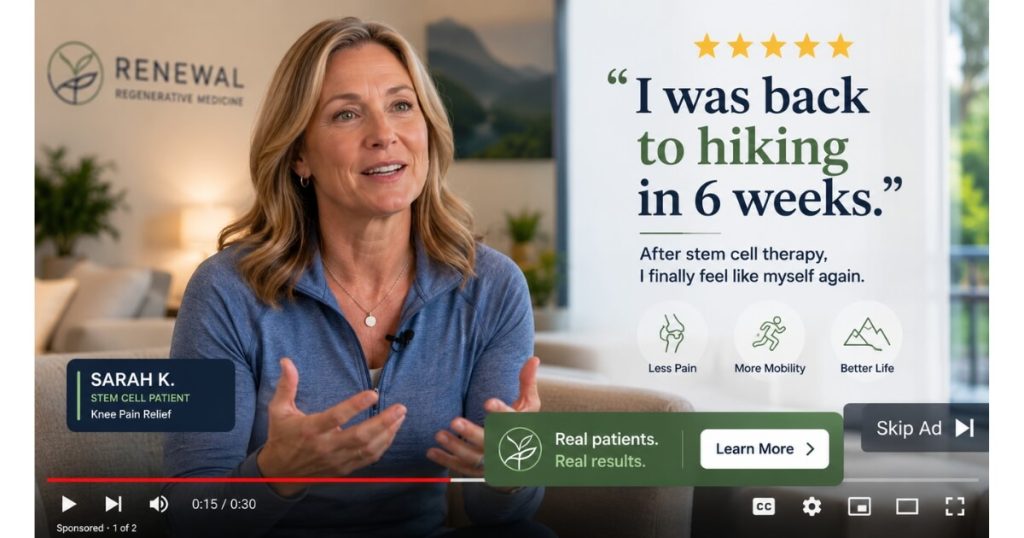
Patient stories work equally well because they answer the question every prospect is thinking:
“Has someone like me gone through this?”
A real patient discussing their experience often creates more trust than any claim a clinic could make itself.
What typically performs poorly:
- Aggressive promotions
- Discount-driven messaging
- Sensational claims
- Overly polished sales videos
The regenerative patient is usually skeptical and highly informed. Education beats hype.
That’s why physician authority and authentic patient stories sit at the center of effective pain management marketing and regenerative advertising.
How do you target the right patients with YouTube ads without violating health-ad policies?
Focus on interests, behaviors, content consumption, keywords, and retargeting audiences rather than directly targeting sensitive health conditions.
Google’s healthcare advertising policies require careful audience construction.
Effective targeting methods include:
- Health and wellness audiences
- Fitness and active-lifestyle audiences
- Viewers of related educational content
- Relevant search keywords
- Website retargeting
- Video-viewer retargeting
Retargeting is often the strongest option.
Someone who visited your website or watched a significant portion of your video has already demonstrated interest and can be re-engaged with additional educational content.
Creative matters as much as targeting.
Keep ads:
- Educational
- Physician-focused
- Practice-focused
- Informational
Avoid:
- Guaranteed outcomes
- Cure claims
- Overstated promises
- Non-compliant medical language
Most successful clinics advertise the physician and expertise rather than specific treatment claims.
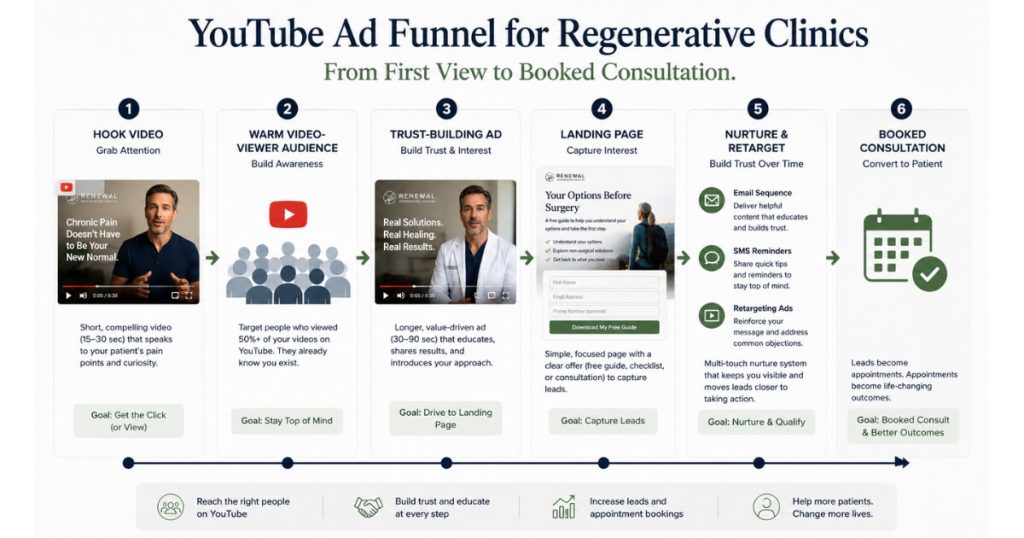
What does a YouTube ad funnel look like for a regenerative clinic?
The best-performing funnels move patients through multiple stages of trust rather than asking for a consultation immediately.
A typical funnel looks like:
- Stage 1: Awareness
Short educational videos introduce the physician and attract attention. - Stage 2: Engagement
Viewers who watch are retargeted with deeper educational content and patient stories. - Stage 3: Lead Capture
Interested viewers visit a landing page offering a consultation or downloadable guide. - Stage 4: Nurture
Email, SMS, and retargeting campaigns continue building trust.
Stage 5: Consultation
The patient books when they’re ready.
This mirrors how regenerative decisions are actually made.
Very few patients watch one ad and immediately book.
Most require multiple touchpoints over several weeks before they feel comfortable moving forward.
The funnel succeeds because it respects the patient’s timeline rather than fighting it.
How much should a regenerative clinic budget for YouTube ads?
Start with enough budget to gather meaningful data over several months rather than treating YouTube as a short-term experiment.
High-ticket regenerative treatments can support a higher acquisition cost than lower-priced services because a single patient may generate significant revenue.
The mistake most clinics make is underfunding the test.
A small budget run for two weeks rarely provides enough data for optimization.
Instead:
- Commit to at least 6–8 weeks
- Test multiple creative variations
- Build retargeting audiences
- Allow the platform time to learn
Evaluate success based on:
- Cost per consultation
- Cost per acquired patient
- Revenue generated
- Return on ad spend
Not:
- Views
- Impressions
- Clicks
The purpose of YouTube is not cheap views.
The purpose is profitable patients.
How should YouTube ads fit into a regenerative clinic’s broader marketing strategy?
YouTube works best as the trust-building layer of a larger marketing system that includes SEO, retargeting, reviews, email nurturing, and follow-up.
A typical patient journey might look like:
- Sees a YouTube ad
- Searches your clinic name
- Reads reviews
- Visits your website
- Downloads a guide
- Receives follow-up emails
- Watches another video
- Books a consultation
Rarely is one channel responsible for the entire conversion.
YouTube creates familiarity.
SEO captures intent.
Retargeting reinforces trust.
Email nurtures the relationship.
Phone follow-up closes the opportunity.
The highest-performing regenerative clinics connect these channels into one system rather than treating each platform as a separate campaign.
That integrated approach is what drives durable growth and turns video views into booked cases.
FAQ’s About YouTube Ads for Regenerative Clinics
Are stem cell and regenerative medicine ads allowed on YouTube?
Yes, but Google restricts certain healthcare claims and may limit how specific treatments can be described. The safest and most effective approach is to advertise the physician, educational content, patient experience, and clinic expertise rather than making explicit promises about treatment outcomes.
How long should a YouTube ad be?
For regenerative medicine, longer educational videos often outperform short ads because trust requires time. Many successful campaigns use videos between 60 seconds and several minutes. Short videos can be effective for awareness, while longer videos build the confidence needed to book a consultation.
Do I need a professional production team?
No. Clear audio, good lighting, and a credible physician matter more than expensive production. Many high-performing regenerative ads are simply a doctor speaking honestly to the camera or a patient sharing their experience. Authenticity often outperforms polished sales content.
How quickly do YouTube ads produce results?
Some consultations may appear within the first few weeks, but the strongest results often emerge after several months as retargeting audiences grow and trust accumulates. Regenerative medicine has a long consideration cycle, so success should be evaluated over months rather than days.
Should I run YouTube ads if I’m already doing SEO?
Yes. SEO captures patients actively searching today, while YouTube creates demand and builds trust before the search happens. Together they create a stronger patient-acquisition system than either channel alone.
What’s the next step?
If your regenerative or stem cell clinic has been treating YouTube as only an organic channel, you’re leaving the platform’s fastest lever on the table. Paid YouTube ads can put your physician’s credibility and your patients’ stories in front of exactly the people deciding whether to trust a high-ticket treatment — and when they’re wired into your SEO, retargeting, and follow-up, they become a durable engine for booked cases.
That integrated, trust-first system is what we build for regenerative and pain practices — the same approach behind helping Dr. Joy Kong become the #1 stem cell expert on YouTube and growing other clinics with organic and paid video together. If you want us to map how YouTube ads fit your practice and what to expect, that’s the conversation to book.