
HOW DOES A CASH-PAY CLINIC TURN GLP-1 / WEIGHT LOSS PATIENTS INTO LONG-TERM TRT OR HRT PATIENTS?
(The 90-Day Self-Assessment Cross-Sell)
A multi-location cash-pay clinic we work with was launching a new GLP-1 paid ad campaign on the same week they were building their TRT patient journey. The strategy call we walked through showed the connection most clinics miss: the same 90-day patient self-assessment form that closes the loop on a weight loss program is also the cross-sell mechanism that turns a 6-month GLP-1 patient into a 12-to-24-month TRT or HRT patient. Here is exactly how the cross-sell works, what questions to ask, and how much it adds to lifetime value per patient.
How does a cash-pay clinic turn GLP-1 weight loss patients into long-term TRT or HRT patients?
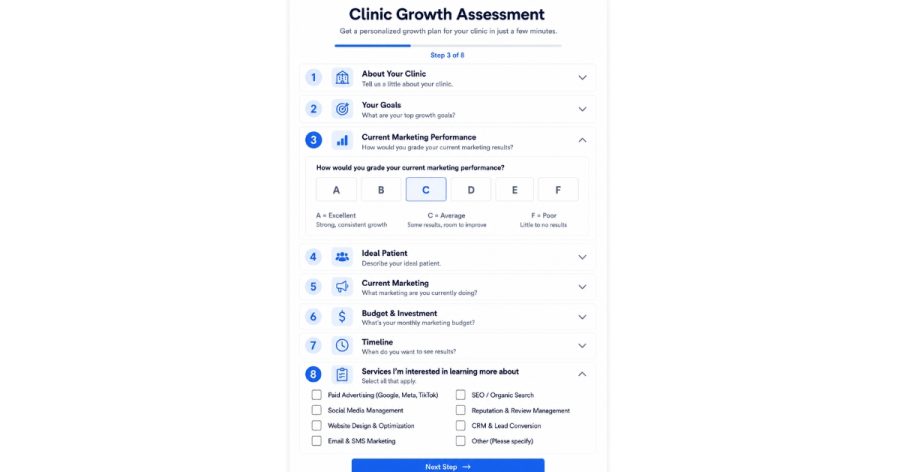
A cash-pay clinic turns GLP-1 weight loss patients into long-term TRT or HRT patients by sending a 90-day patient self-assessment intake form that asks the patient to grade themselves A through F across sleep, mood, weight, fitness, energy, and stress — and then asks which additional services they want to learn about.
The list of additional services is the cross-sell menu:
- hormones
- peptides
- longevity programs
- preventive medicine
- biohacking
Patients who check “interested in TRT” or “interested in hormones” pre-sell themselves; the front desk schedules a paid follow-up consult with the in-house TRT provider that week.
The form is the cross-sell mechanism.
The provider is the closer.
The highest-performing GLP-1 & weight loss clinic marketing systems support that process by attracting patients into a structured care pathway instead of promoting GLP-1 as a one-time solution.
The same self-administered tool can run on an iPad in the waiting room — “fill this out while you wait” — and the conversion happens before the consult starts.
Why does the patient self-sell when given the right intake form?
The patient self-sells because the questions force articulation of progress, gaps, and unmet goals in the patient’s own language.
A weight-loss-only patient who writes:
“I have lost 22 pounds but my sleep is still a C- and my energy is a D”
…has just told the provider they want hormone optimization.
The provider does not need to upsell.
The form has already done the work.
We discovered this pattern years ago in person at a cash-pay clinic that was relying entirely on provider talent to upsell during consults.
The fix was to template the conversation:
- build a follow-up form that gets the patient to grade themselves
- get them to articulate next-step goals
- remove dependency on which provider happens to be on shift that day
The mechanism is the same one therapists use — get the patient to say it out loud — adapted for a recurring-revenue cash-pay practice.
What questions should be on a 90-day GLP-1 patient self-assessment intake form?
A 90-day GLP-1 patient self-assessment intake form should include eight question categories.
1. Original health goals when you joined the program
Anchors the progress conversation.
2. Where have you noticed the most improvement and in what ways?
Confirms the win.
3. A through F self-grade across:
- sleep
- mood
- weight
- fitness
- energy
- stress
Produces the data the provider uses on the follow-up call.
4. How well did you follow your treatment plan?
Include a free-text reason if not.
This surfaces compliance issues so the provider does not blame the protocol for the patient’s pizza-on-vacation choices.
5. Any new goals that have come up since you started?
Opens the door to:
- longevity
- hormones
- fitness
- peptides
6. What has been the most outstanding part of your experience?
Gathers review-quality language for marketing.
7. What other services are you interested in learning about?
The cross-sell menu:
- hormones
- peptides
- longevity
- biohacking
- gut health
- preventive medicine
8. Anything else you would like to discuss in the next consult?
Forty-five seconds to fill out.
Months of compounded revenue on the back end.
When should the 90-day cross-sell form go out?
The 90-day cross-sell form should go out:
- at 90 days for GLP-1 and weight loss patients
- at 8 weeks for TRT patients ahead of the first follow-up consult
Monthly is too aggressive — the patient has not accumulated enough physiological or psychological delta to self-report meaningful change, and the form starts to feel like spam.
Quarterly is the right interval.
The average weight loss patient stays for roughly 6 months, so a 90-day form gives a clinic two cross-sell touchpoints per patient:
- one at 90 days
- one at 180 days
…before the patient churns out of the program.
Both moments map to physiological turning points where TRT or HRT becomes more relevant, not less.
For a multi-location cash-pay practice that scaled GLP-1 and adjacent revenue together, see how NuLevel Wellness Medspa added $6,708,600 in revenue in a single year with a multi-channel paid ad strategy that fed a recurring membership model — the same patient journey logic was running underneath the paid ad spend.
How do you convert a GLP-1 patient who marks “interested in TRT” on the 90-day form?
You convert a GLP-1 patient who marks “interested in TRT” on the 90-day form by scheduling a paid consult with the in-house TRT provider within one week of the form submission.
The handoff is internal.
Billing is on file.
The buying-decision threshold is much lower than for any cold lead.
Use the patient’s documented GLP-1 progress as the credibility anchor on the consult:
“you have lost 18 pounds in 90 days, your energy is still rating a D, here is what we typically see when we add testosterone optimization at this point in the journey.”
Do not require a separate intake call.
Do not requote pricing.
The patient has already trusted the provider with one protocol; the second protocol is a renewal of that trust, not a new sale.
The clinic’s job is to make the transition feel inevitable.
Why does GLP-1 to TRT or HRT cross-sell work in particular for cash-pay clinics?
GLP-1 to TRT or HRT cross-sell works at cash-pay clinics specifically because three conditions stack at the right time.
First
The patient already has:
- 6 months of relationship
- provider trust
- clinic familiarity
- billing on file
Second
The patient has just produced a visible win.
Weight loss is more visible than almost any other clinical outcome, so they are physically and psychologically in a state of confidence about clinical interventions.
Third
Weight loss exposes hormone optimization opportunities that were masked by excess weight.
Patients often feel the energy and mood gap once the weight comes off.
The provider has:
- the timing
- the data
- the trust
…at the same moment.
An insurance-driven practice has no equivalent cross-sell path because insurance does not pay for the second program.
The cash-pay clinic is the only model where this handoff is structurally available.
Clinics that excel at men’s hormone & TRT clinic marketing intentionally build these transition points into the patient journey, making hormone optimization a natural next phase instead of an unexpected upsell.
How much patient LTV does the GLP-1 to TRT or HRT cross-sell add?
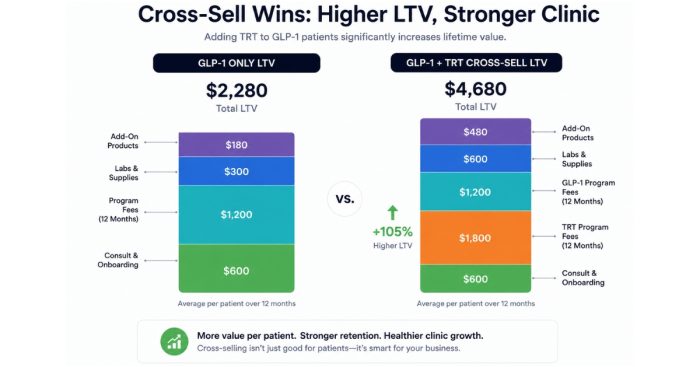
A GLP-1 to TRT or HRT cross-sell adds roughly 3 to 5x the LTV of a single-program patient.
The math:
- A GLP-1 patient at $300 to $350 per month for an average 6-month tenure produces $1,800 to $2,100 in LTV.
- Adding TRT at $200 to $400 per month for 12 to 24 months adds another $2,400 to $9,600 per patient.
- The combined LTV moves from roughly $2,000 to a range of $4,400 to $11,700.
The economics are why many clinics focus on cross-selling GLP-1 patients into TRT and HRT rather than treating weight loss as a standalone service. Once the acquisition cost has been recovered through the GLP-1 program, the hormone membership becomes high-margin recurring revenue.
The cost to acquire was already paid on the GLP-1 ad — the cross-sell is incremental margin against a sunk customer-acquisition cost, which means the gross margin on the TRT or HRT revenue can exceed 80% net of provider time.
The clinic’s effective cost per acquired TRT patient via cross-sell approaches zero.
For a longer view of how an HRT-led cash-pay practice compounds membership LTV, see how Eternity Health Partners grew from $1M to $4M in 4 years by stacking $1.7M of recurring membership revenue on top of an existing patient base — the cross-sell math is the same shape at every scale.
What email cadence should a TRT or HRT patient journey use at a cash-pay clinic?
A TRT or HRT patient journey at a cash-pay clinic should use twelve emails over twelve months.
Email 1
Dosing and self-administration instructions.
Email 2
What to expect by week 6 — energy, libido, sleep, body composition shifts.
Email 3
How and when to reach out with questions, including a clear no-question-is-too-small reassurance.
Emails 4 through 9
- lab repeat cadence
- plateau navigation
- supplement stack
- sleep and recovery
- partner conversations
- training-load adjustments
Emails 10 through 12
- one-year anniversary
- maintenance pricing
- options for the next protocol layer (peptides, longevity, advanced labs)
Review request at week 9, one week after the 8-week consult, when the patient is at the warmest documented point in the journey.
The emails do not need to be elaborate — even a simple 12-email Canva PDF series, repurposed inside the CRM, outperforms no journey at all.
What should a cash-pay clinic do this quarter to start the GLP-1 to TRT or HRT cross-sell?
A cash-pay clinic should do four things this quarter to start the GLP-1 to TRT or HRT cross-sell.
First
Build the 90-day self-assessment form using the eight categories above and host it in your CRM with an automated trigger at day 90 of the GLP-1 program.
Second
Route form submissions to a single admin email and to the front desk so the cross-sell-tagged patients are flagged inside 24 hours.
Third
Write a 12-email TRT or HRT email cadence — even a rough draft is better than no cadence — and schedule the review request for week 9.
Fourth
Train the front desk to read the form before scheduling the consult and to mention one specific data point from the form (“you graded sleep a C-“) on the confirmation call.
The four steps cost zero new ad spend.
They convert existing weight loss revenue into 3 to 5x LTV inside one quarter.