
What Conversion Rate Should a Men’s Hormone (Low-T) Clinic Expect From Its Leads?
Most men’s hormone and low-T clinic owners ask the wrong version of this question.
They want a single number — “what’s a good conversion rate?”
The honest answer is that there is no single number.
The funnel has three separate conversion steps stacked on top of each other, and each one quietly multiplies against the others.
A clinic that converts 78% of its in-clinic visits into members can still be bleeding money if half its leads never get a phone call back.
This is the field-tested breakdown of what a realistic lead-to-consult-to-paying-patient funnel actually looks like at a men’s hormone clinic, where the leaks hide, and how to raise the rate — drawn from real numbers at clinics running free-T offers and paid search.
What is a good lead-to-paying-patient conversion rate for a men’s hormone clinic?
Across the full funnel — raw lead all the way to paying member — a healthy men’s hormone or low-T clinic lands somewhere between 15% and 30%.
The strong ones cluster near the top of that range.
The reason the band is so wide is that the funnel is not one conversion.
It is three:
- A lead has to book an appointment.
- The booked appointment has to actually show up.
- The person who shows has to sign up.
Each step is a separate percentage.
And because they multiply, a clinic can post a fantastic in-visit close rate and still end up with a mediocre lead-to-member number if the first two steps leak.
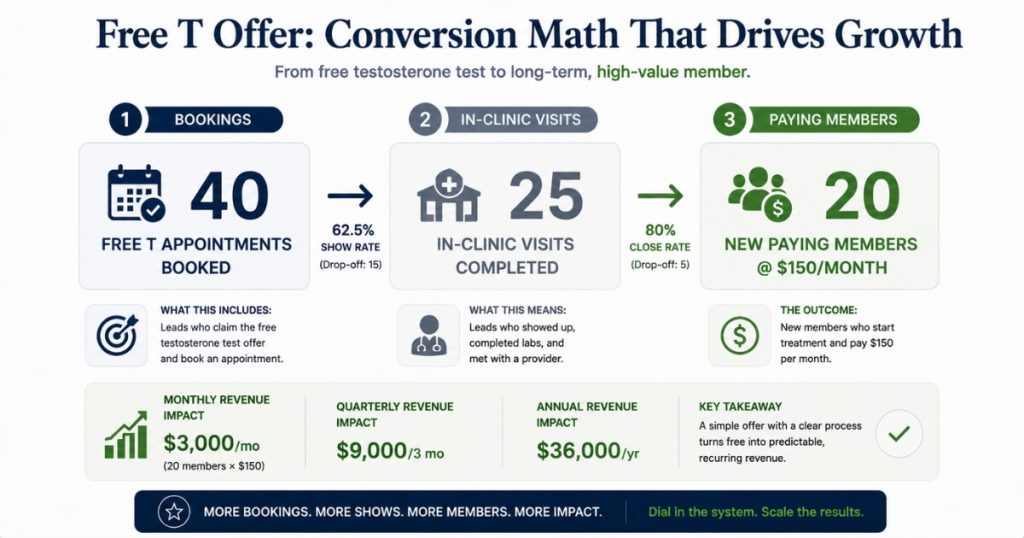
At one established men’s hormone clinic we work with, a free-testosterone-test offer converted roughly 50% of bookings into paying members in a single month.
That meant 40 free-T appointments produced 25 in-clinic visits.
About 20 of those became members at $150 a month.
That 50% is the high end of the cold-lead funnel.
It is achievable specifically because hormone care is a recurring, high-trust, in-person relationship rather than a one-off aesthetic transaction.
The lesson is not to chase a single headline figure.
It is to measure every step:
- Lead to booked
- Booked to showed
- Showed to paying
If you only watch the first and the last, you will never find the leak.
And in men’s hormone, the leak is almost always in the middle.
For the bigger picture on how this funnel fits into the rest of your growth strategy, our patient acquisition hub maps how leads, channels, and conversion work together.
What close rate should a men’s hormone clinic expect once a patient shows up for the visit?
Once a man actually sits down in the room and gets his full set of labs, a well-run men’s hormone clinic should close 70% to 80% of those visits into a paying membership.
At the established clinic in our data, the number was 78% in a single month.
That was 45 patients who came in for a visit, and 35 who signed up.
The owner described it the way the best operators do, in plain arithmetic:
If they come in, get their full set of labs, almost 80%, eight out of ten of them sign up.
That is the single most important and most overlooked benchmark in the entire business.
It tells you something counterintuitive.
The hard part is not selling testosterone therapy.
The hard part is getting a qualified man into the chair.
A man who has already driven to your clinic, given blood, and is sitting across from a provider has self-qualified at an extraordinary rate.
He is past skepticism.
Past price shopping.
Past “I’ll think about it.”
That is why the in-visit close is so high when the front of the funnel does its job.
So if your show-to-member close is sitting at 40% or 50%, do not pour more money into ads.
You do not have a marketing problem.
You have a consultation and offer problem.
And that one is fixable with sales-dialogue training rather than spend.
There is real room to improve conversion just in the dialogue a provider or front-desk rep has with the patient.
What conversion rate should I expect from a free testosterone test (free-T) offer?
A free testosterone test is the standard front-end lead magnet for low-T clinics.
You should expect roughly 60% of booked free-T appointments to show for the in-clinic visit.
Then roughly 80% of those should convert.
That nets out to about 50% of free-T bookings becoming paying members.
In our source clinic, the math was clean:
- 40 free-T appointments
- 25 turned into visits
- 62.5% show rate
- About 20 became members
- Roughly 50% of the original free-T bookings became members
The free-T offer works because it lowers the barrier to entry to almost nothing.
At the same time, it still self-selects for men who already suspect they have a real problem.
A man does not book a testosterone test on a whim.
He books it because he is tired, foggy, and wondering why.
That intent is what makes the downstream close rate so strong.
One important caveat keeps clinic owners from misreading their own dashboards:
The free-T conversion rate understates total clinic conversion.
An established brand also gets men who skip the free test entirely.
They already know they want to be a member.
Or they are already on therapy and simply switching providers because they want a real face-to-face relationship instead of a faceless telehealth refill.
So treat the free-T number as your cold-lead benchmark, not your whole-clinic number.
The two should be tracked separately because they answer different questions.
Where do men’s hormone clinics lose the most leads in the funnel?
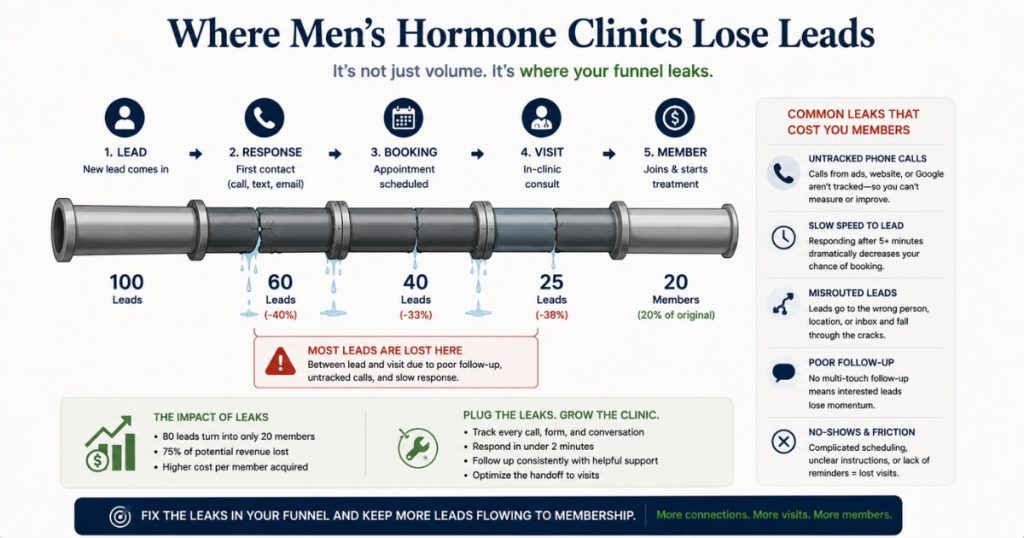
The biggest leaks are not in the consultation room.
They are in the gap between a lead coming in and a human responding to it.
The failures we see over and over are mechanical, not strategic:
- Inbound phone leads that never get logged into the CRM
- Leads that route to the wrong location or staff member and then sit unworked
- Slow speed-to-lead because nobody is assigned to reply fast
- Staff getting yanked off lead duty for other clinical tasks
At one clinic, roughly 80 form leads were tracked in a month.
But another 40 inbound phone calls were never entered into the system at all.
That means a third of the real lead volume was invisible, unattributed, and largely unworked.
You cannot convert a lead you cannot see.
Another location estimated it was losing about two of every fifteen leads simply because they fell through the cracks.
The operator made the point that most owners miss:
When you double the ad budget, you also double the leak.
If you lose 10% at fifteen leads a month, you lose twice as many actual human beings at thirty leads a month.
That is why throwing more spend at a leaky funnel is the most expensive mistake in this category.
Fix the response system first.
Then scale.
It is far easier to build the system before you get busy than to bolt one on while you are surviving day to day.
How do you raise the conversion rate at a men’s hormone clinic?
You raise it by attacking each funnel step in order:
- Speed-to-lead first
- Show rate second
- In-visit close third
Speed-to-lead is the single highest-leverage fix.
It is the reason small operators routinely out-convert bigger clinics.
In our source, the newest, smallest operator out-converted the established location on raw responsiveness alone.
The moment something hit the website, he was calling and texting that person.
Laptop open at home.
Answering within minutes.
The busy clinic, by contrast, let leads sit because nobody had the bandwidth.
The fixes are unglamorous, and they work:
- Get the CRM on the rep’s phone.
- Turn on reply notifications so a text-back is never missed.
- Automate the first reply so response time drops to seconds instead of hours.
To protect the show rate, strip out friction.
Route patients to a closer lab so a man can get tested on his lunch break instead of driving 45 minutes.
Use telehealth to absorb overflow demand instead of letting it evaporate.
To raise the in-visit close, train the consultation dialogue with a problem-centered approach rather than a product pitch.
Even the men who do not convert should leave feeling helped, because that goodwill becomes referrals.
And capture every inbound phone call in the CRM so you can actually work the leads you are already paying for.
The discipline that ties it all together is measuring each step separately.
That way, you know precisely which lever to pull.
Clinics like Eternity Health Partners, which built up to 60 new-patient inbound calls a month and 250 members, and VYVE Wellness, which saw a 900% lead increase and 100-plus calls a month, show what happens when the response system and the volume scale together instead of one outrunning the other.
How many leads does a men’s hormone clinic need to hit a new-patient goal?
You back into it from your conversion rates.
And the math gets unforgiving the moment you write it down.
The established clinic in our data wanted 80 new memberships a month.
At an 80% visit-to-member close rate, that requires 96 new-patient visits.
The owner translated that into the provider seeing six new patients a day, four days a week.
To fill those 96 visits at the clinic’s lead-to-visit rate, they needed roughly 200 to 250 leads a month.
So the full chain reads:
- About 250 leads
- To 96 visits
- To 80 members
Every conversion point you lose along that chain forces you to buy more leads to hit the same goal.
This is why conversion rate is never an abstract metric.
At a cost per lead of around $40 on Google for low-T — with a realistic target of pushing that down toward $20 to $30 as the campaign is tuned — the difference between a 15% and a 25% lead-to-member rate is the difference between a clinic that scales profitably and one that pours cash into a bucket with a hole in it.
The clinics that grow without going broke fix conversion first.
That way, they need fewer leads per patient.
Then they scale spend on top of a funnel that already holds water.
That sequencing — funnel before fuel — is the whole game.
FAQ’s About Men’s Hormone Clinic Lead Conversion Rates
What is a good lead-to-paying-patient conversion rate for a men’s hormone clinic?
Across the full funnel — raw lead all the way to paying member — a healthy men’s hormone or low-T clinic lands somewhere between 15% and 30%.
The strong ones cluster near the top of that range.
The reason the band is so wide is that the funnel has three separate conversion steps stacked on top of each other.
Each one multiplies against the others.
At one established men’s hormone clinic we work with, a free-testosterone-test offer converted roughly 50% of bookings into paying members in a single month.
That meant 40 free-T appointments produced 25 in-clinic visits.
About 20 of those became members at $150 a month.
That is the high end, and it is achievable specifically because hormone care is a recurring, high-trust, in-person relationship rather than a one-off transaction.
The number you should hold yourself to is not a single headline figure.
It is each step:
- Lead to booked appointment
- Booked to showed
- Showed to paying patient
If you only measure the first and the last, you will never find the leak.
And the leak is almost always somewhere in the middle.
What close rate should a men’s hormone clinic expect once a patient shows up for the visit?
Once a man actually sits down in the room and gets his full set of labs, a well-run men’s hormone clinic should close 70% to 80% of those visits into a paying membership.
At the established clinic in our source, the number was 78% in a single month.
That was 45 patients who came in for a visit, and 35 who signed up.
The owner put it plainly:
If they come in and get their full set of labs, almost 80%, eight out of ten of them sign up.
That is the most important and most overlooked benchmark in the whole business.
It tells you that the hard part is not selling testosterone therapy.
The hard part is getting a qualified man into the chair.
A man who has already driven to your clinic, given blood, and is sitting across from a provider has self-qualified at an extraordinary rate.
If your in-visit close rate is sitting at 40% or 50%, you do not have a marketing problem.
You have a consultation and offer problem.
That is fixable with sales-dialogue training rather than more ad spend.
What conversion rate should I expect from a free testosterone test (free-T) offer?
A free testosterone test offer is the standard front-end lead magnet for low-T clinics.
You should expect roughly 60% of booked free-T appointments to actually show for the in-clinic visit.
Then roughly 80% of those should convert to paying members.
That nets out to about 50% of free-T bookings becoming members.
In our source clinic, the math was:
- 40 free-T appointments
- 25 turned into visits
- 62.5% show rate
- About 20 became members
- Around 50% of the original free-T bookings became members
The free-T offer works because it lowers the barrier to entry to almost nothing.
It also self-selects for men who suspect they have a real problem.
It is worth knowing that the free-T number understates total clinic conversion.
An established brand also gets men who skip the free test entirely.
They already know they want to be a member.
Or they are already on therapy and switching providers.
So treat the free-T conversion rate as your cold-lead benchmark, not your whole-clinic number.
Where do men’s hormone clinics lose the most leads in the funnel?
The biggest leaks are not in the consultation.
They are in the gap between a lead coming in and a human responding to it.
The most common failures we see are:
- Inbound phone leads that never get logged into the CRM
- Leads that route to the wrong location or staff member and then sit unworked
- Slow speed-to-lead because nobody is assigned to reply fast
- Staff getting pulled off lead duty for other tasks
At one clinic, roughly 80 form leads were tracked in a month.
But another 40 inbound phone calls were never entered into the system at all.
That means a third of the real lead volume was invisible and largely unworked.
Another location estimated it was losing about two of every fifteen leads simply because they fell through the cracks.
The operator pointed out the part most clinics miss:
When you double the ad budget, you also double the leak.
If you lose 10% at fifteen leads, you lose twice as many bodies at thirty leads.
Fixing the response system before scaling spend is almost always the higher-return move.
How do you raise the conversion rate at a men’s hormone clinic?
You raise it by attacking each funnel step in order:
- Speed-to-lead first
- Show rate second
- In-visit close third
Speed-to-lead is the single highest-leverage fix.
The small operator in our source out-converts bigger clinics simply because the moment something hits the website, he is calling and texting that person immediately.
The busy clinic lets leads sit because nobody has the bandwidth.
Get your CRM on the rep’s phone.
Turn on reply notifications so a text-back is never missed.
Automate the first reply to compress response time to seconds.
To protect the show rate, reduce friction.
Route patients to a closer lab so a man can get tested on his lunch break instead of driving 45 minutes.
Use telehealth to absorb overflow.
To raise the in-visit close, train the consultation dialogue with a problem-centered approach rather than a product pitch.
And capture every inbound phone call in the CRM so you can actually see and work the leads you are already paying for.
The discipline that ties it together is measuring each step separately so you know exactly which one to fix.
How many leads does a men’s hormone clinic need to hit a new-patient goal?
You back into it from your conversion rates.
And the math is unforgiving once you write it down.
The established clinic in our source wanted 80 new memberships a month.
At an 80% visit-to-member close rate, that requires 96 new-patient visits a month.
The owner translated that into the provider seeing six new patients a day, four days a week.
To fill 96 visits at the clinic’s lead-to-visit rate, they needed roughly 200 to 250 leads a month.
So the chain is:
- About 250 leads
- To 96 visits
- To 80 members
This is exactly why conversion rate is not an abstract metric.
Every point of conversion you lose forces you to buy more leads to hit the same goal.
At a cost per lead of $40, that gap gets expensive fast.
The clinics that grow profitably fix conversion first so they need fewer leads.
Then they scale spend on top of a funnel that already holds water.