
How Should a Concierge Medicine Clinic Structure Its Membership Pricing?
The pricing structure is the product. For a concierge medicine clinic, how you tier, bundle, and anchor your membership determines whether patients enroll, how long they stay, and how much they are worth over their lifetime.
Most clinics get this wrong by publishing a single flat fee or a confusing menu of options. However, the clinics that scale build a deliberate three-tier ladder, front-load recurring value into every tier, and anchor every price against the real cost of the services inside it.
This is the concrete framework — pulled from a working concierge pricing model and the membership programs we have helped scale — for structuring concierge medicine membership pricing.
How many membership tiers should a concierge medicine clinic offer?
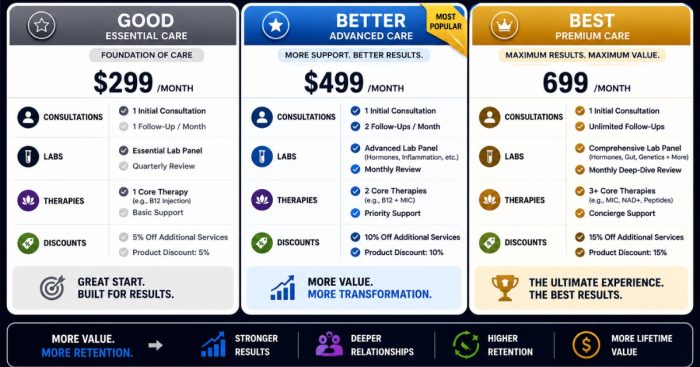
Three tiers is the proven structure — a low-commitment entry tier, a mid tier where most members land, and a premium tier that anchors the value of the other two.
A working concierge model runs:
- Foundation: $99/month
- Core: $199/month
- Elite: $449/month
Each tier is structured as a 12-month program.
The Foundation tier removes the price objection and gets a patient into the membership relationship at a number almost anyone can say yes to.
Meanwhile, the Core tier is where most members should land. Therefore, it should be deliberately designed as the obvious best value.
The Elite tier serves two purposes:
- It attracts your highest-LTV patients.
- It makes the Core tier look like a bargain by comparison.
Two tiers leave money on the table because there is no anchor and no upgrade path.
Conversely, four or more tiers create decision paralysis and slow enrollment.
Three tiers convert best.
In fact, it is the same pricing psychology that underpins the broader offer and positioning strategies covered in our medical practice marketing playbook.
What should each concierge membership tier actually include?
Each tier should bundle a mix of:
- Included services
- Member-only discounts
- Enhanced access
More importantly, every step up should add new categories of value rather than simply providing more of the same thing.
In a real concierge program, the entry tier includes:
- Two provider consultations annually
- One diagnostic lab panel
- One monthly red light therapy session
- Two body-scanner sessions per year
- Concierge refill guidance
- 10% off supplements
The middle tier expands on that foundation by adding:
- A third provider consultation
- A peptide discount
- A second lab panel
- A second monthly therapy session
The premium tier includes substantially more value:
- Hormone therapy included
- Unlimited red light therapy
- Unlimited body scanner usage
- Hyperbaric oxygen discounts
- Specialty testing discounts
- Longevity guide access
- Direct concierge care team access
- Four provider consultations annually
The key principle is simple.
The services patients use most frequently should form the backbone of the membership.
That means:
- Consultations
- Lab testing
- Refill management
- Recurring therapies
These services create perceived ongoing value, which directly improves retention.
Meanwhile, discounts on higher-ticket services such as peptides and hormones reward your highest-spending members without eroding profitability at lower tiers.
Should concierge membership be billed monthly or annually?
Lead with monthly pricing because lower monthly numbers reduce friction.
However, structure every tier as a 12-month commitment and offer annual prepay as a discounted option.
The model that performs best displays:
- $99/month
- $199/month
- $449/month
All under a 12-month agreement.
The monthly figure removes sticker shock.
Meanwhile, the annual commitment protects lifetime value.
Membership economics only work when patients stay long enough to use the included services and develop loyalty to the program.
Additionally, offering annual prepay at a discount accomplishes two goals:
- It pulls cash flow forward.
- It locks in your most committed members.
The biggest mistake is offering true month-to-month membership with no commitment.
When patients experience a slow month, they cancel.
As a result, the clinic never recovers acquisition costs.
Display monthly. Commit annually.
How do you use value anchoring in concierge membership pricing?
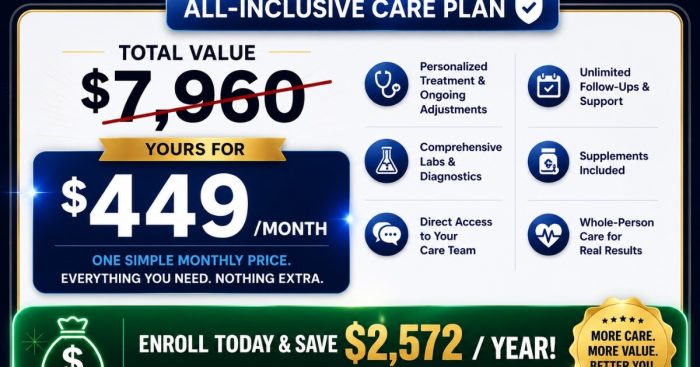
Show the total a la carte value of everything included next to the membership price.
That way, patients immediately see the financial advantage of enrolling.
In a live concierge program:
- Premium tier: $7,960 value vs. $449/month
- Middle tier: $2,905 value vs. $199/month
- Entry tier: $1,670 value vs. $99/month
Each tier also includes a savings statement such as:
“Enroll in membership and save $2,572 per year.”
This approach accomplishes three things:
- It justifies the membership fee.
- It frames enrollment as a financial gain rather than a cost.
- It makes the middle tier feel like the best overall deal.
As a result, patients stop comparing prices and start comparing value.
Never publish membership pricing without a value stack and savings calculation beside it.
Price alone invites comparison shopping.
Value creates enrollment.
How does the pricing structure itself drive retention and lifetime value?
The structure drives retention by front-loading recurring value into every tier.
At the same time, it creates a natural upgrade path that encourages patients to move up rather than cancel.
When memberships include services patients use regularly, such as:
- Refills
- Consultations
- Monthly therapies
- Member pricing on products
Cancelling becomes difficult because patients lose access to care they actively use.
That is a much stronger retention mechanism than a simple discount card.
Additionally, tiered memberships create built-in upsell opportunities.
A patient who starts on the entry tier and later adopts hormones or peptides naturally upgrades into a higher tier where those services are included or discounted.
That progression steadily increases lifetime value.
We have seen this model work firsthand.
One concierge clinic we work with grew from $1M to $4M in revenue running a membership at $1,000/month across roughly 250 members by combining recurring revenue with a structured upgrade path.
We have seen a similar outcome at a longevity and functional medicine clinic where membership-driven recurring revenue carried the growth.
How do you price a concierge membership so it is profitable, not just attractive?
Price every tier based on the loaded cost of included services plus your target margin.
Then position the displayed value so the membership feels like a strong deal without compromising profitability.
Start by calculating:
- Provider time per consultation
- Lab costs
- Supply costs for recurring therapies
- Discount costs on add-on services
Even your most active members should cost significantly less than the membership fee they pay.
At lower tiers, discounts should carry expensive categories such as hormones and peptides instead of fully included benefits.
The premium tier can absorb more inclusions because:
- Members pay a higher monthly fee.
- They often purchase additional services at member pricing.
Before launching any tier, model the worst-case heavy user.
Then verify profitability.
Attractive pricing that loses money on your most engaged members is one of the fastest ways to destroy a membership program.
FAQ’s About Concierge Medicine Membership Pricing
What is a typical price range for concierge medicine membership?
Concierge membership pricing varies significantly by model.
A tiered membership program may range from $99 to $449 per month across three tiers.
Meanwhile, a high-touch relationship-based concierge model can exceed $1,000 per month.
The right price depends on:
- Included services
- Target patient demographics
- Desired lifetime value
It should never be based solely on industry averages.
Should hormones be included in the membership or sold separately?
Include hormones only in the premium tier where pricing supports the cost.
For lower tiers, offer hormones at a member discount.
This protects profitability while making premium-tier upgrades attractive to hormone patients, who often become the highest-LTV members.
How do I get members to choose the middle tier?
Design the middle tier to offer the strongest value-to-price ratio.
Additionally, position it visually between a limited entry tier and a premium-priced top tier.
The premium tier acts as the anchor.
Meanwhile, the entry tier makes the middle option feel complete.
As a result, most members naturally select the middle package.
Can a new concierge clinic launch with this pricing structure?
Yes.
A three-tier structure works exceptionally well at launch because it provides:
- A low-risk entry point
- Clear upgrade opportunities
- Flexible pricing options
Start with conservative inclusions that remain profitable.
Then anchor every price against a clearly presented value stack.
As usage patterns emerge, refine the bundles accordingly.
How often should I revisit my membership pricing?
Review pricing annually at minimum.
Additionally, revisit pricing whenever service costs change significantly.
Track:
- Tier selection
- Service utilization
- Retention rates
- Churn by tier
Then adjust pricing and inclusions to ensure:
- The middle tier remains the strongest value
- Every tier remains profitable