
Why Don’t Your Own Patients Know What Your Clinic Offers? (The Bi-Weekly Service-Spotlight Email + Paperless Intake Playbook)
The strangest leak in a multi-service clinic’s revenue isn’t lost leads — it’s existing patients buying your services from someone else. On a strategy call with a functional medicine practice, the office manager put it plainly: current patients don’t even know we have peptides; they don’t know we do PRP or prolotherapy — they’ll source out someone else to do it. The fix we built is almost embarrassingly simple, and the early evidence was already in her inbox. This is the FAQ on the bi-weekly service-spotlight email system — and the paperless intake setup from the same call that smooths out every visit those emails generate.
Why are your own patients buying services somewhere else?
Because they don’t know you offer them — and telling them once doesn’t count.
The practice on this call is a naturopathic and functional medicine clinic with a deep service menu:
- Peptides
- PRP
- Prolotherapy
- IV therapy
- And more
Patients knew the clinic for what brought them in — their primary protocol — and routinely went elsewhere for services the clinic already performs.
The office manager’s own experience proved the awareness gap is real and fixable:
Past email blasts featuring “the fun stuff we have here in clinic” produced “a very high turnaround of people scheduling those items or buying those products.”
The kicker was an email that wasn’t even a promotion.
A holiday-hours announcement with a few wellness tips at the bottom generated calls from patients who’d just discovered a product the clinic had sold for years.
Patients were saying:
“I didn’t even know you guys made these; what’s in them?”
If a footer can sell, a system will.
What’s the right cadence for emailing your patient list?
Every two weeks.
- Weekly is overkill.
- Monthly lets them forget.
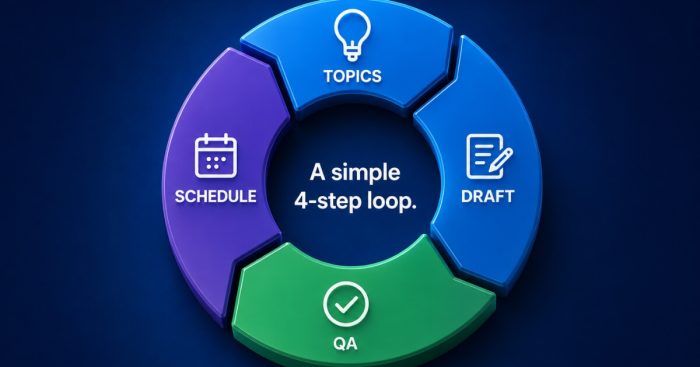
The production system is:
- Pick eight services patients chronically forget or never knew about.
- Draft emails in the clinic’s brand voice.
- Plug in booking links and contact information.
- Have the office manager QA each email for clinical accuracy and tone.
- Schedule all eight emails in the CRM.
The result:
| Item | Outcome |
|---|---|
| 8 emails | Created in one session |
| Every 2 weeks | Send frequency |
| 16 weeks | Marketing calendar completed |
That batching is the entire trick.
Clinics fail at patient email not because writing is hard, but because nobody owns a recurring task in a busy clinic.
Build the quarter’s emails in one sitting.
Schedule them.
Then let the system run while the front desk answers the calls it generates.
What makes a service-spotlight email actually convert?
One specific service per email, framed as education with a clear next step — not a generic “here’s what we do” brochure.
The office manager’s instinct on this was exactly right.
It’s the difference between:
Generic
“We’re your functional medicine clinic!”
and
Specific
“Did you know we offer PRP for joint pain — here’s how it works and who it’s for.”
The second version creates the:
“I didn’t know that.”
moment that produces bookings.
Patients had literally been told about these services during visits.
The provider’s frustration sounded like:
“I’ve told you a million times.”
But it still didn’t stick.
Why?
Because repetition in writing, service by service, is what sticks.
Structure of every spotlight email
Each email becomes a miniature condition-and-solution story:
- Who the service helps
- What it does
- What patients say
- The booking link
Sound familiar?
It’s the same education-first structure that makes clinic content rank in search and LLMs.
The spotlight email is simply that content aimed at the warmest audience you have, which is the heart of working medical practice marketing.
How valuable is the list you already have?
This clinic had:
| Metric | Count |
| Total Contacts | 6,500 |
| Email Addresses | 5,500 |
That’s a paid-acquisition audience most clinics would spend six figures to rebuild.
And it’s sitting idle.
Run the math implied by the call:
- 5,500 emailable patients
- Existing trust
- Existing awareness
- Existing relationship
Each person is a candidate for at least one service they don’t know you offer.
A bi-weekly spotlight that books even a fraction of a percent per send creates a steady stream of appointments at zero acquisition cost.
Every booking is also a patient going deeper into the practice rather than a stranger being convinced from scratch.
The list is also the cheapest cross-sell engine into recurring programs.
A patient who comes in for the spotlighted IV service is one conversation away from:
- A membership
- A program
- A protocol
- A long-term relationship
The high-LTV relationships that compound, the way an HRT clinic built 250 members paying $1,000 a month on its way from $1M to $4M a year.
How should the intake process handle the appointments those emails generate?
Digitally.
End to end.
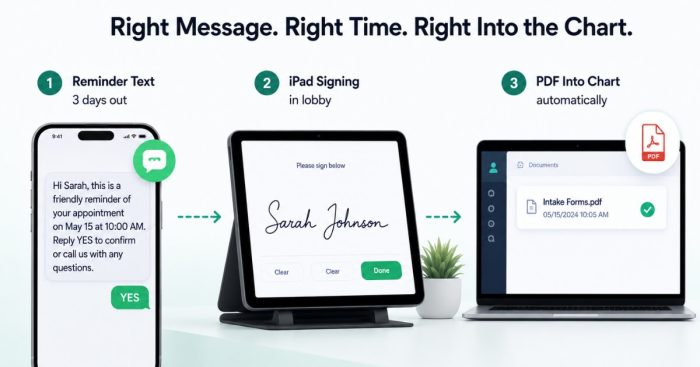
The system built during the call used GoHighLevel’s documents-and-contracts engine.
Core components
Intake Template
- One current template only
- Old copies retired
- Prevents staff from grabbing outdated forms
Required Signatures
- Signature fields required
- Forms cannot be submitted unsigned
Lobby iPad
- Dedicated reception email alias
- Patients never see staff inboxes
Reminder Automation
- Text reminder
- Email reminder
- Sent 3 days before appointment
Telehealth
- Same intake link
- Same workflow
Completion Automation
- Front desk receives completed PDF
- PDF attached automatically
- Ready for chart upload
The design principle from the call:
“It has to be easy enough for her to not want to say F it.”
If the digital workflow is harder than paper, staff will hand over paper.
Build for the front desk’s worst Tuesday.
Run one process for:
- In-person visits
- Telehealth visits
Not two.
What operational hygiene protects all of this?
Three simple rules:
1. One login per person
Never shared logins.
The clinic had staff sharing CRM credentials.
Problems created:
- Compliance risk
- Security issues
- Impossible troubleshooting
The clinic was already seeing text messages occasionally route to the wrong patient profile.
With PHI involved, that’s not an annoyance.
It’s a risk.
2. One communication platform
Every patient interaction should live in one place:
- Texts
- Emails
- Forms
- Conversations
The office manager’s exact words:
“I like using one area to be able to communicate with patients.”
3. Document every glitch
When a bug appears:
- Screenshot it
- Save the conversation link
- Capture the timestamp
Intermittent bugs only get fixed when there’s evidence.
It’s boring discipline.
But it’s what keeps a 5,500-contact communication engine trustworthy enough to run patient relationships on.
FAQ’s About Service-Spotlight Emails and Paperless Intake
How often should a clinic email its patient list?
Every two weeks.
- Weekly burns goodwill.
- Monthly lets patients forget.
Batch:
- 8 service topics
- 1 production session
- 16 weeks scheduled
What should each email cover?
One specific service patients forget or never knew about:
- Peptides
- PRP
- Prolotherapy
- IV add-ons
Frame it as:
- Who it helps
- How it works
- Why it matters
Include a booking link.
Generic “what we do” emails don’t create the:
“I didn’t know that.”
moment that books appointments.
Does emailing current patients actually produce revenue?
Yes.
This clinic’s past spotlight campaigns produced:
“A very high turnaround”
of bookings and product purchases.
Even a holiday-hours email generated calls about products patients never knew existed.
What does a paperless intake flow need?
- One current template
- Required signatures
- Dedicated reception email alias
- Lobby iPad
- Three-day reminder automation
- Same link for telehealth
- PDF delivery automation for charting
Why ban shared logins in the clinic CRM?
Because of:
- Compliance
- Security
- Diagnosability
Shared credentials make misdirected messages impossible to trace.
Individual accounts cost nothing and solve the problem.
What’s the next step?
If your patients are buying your own services from competitors, the problem isn’t your menu — it’s that nobody’s reminding them it exists.
Start with:
- Pick eight forgotten services.
- Write the spotlight emails once.
- Schedule them every two weeks.
- Let your warmest audience rediscover you.
Then make sure the visits those emails create run through a paperless intake flow your front desk will actually use.
If you want the full patient-communication engine built — the spotlight calendar, the intake automations, and the CRM hygiene underneath — book a strategy call.
We’ll map your list’s revenue potential on the call and wire it into your medical practice marketing and patient acquisition systems.