
Why Does My Clinic’s Ad Account Keep Getting Banned (and How Do I Recover It)?
If you run a cash-pay medical practice, getting your ad account suspended is not a question of if — it is a question of when, and whether you have a plan for it.
Weight-loss, hormone, GLP-1, and medical offers live inside the exact policy categories Meta and Google police hardest. Unfortunately, the same automated systems that kill scam supplement ads cannot always tell the difference between a sketchy fat-burner and a licensed clinic running a real semaglutide program.
This is the field guide we wish every clinic owner had before their first ban — the real triggers behind Meta and Google suspensions, how to stop them before they happen, and the exact recovery and escalation steps that actually get accounts reinstated.
Why does my medical clinic’s Facebook or Google ad account keep getting banned?
Because clinic ad accounts sit inside the two categories the platforms police hardest:
- Health claims
- Restricted products
As a result, most clinics trip the automated systems without realizing it.
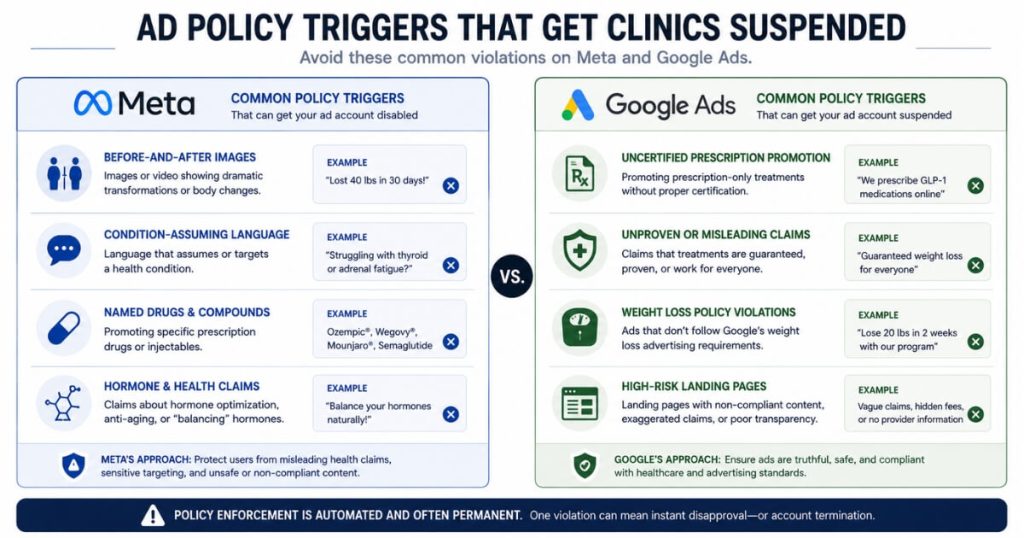
Common Meta triggers
The biggest Meta triggers include:
- Before-and-after photos
- Weight-loss or body-shaming language
- Copy that implies you know the user’s health condition
- Promoting prescription drugs by name
- Hormone and testosterone language
- Personal-attribute targeting
Examples include naming:
- Ozempic
- Wegovy
- Semaglutide
- GLP-1 medications
Common Google triggers
Google watches for:
- Prescription-drug promotion without certification
- Unapproved health claims
- Weight-loss policy violations
- Landing pages that appear high-risk
There is also a second layer of risk: account history.
That includes:
- Failed payments
- Frequent payment-method changes
- Sudden spending spikes
- New accounts running aggressive health offers
- Multiple ad disapprovals
Most clinics are not banned because of one terrible ad.
Instead, the machine-learning system stacks several smaller warning signals together and decides the account is high-risk.
The frustrating part is that legitimate medical offers often look identical to scam offers from the platform’s perspective.
A licensed GLP-1 clinic can trigger the same systems that were originally built to stop fake supplement advertisers.
This is one of the most common firefights in medical practice marketing, and it is survivable when you understand the machine you are working against.
What specific ad content gets a clinic suspended on Meta (Facebook and Instagram)?
Five things trigger Meta suspensions more than anything else:
- Before-and-after imagery
- Weight-loss or body-shaming language
- Condition-assuming copy
- Named prescription drugs
- Hormone or sexual-health claims
Before-and-after photos are especially dangerous for weight-loss and aesthetic clinics.
Meta’s Personal Health and Appearance policy restricts content that:
- Shows idealized results
- Implies someone’s body should be changed
- Highlights personal insecurities
Condition-assuming copy creates another issue.
For example:
“Are you struggling to lose those last 20 pounds?”
This violates Meta’s personal-attributes policy because it implies knowledge of the user’s health status.
Drug names create even more risk.
Mentioning:
- Ozempic
- Wegovy
- Semaglutide
- Tirzepatide
- Testosterone
can lead to ad disapprovals or account restrictions if the proper certifications are not in place.
Hormone, TRT, and sexual-wellness content also sits in a heavily restricted category.
Because Meta enforcement is account-wide, several disapprovals within a short period can move an account from warning status to permanent restriction.
The clinics that survive on Meta focus on:
- The problem
- The lifestyle outcome
- The provider
- The clinic experience
They avoid focusing on:
- The drug
- The diagnosis
- The body itself
This is exactly how an orthopedic surgical practice scaled with us to $2M in revenue from Facebook ads alone — compliant creative that never gave the algorithm a reason to pull the account.
What gets a clinic’s Google Ads account suspended for medical or weight-loss content?
The biggest Google suspension triggers are:
- Promoting prescription drugs without certification
- Exaggerated health claims
- Weight-loss policy violations
- High-risk landing pages
Google’s Healthcare and Medicines policy requires certification before advertising prescription-only medications.
As a result, clinics naming GLP-1 drugs without the proper certifications frequently get suspended.
Claims also matter.
Statements like:
- “Reverse your neuropathy”
- “Melt fat fast”
can trigger healthcare and misrepresentation policies.
Landing pages matter just as much as ad copy.
Google crawls the destination page and evaluates:
- Medical claims
- Credentials
- Compliance signals
- Commercial intent
If the page looks like a prescription marketplace or an unverified health offer, the account can be flagged even if the ad itself is compliant.
Google also monitors account-level risk factors, including:
- Suspicious payment activity
- Circumventing systems
- Rapid scaling
- Connections to previously suspended accounts
The solution is straightforward:
- Obtain the required healthcare certifications
- Keep claims conservative
- Present the clinic as a legitimate medical practice
- Display real credentials and policies
Done correctly, Google often becomes the lowest-cost lead source available.
For example, we cut one wellness clinic’s Google cost per lead by 50% while maintaining full policy compliance.
How do I prevent my clinic’s ad account from getting banned in the first place?
The best defense is treating compliance as part of campaign strategy from day one.
Start with the foundation:
- Verified Meta Business Manager
- Verified Google Ads account
- Real business entity
- Verified domain
- Stable payment method
Many clinics trigger account reviews simply because a payment fails or a card changes.
Next, create compliant creative by default.
Avoid:
- Before-and-after photos
- Condition-assuming language
- Named prescription drugs
- Aggressive health claims
Instead, focus on:
- Provider expertise
- Patient education
- Lifestyle outcomes
- Consultation offers
Your landing page also matters.
Make sure it clearly shows:
- Medical credentials
- Privacy policy
- Real clinic information
- A legitimate consultation process
Then secure the certifications that apply to your offer.
These may include:
- Google healthcare certifications
- Pharmacy certifications
- LegitScript approval
Finally, build redundancy before you need it.
Maintain:
- A second verified ad account
- Additional business pages
- A documented appeal process
That way, one suspension does not shut off patient flow overnight.
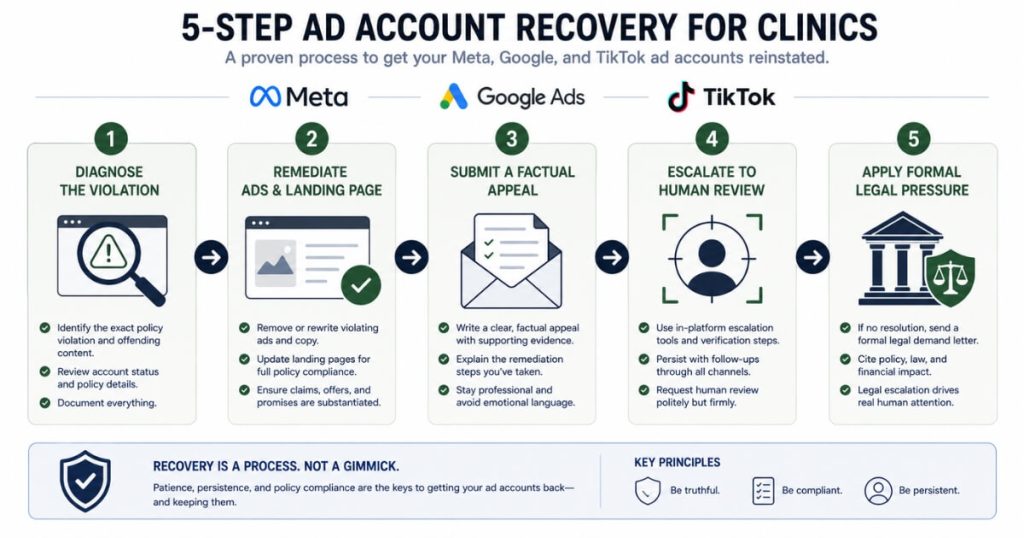
What are the exact steps to recover a banned clinic ad account on Meta or Google?
Step 1: Identify the violation
Open:
- Meta Account Quality
- Google Policy Manager
Find the exact policy cited.
You cannot fix a problem you do not understand.
Step 2: Correct the issue
Review:
- Ad copy
- Creative
- Landing pages
- Payment methods
- Verification status
Remove anything that violates policy.
Step 3: Submit the appeal
Use the official review process.
Include:
- Business licenses
- Medical credentials
- Required certifications
Keep the appeal factual and professional.
Step 4: Escalate
If the automated review fails:
- Request human review
- Contact support
- Save reference numbers
- Document communications
Step 5: Apply formal pressure if necessary
Many clinics stop after the first denial.
However, some recoveries require:
- Legal letters
- Formal documentation
- Regulatory escalation
We have seen accounts restored only after legal intervention forced a human review.
The platforms often move once the cost of ignoring the issue exceeds the cost of reviewing it.
Should I just start a new ad account instead of trying to recover the banned one?
Usually, no.
Creating a new account to avoid a suspension is considered circumventing systems, which is itself a bannable offense.
Both Meta and Google track:
- Payment methods
- Domains
- Devices
- IP addresses
- Business entities
As a result, replacement accounts often get suspended quickly.
The better approach is:
- Exhaust the appeal process.
- Correct the original issue.
- Recover the existing account if possible.
A recovered account keeps:
- Historical spend
- Conversion data
- Pixel data
- Trust signals
A brand-new account starts from zero.
There are rare situations where a new account is appropriate.
However, it must be:
- Properly verified
- Compliant
- Structurally different from the suspended setup
The smartest clinics prepare before problems occur by maintaining verified backup assets.
Which ad platforms are safest for clinic and weight-loss advertising right now?
No platform is completely safe.
However, the risk profile varies significantly.
Highest scrutiny
- Meta
These platforms offer the most reach but enforce the strictest policies.
Moderate risk
- TikTok
TikTok suspends aggressively but accounts are often recoverable through persistence and escalation.
Lower scrutiny
These platforms are generally more permissive with wellness and health-related content.
Pinterest is especially attractive because it naturally attracts:
- Women
- Wellness-focused consumers
- Weight-loss audiences
Reddit also tends to allow health discussions that would struggle on Meta.
The safest strategy is not choosing one platform.
Instead, diversify.
A multi-channel approach ensures that a suspension on one platform never reduces patient acquisition to zero.
That strategy helped a weight-loss and medspa clinic generate $6.7M in revenue across 3,727 new patients using a diversified paid-media engine.
FAQ’s About Recovering a Banned Clinic Ad Account
How long does it take to recover a banned clinic ad account?
Recovery can take anywhere from a few hours to several weeks.
Simple cases may resolve within 24 to 72 hours.
Health-related accounts often require additional reviews and escalations.
Formal legal pressure can sometimes accelerate stalled cases.
Can I get banned just for naming Ozempic or Wegovy in my ad?
Yes.
Naming prescription GLP-1 drugs without proper certification is one of the most common reasons health ads are disapproved.
Multiple disapprovals can escalate into account-level restrictions.
Keep drug names behind the consultation process whenever possible.
Will appealing a suspension make it worse?
No.
A factual, professional appeal is the correct path.
What does make things worse is creating duplicate accounts to avoid the suspension.
Platforms treat that as ban evasion and punish it more aggressively than the original violation.
Why did my account get banned when my competitor runs similar ads?
Enforcement is account-specific.
The platform evaluates:
- Account history
- Payment stability
- Certifications
- Landing pages
- Prior disapprovals
Two clinics running similar offers can receive very different outcomes.
Should every clinic have a backup ad account?
Yes.
At a minimum, maintain:
- A second verified ad account
- Additional business pages
- Presence on alternative platforms
Redundancy is inexpensive insurance.
A suspension should slow growth, not stop it entirely.