
How Should a Cash-Pay Telehealth Weight-Loss Clinic Set Up Booking and Ads to Stop Losing Patients? (Cost-Per-Schedule, Not Cost-Per-Lead)
A cash-pay telehealth weight-loss clinic rarely has a lead problem. It has a leak problem — patients lost between the ad click, the form fill, and the booked, attended consult. The clinics that fix it standardize one free consult with a card on file, run everything through a CRM, and stop optimizing for cheap leads that never book. Here’s the FAQ on setting up booking and ads so the patients you’re already paying for actually show up.*
How should a cash-pay telehealth weight-loss clinic set up booking and ads to stop losing patients?
Standardize a single free 15-minute telehealth consult with a card on file, run every booking through one CRM calendar with automated reminders, and judge ads by cost per schedule, not cost per lead.
Those three moves close the three biggest leaks:
- The card-on-file requirement drives attendance above 95%.
- The single CRM calendar keeps a multi-provider team coordinated and prevents leads from scattering.
- Cost-per-schedule tracking exposes which channels actually produce booked patients.
The critical sequencing rule:
Fix the booking flow before you scale ad spend, because there’s no point driving more paid clicks into a funnel that drops them.
This funnel discipline is the same engine behind a weight-loss clinic where we added $6.7M in revenue in one year across 3,727 new patients.
Should the telehealth consult be free or require a deposit?
Make it free, but require a credit card on file.
A free consult removes the barrier that stops a curious weight-loss prospect from booking in the first place.
The card requirement filters out the no-shows.
Together, they can push attendance above 95%.
You’re not charging the card for the consult.
You’re using it as a commitment device.
The distinction matters because a calendar full of free bookings that ghost is worse than useless.
It:
- Burns provider time
- Creates the illusion of demand
A calendar full of card-on-file bookings that actually show up is the foundation everything else is built on.
Why am I getting leads but no booked appointments?
Because you’re optimizing for cost per lead instead of cost per schedule.
The cheapest leads are frequently the most expensive traffic you can buy.
In practice, one channel produced the lowest cost per lead but a cost per schedule roughly three times higher than another — because almost none of those cheap leads ever booked.
One agency campaign:
- Spent $70
- Generated seven leads
- Booked exactly zero
If you only watch cost per lead, that looks fine.
If you watch cost per schedule, it’s a disaster.
Track what it actually costs to produce a booked, attended appointment, and move spend toward the channels that fill your calendar.
That conversion-first thinking is what lets a clinic convert leads at rates like the 79.4% lead-to-booked conversion we drove at a cash-pay clinic.
Where should I send paid traffic — Google, TikTok, or Facebook?
Lead with Google and TikTok, which deliver a healthy cost per schedule, and treat Facebook with caution.
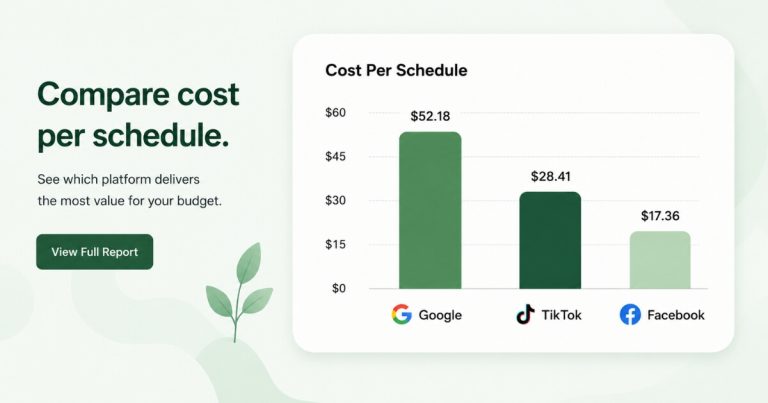
For a cash-pay weight-loss telehealth clinic:
- Google Ads captures the high-intent search demand.
- TikTok reaches the 30-to-50 female weight-loss and hormone audience with a workable cost per schedule.
- Facebook can produce cheap leads, but its cost per schedule often runs around three times TikTok’s.
Cheap clicks that don’t book.
Keep a small Facebook test running for volume if you like, but build on the channels that actually produce appointments.
And don’t relaunch any paid campaign until the booking flow is fixed.
Clicks into a broken funnel just convert ad budget into frustration.
Should I use my EHR or a CRM for telehealth bookings?
Use a CRM for the consult-booking flow — not your EHR.
Pushing new consult leads into the EHR tends to bury them in a queue where they get lost.
A CRM lets you:
- Call from inside the tool
- Record from inside the tool
- Automate new-booking notifications
- Automate patient reminders
- Work the lead as a flow rather than a chart
Sync each provider’s calendar into the CRM so appointments land on their phones.
Keep one shared calendar so a multi-provider team stays coordinated.
Critically, set up reminders that catch the last-hour booking gap.
When someone books an appointment an hour ahead and nobody reminds them, they usually miss it.
Automating that single reminder recovers appointments most clinics quietly lose.
Should I put prices in my weight-loss ads?
Yes — stating the price up front pre-qualifies clicks and lifts your schedule rate.
Putting a price range in the ad or on the landing page —
“Patients typically invest a few hundred dollars a month; is that comfortable for you?”
— filters out tire-kickers before they consume a consult slot.
The people who click anyway are signaling they can pay.
So the ones who book are far more likely to convert.
This is the opposite of the instant-form approach that maximizes cheap leads.
You’re trading raw lead volume for booked, qualified patients, which is exactly what cost-per-schedule thinking rewards.
Pair price-qualified ads with a simple landing page and one-click scheduling, and the gap between click and booked appointment shrinks dramatically.
FAQ’s About Telehealth Weight-Loss Booking and Ads
What is cost per schedule and why does it matter more than cost per lead?
Cost per schedule is what you spend to produce one booked, attended consult.
It matters more than cost per lead because a cheap lead that never books is the most expensive traffic you can buy — only booked patients generate revenue.
How does a card on file raise attendance?
It acts as a commitment device.
A free consult lowers the barrier to booking, and the card requirement filters out people who never intended to show, which together can push attendance above 95%.
Why not just keep leads in my EHR?
Consult leads tend to get lost in the EHR’s queue.
A CRM lets you call and record from inside the tool, automate reminders, and work each lead as a flow — far better suited to converting inquiries into booked patients.
Should I fix booking or scale ads first?
Fix booking first.
Scaling ad spend into a broken booking flow just buys more dropped patients.
Get the free-consult-with-card model, the CRM calendar, and the reminders working, then turn the traffic up.
What’s the next step?
If your telehealth weight-loss clinic is generating leads but not booked patients, the fix isn’t more spend — it’s a tighter booking flow and cost-per-schedule discipline.
Stop the leak first, then scale the channels that actually fill your calendar.
On a free strategy call we’ll audit your booking flow, your CRM setup, and your channel mix, and show you exactly where the gap between click and consult is costing you patients.