
What Should a Cash-Pay Medical Practice Automate — and What Should It Never Automate?
The 5-Stage Decision Map for Lead Gen, Nurture, Conversion, Delivery, and Resell
Every cash-pay medical practice owner reaches a point where the volume of inbound work outpaces the staff bandwidth, and the natural move is to automate everything that touches a patient. The clinics that scale do not. They automate the operational moves that don’t require human warmth — appointment confirmations, intake form delivery, review requests, patient journey emails — and they leave the human moves human. The mistake that quietly kills retention at a cash-pay clinic is automating the calls, the referrals, and the consultations themselves. Here’s the FAQ on what to automate at each stage of the patient lifecycle, and what destroys the patient relationship the moment you try.
What should a cash-pay medical practice always automate?
There are five categories every clinic should automate:
- Lead-gen auto-responders
- Appointment confirmations and reminders
- Patient-focused intake forms
- Review requests with a screening step
- Patient journey nurture emails
These five perform the same job a human assistant would do. However, they do it faster, cheaper, and even at 3am when the staff is asleep.
For example, a new lead fills out a website form at 11pm. Immediately, an auto-responder confirms the request and lets the lead know someone will follow up tomorrow.
Likewise, appointment confirmations and reminders fire automatically from the EHR or GoHighLevel.
As a result, the front desk can focus on work that actually requires a person.
In addition:
- Intake forms go out two days before the first consult.
- Reminder messages follow if forms remain incomplete.
- Review requests are sent after treatment or at the 90-day membership mark.
- Patient journey emails keep members engaged at months 1, 3, 6, and 12.
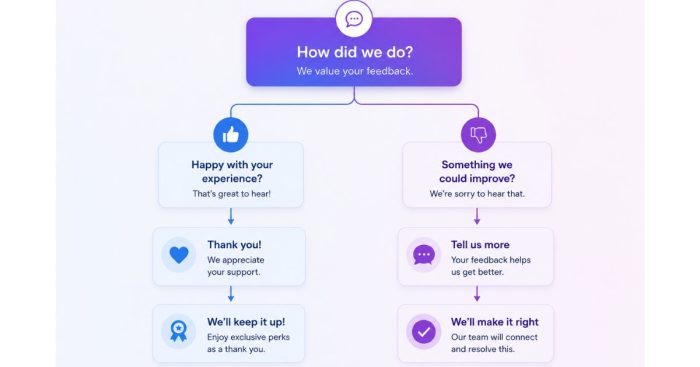
Review requests should also include a thumbs-up/thumbs-down branch. This determines whether patients see a Google My Business link or an internal feedback form.
Ultimately, all five automations are operational.
More importantly, all five make the clinic feel more responsive, not less personal.
What should a cash-pay medical practice never automate (and why)?
There are four categories that should remain human:
- The sales conversation
- Calling leads to book them
- Asking for patient referrals
- Membership check-in calls
Each of these moments depends on human connection.
The rule is simple:
If the moment is meant to build relationship or capture intent, do not automate it.
Understanding what to automate and what not to is often the difference between building operational efficiency and accidentally weakening the patient relationship.
The sales process is the clearest example.
Today, many clinics use video webinars as pre-consult education. They expect the video to warm up the patient before the consult.
However, that rarely happens.
The patient who watches a 20-minute prerecorded video about your offer is not warmed up. Instead, they’re often inoculated.
The same principle applies to lead booking.
Texting a prospect to schedule a consult instead of calling them reduces attendance rates by 20% to 40%.
Why?
Because the patient is multitasking while texting.
By contrast, the phone call creates commitment.
Referral requests belong in the same category.
Patients refer specific people they trust. They do not refer clinics.
The referral request that converts is:
“by the way, I just wanted to thank you personally, and if you know anyone who would benefit from what we did together, I’d be honored if you sent them my way.”
Meanwhile, the referral request that doesn’t convert is an automated email signed:
“the team at the clinic.”
Membership check-in calls should also remain human.
A five-minute call from a coordinator can be worth $1,000 a month in retained recurring revenue.
Consequently, the automation that replaces that call becomes the most expensive cost-cutting move a clinic can make.
Should a cash-pay medical practice automate appointment confirmations and reminders?
Yes — for roughly 90% of the patient base.
However, high-LTV bookings deserve a manual call.
That includes:
- Initial consults priced at $600+
- Six-month-program enrollments
- Post-cancellation re-enrollments
For everyone else, automated reminders work well.
Set up SMS and email reminders at:
- 48 hours
- 24 hours
- 1 hour
before the appointment.
This system handles volume efficiently.
Meanwhile, the patient coordinator manually calls the highest-value bookings the day before.
The clinics that consistently achieve 85%+ attendance rates use exactly this approach.
In other words:
- Automation handles the long tail.
- Humans handle the high-value tail.
By contrast, clinics that automate every confirmation often plateau at 60% to 70% show rates.
The math is simple.
A manual confirmation call costs pennies.
A no-show on a $600 consult costs the entire consult.
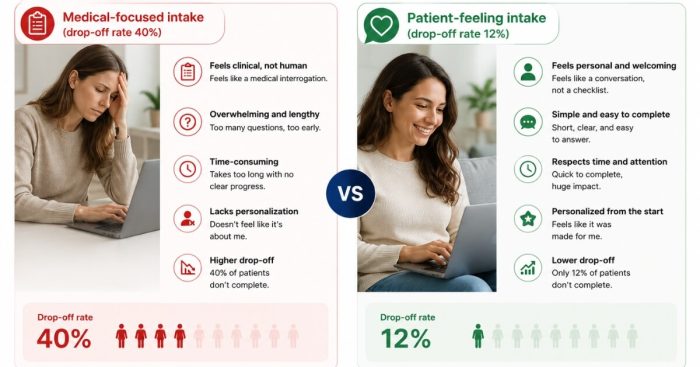
How should a cash-pay clinic automate its intake form for higher conversions?
Build the intake form in GoHighLevel.
Then structure the questions around:
- How the patient feels
- How the patient wants to feel
Avoid making the form primarily about medical history.
Most clinics make that mistake.
Instead, they ask for:
- Medications
- Conditions
- Insurance information
As a result, patients feel like they are feeding a bureaucracy.
Higher-converting clinics take a different approach.
They ask:
- What would your life look like if this problem were fixed?
- What have you already tried?
- What’s at stake if nothing changes?
These questions pre-sell the consult.
Furthermore, they help patients articulate their own motivation.
By the time patients arrive for the first consult, they have already written down the reasons they want treatment.
Consequently, providers no longer need to extract that motivation from scratch.
The automation itself is straightforward:
- Form delivered two days before the consult
- Reminder one day before
- SMS confirmation one hour before
The delivery is automated.
However, the conversion lift comes from the content of the questions.
When should a cash-pay clinic ask patients for Google reviews — and how do you screen for negative reviews?
For one-off services, ask on the day of treatment.
For membership patients, ask at the 90-day mark.
However, never send patients directly to Google.
Instead, route them through a thumbs-up/thumbs-down screening page.
The process looks like this:
Thumbs Up
→ Google My Business review page
Thumbs Down
→ Private feedback form
The feedback form should notify both the practice owner and the patient coordinator.
As a result, the clinic can address concerns before they become public reviews.
Additionally, these responses become an internal goldmine.
They surface:
- Protocol issues
- Staff issues
- Operational gaps
Timing matters as well.
A patient on day one of a six-month membership has little to review.
However, a patient at day 90 has results, experiences, and a real relationship with the clinic.
Should a cash-pay membership clinic automate the entire patient journey nurture sequence?
No.
Automate the emails and SMS messages.
Do not automate the human check-ins.
The blended approach drives retention beyond 12 months.
The pattern is common among clinics that retain more than 70% of members past year one.
Automated Touchpoints
- Month 1
- Month 3
- Month 6
- Month 9
- Month 12
Human Touchpoints
- Month 3 coordinator call
- Month 6 coordinator call
Each call lasts about five minutes.
Each call includes three questions and a clear next step.
The emails handle volume.
Meanwhile, the calls strengthen the relationship.
As a result, patients experience the cadence as care rather than marketing.
A cash-pay HRT and functional medicine membership clinic we helped scale from $1M to $4M over four years runs exactly this blended structure — and the consistency of the human check-in cadence at month 3 and month 6 is one of the structural reasons the clinic’s year-one retention is meaningfully above its competitors.
Automating the entire sequence would be cheaper.
However, automating the entire sequence would also gut retention.
Why can’t a cash-pay medical practice automate calling leads and asking for referrals?
Because both activities depend on a patient feeling that a specific human is paying attention.
Automation cannot deliver that signal.
The difference is dramatic.
Leads who receive a phone call convert at roughly 30% to 50%.
Meanwhile, leads who only receive automated text follow-up convert at roughly 5% to 10%.
The psychological state is different.
A patient answering a phone call is:
- Listening
- Engaged
- Committing
By contrast, a patient reading a text is usually multitasking.
Calling is expensive.
Nevertheless, it remains the highest-converting sales activity in the clinic.
Most clinics stop after one or two attempts.
The highest-performing clinics:
- Call three to five times
- Spread attempts across two weeks
- Leave voicemails
- Use SMS between calls
Importantly, they use SMS as a reminder rather than a replacement.
Referrals follow the same pattern.
Patients refer people they trust to providers they trust.
They say:
“go see Dr. Lopez at MVP Men’s, ask for her by name.”
They do not say:
“go to that clinic, they automate their referral emails really well.”
Therefore, the referral ask must stay human.
The clinic can track the referral in GoHighLevel.
However, the ask itself should never be automated.
What’s the next step?
If your cash-pay medical practice is automating things that should stay human — or manually handling every confirmation, intake, and review request because nobody has built the workflows — the automation map is the missing layer.
The framework is simple:
Automate These Five
- Lead-gen auto-responders
- Appointment confirmations
- Intake delivery
- Review requests
- Patient nurture emails
Keep These Four Human
- Sales conversations
- Lead booking calls
- Referral requests
- Membership check-ins
In addition, pair automated nurture with human follow-up at the membership level.
These are the same operating decisions we install at every cash-pay HRT, functional medicine, and concierge clinic we work with.
In a 60-minute strategy call, we’ll audit your current automation stack, identify the human-touch gaps, and build the workflow map your team needs.