
Which Marketing Channel Should a Cash-Pay Medical Practice Use for Each Treatment? (The Filler → TikTok, Joint Pain → Facebook, TRT → SEO Map)
There is no “best ad platform” for a cash-pay medical practice. There is only the right channel for the specific treatment you sell. The clinics that scale fastest stop arguing about TikTok vs Facebook vs Google and start mapping each offer to where the right buyer actually lives — because filler buyers, joint-pain sufferers, and TRT patients do not behave the same way, do not search the same way, and do not convert on the same creative. This is the synthesis article — the treatment-to-channel map pulled directly from the field. After running every major patient-acquisition channel across 40 of the fastest-growing cash-pay medical clinics in the country, this is the FAQ on which channel to use for which treatment.
Why does the right marketing channel for a cash-pay medical practice depend on the specific treatment — and not on a generic “best ad platform”?
Because each treatment lives at a different stage of awareness, attracts a different demographic, and carries a different cash ticket — and channels are not interchangeable across those three variables.
The 5 Stages of Awareness explain most of it.
- A filler patient is Product Aware — they already know what filler is and they are choosing who to buy it from.
- A gut-health patient is only Problem Aware — they know something is wrong and imagine solutions exist but do not know where to start.
- GLP-1 and TRT have moved into Product Aware, which is why search-driven channels suddenly work for them.
Map the treatment to the awareness stage and the channel becomes obvious — Product Aware buyers respond to Google and YouTube because they are searching by name, Problem Aware buyers respond to discovery channels like TikTok and Facebook because they are not searching yet.
Demographics and ticket size finish the equation.
- TikTok skews female and aesthetic-curious.
- Conservative talk radio reaches Low-T-eligible men.
- TV long-form infomercials are watched by older audiences with the time and motivation to call a 1-800 number for knee pain.
A $300 filler offer cannot live on the same channel as a $20K neuropathy program — the audience, the creative, the funnel, and the cost-per-acquisition math are all different. Pick the channel based on those three variables together, not on what your competitor is running.
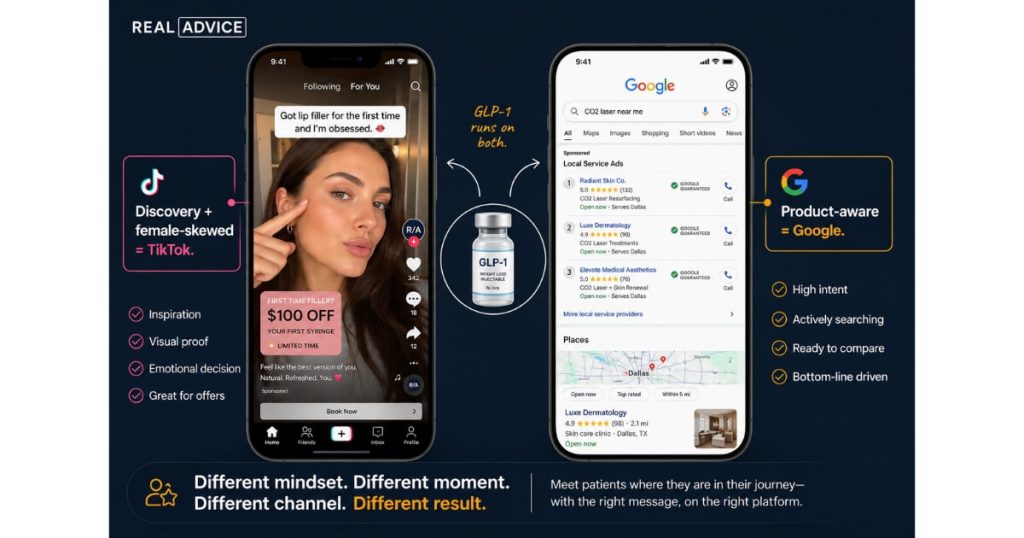
Which marketing channels work best for aesthetic and cosmetic treatments (filler, lasers, body contouring, GLP-1)?
TikTok for discovery and Google for name-search, with GMB and organic social compounding both — that is the medspa stack.
TikTok
is the lead channel for aesthetics.
It is a primarily female audience, so anything aesthetic or cosmetic does well there:
- filler offers
- CO2 laser offers
- any laser offer really
- body contouring
- GLP-1
- hormone
Testimonials or stories about real patient experiences outperform polished brand creative every time, and you should always include the offer in the ad or a video of the procedure being done if you can get the consent.
Historically, TikTok has produced a lower CPL and CAC than any other paid platform for aesthetic offers.
Run:
- To a lead form if you want volume
- To a landing page if you want quality
- To a scheduling page with a credit-card hold if you want only people who are ready to book
Google and YouTube
Google and YouTube cover the Product Aware demand — botox, filler, CO2, and GLP-1 are all things people search for by name.
Start with:
- tight phrase-match on terms you already know people are typing
- get some conversions
- then graduate to Performance Max with assets so YouTube starts compounding
Run to a landing page because you want to track conversions, escalate to a quiz if you want higher quality, and use a scheduling page with a credit-card field if you want only the most-aware buyers.
Facebook/Instagram
Facebook/Instagram works for medspa too, but it shines for body contouring and any $3K+ front-end cash offer because the diverse audience needs aggressive offers and a fast-followup operation.
We saw this stack compound in real time at a weight-loss and medspa clinic where we added $6.7M in revenue in one year across 3,727 new patients — TikTok pulled the front-end aesthetic demand, Google captured the GLP-1 name-search, and the brand presence on social made every other channel convert better.
GMB and organic social are not optional here; they are the multipliers.
Which channels actually convert hormone, TRT, and HRT patients at a cash-pay clinic?
SEO and GMB first, Google/YouTube second, with radio and events stacking on top for the segments other channels miss.
Hormone is the textbook recurring high-LTV cash-pay business — and SEO is the default for all high-LTV recurring care, including:
- HRT
- TRT
- functional medicine
- longevity
- regenerative medicine
SEO produces the leads most ready to buy and most familiar with the business, and when you couple it with strong Google reviews and an established social brand, it compounds for years.
On-page SEO rewards:
- search-intent match
- title and header tags
- content depth
- internal linking
- URL structure
- site speed
- fresh content
GMB rewards:
- accurate services
- an accurate description with keywords people actually type
- frequent reviews that mention the services you want to be found for
- GMB posts tied to the same topics
Google and YouTube ads pick up the rest of the TRT and HRT demand because patients are Product Aware and searching by name.
Cost per lead is what matters here — quality is already high enough that the sales process can carry it.
Radio is the underrated TRT and Low-T channel, especially conservative talk radio when you can get the host to talk about or recommend the offer.
Podcast host-reads work the same way; a little more expensive, but they convert.
Events at:
- gyms
- marathons
- Pilates studios
- boot camps
…round it out — a free-labs offer or an on-the-spot B12 or IV injection captures the lead before the offer is given, which is the part most clinics miss.
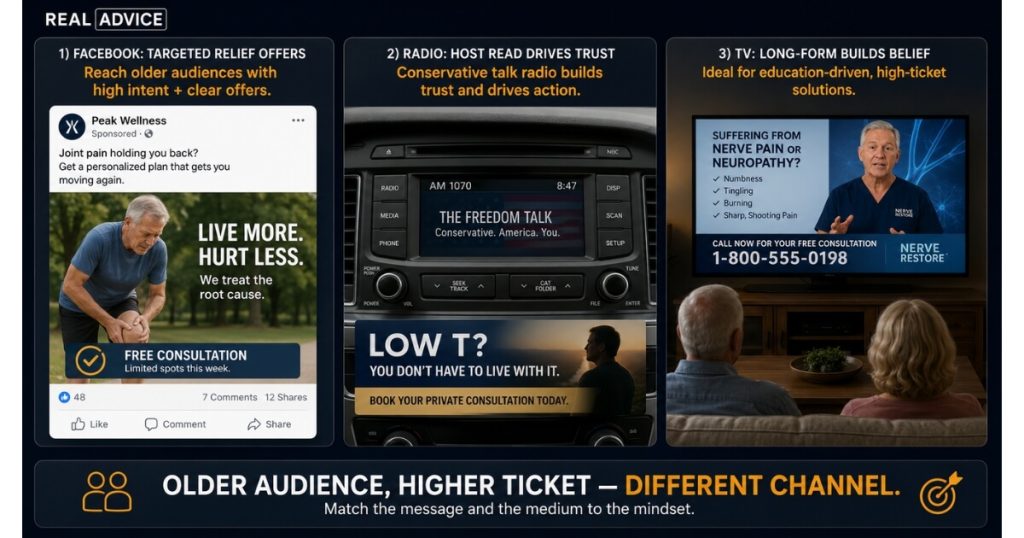
Which channels convert regenerative-pain, joint-pain, neuropathy, and orthopedic patients at a cash-pay clinic?
Facebook/Instagram for joint pain and neuropathy under $20K, and long-form TV for programs above $20K — with SEO as the always-on layer underneath both.
Facebook/Instagram
Instagram/Facebook is the workhorse for:
- joint pain
- neuropathy
- any $3K+ front-end-cash offer in this category
The diverse audience supports the high-ticket spend and the aggressive-offer creative this category needs, but you cannot run it without fast follow-up — most of the time, cash needs to come in as fast as you are putting it out.
The playbook:
- audience callout in the copy and image
- static and video creative tested in parallel
- aggressive offer
- VSL or quiz funnel
- calendar with a credit-card hold
The case study people ask about most in this category is an orthopedic surgical practice where we added $2M in revenue from Facebook ads alone — that is what dialed-in FB looks like when the offer, the ad team, and the follow-up are all in place.
TV
TV is the channel for $20K+ programs — long-form infomercials for neuropathy and knee pain.
The person watching long-form TV:
- is older
- has the time to engage with a 20-minute pitch
- will call a 1-800 inbound-call ad when the pain story matches their life
SEO
SEO is the always-on layer for everything in this category because pain is a search-first behavior — patients are problem-aware and typing in symptoms, locations, and treatment names.
GMB does heavy lifting for the local-search slice because most ortho and regen clinics are competing within a 25-mile radius.
Which channels work for functional medicine, longevity, gynecology, and weight loss at a cash-pay clinic?
SEO and Local Service Ads first, with Google/YouTube and events filling in — and TikTok layered on top for the GLP-1 slice of weight loss.
Local Service Ads
Local Service Ads are underused here because most clinics cannot navigate the policies to get approved.
These categories qualify:
- weight loss
- functional medicine
- holistic medicine
- gynecology
The gynecology approval is a quiet superpower because it opens the door to upselling patients into hormone programs.
LSAs are:
- pay-per-call
- top-of-funnel by phone
- boosted by the Google trust badge
SEO
SEO is the long-term moat for this entire category — functional and longevity patients spend weeks researching before they book, and they choose the clinic that shows up across:
- blog content
- GMB
- review signals
…at the same time.
Additional channels
Google and YouTube ads cover the Product Aware GLP-1 and weight-loss search demand.
Events at:
- gyms
- marathons
- Pilates studios
- boot camps
…work especially well for functional and longevity because the audience self-selects as active and motivated.
Offer:
- free labs
- a B12 shot
Capture the lead on the consent form before the service is given, and convert from there.
TikTok works for the GLP-1 slice of weight loss because the buyer overlaps heavily with the medspa-aesthetic audience.
What about telehealth-only services like ADHD, direct primary care, and concierge — which channels actually work?
ZocDoc first for the gateway visit, then your own SEO and organic social to retain and upsell — paid social and Google work as accelerators but rarely as the lead horse.
ZocDoc has evolved into the starting point for people who want fast telehealth care, and it is pretty much all telehealth at this point.
For direct primary care and concierge:
- a lot of people just want to see a primary care doctor
- if you build the relationship and you service them well virtually, you can predictably acquire customers this way
The attendance rate is good, the appointments are paid, and you make your money back quickly.
ADHD and weight loss are the two highest-volume verticals on ZocDoc and they both upsell into broader telehealth offerings if you have a real service ladder built behind the first visit.
SEO and organic social do the retention and upsell work — a concierge or DPC patient who finds your educational content stays longer and pays more.
Google ads can work for ADHD and weight loss but only if you can navigate platform policy, and FB/IG can scale paid telehealth offers once the ZocDoc-first economics prove out.
The mistake to avoid is treating telehealth like a medspa funnel — the buyer behavior is closer to “find me a doctor I can talk to today” than “I want a $1,500 treatment by Friday.”
How do you stack channels per treatment to compound (e.g., Google + SEO for TRT, FB + Radio for joint pain, TikTok + GMB for medspa aesthetics)?
You pick one lead channel per treatment, you maximize it before adding a second, and then you stack the second channel based on what gap it fills — intent, demographic, or ticket size.
This is where the treatment-to-channel map becomes valuable. Instead of treating every service the same, the highest-performing cash-pay clinics match each treatment to the channel that best fits the buyer’s awareness stage, demographics, and expected cash value, then layer additional channels only after the primary acquisition source is working predictably.
TRT and HRT
- SEO + GMB as the always-on layer
- Google/YouTube for Product Aware search demand
- conservative talk radio for the demographic search engines miss
Joint pain and neuropathy
- Facebook for the $3K–$20K offers
- TV for the $20K+ programs
- SEO underneath both
Medspa aesthetics
- TikTok for discovery
- Google for name-search
- GMB + organic social as the multiplier
Functional and longevity
- LSAs + SEO for inbound
- events for community
- TikTok for the GLP-1 overlap
Telehealth-only ADHD and DPC
- ZocDoc first
- SEO + organic social to retain
The principle is depth before width.
Pick one lead channel, maximize it, then stack the second based on the gap.
The clinics that try to run:
- TikTok
- SEO
- radio
- TV
- ZocDoc
…simultaneously without an established brand burn cash and burn out their teams.
The clinics that grow fastest pick the treatment-channel pair that fits:
- the awareness stage
- the demographic
- the ticket
…and then they go deep before they go wide.
What’s the next step?
If you are running a cash-pay medical practice and you have been trying to figure out whether you should be on TikTok, Facebook, Google, or somewhere else, the answer is in your treatment menu — not in the platform debate.
Map each treatment to:
- the awareness stage of the buyer
- the demographic that buys it
- the cash ticket
Then:
- pick the lead channel that fits all three
- maximize it before you add a second
- stack from there
That is how every clinic on this list has scaled, including an orthopedic surgical practice where we added $2M in revenue from Facebook ads alone.
If your cash-pay medical practice is at the point where you need someone to look at your treatment menu, your offers, and your channel mix together — and tell you exactly where the leverage is — that is the conversation to book. We will pull the treatment-to-channel map for your practice on the call.