
What Patient Nurture Activity Metrics Should a Cash-Pay Medical Practice Track to Convert More Leads Into Booked Patients?
Most cash-pay clinic owners track the wrong number. They look at booked appointments per week and judge the front desk by that. But booked appointments are the byproduct of nurture activity — the cause is upstream of the symptom. Track the four nurture-activity metrics that drive the booking number, and the booking number takes care of itself. Track only the booking number, and the front desk staff has no idea what specifically to do differently when the number drops. Here’s the FAQ on what to track and how.
What’s the Difference Between Patient Nurture, Activity, and Productivity at a Cash-Pay Medical Practice?
Nurture is the goal (providing value to prospective patients in a way that helps them solve their problem).
Activity is the daily work (calls, texts, emails).
Productivity is the result (booked appointments).
In other words, booked appointments are the byproduct of correct nurture activity — they are not the activity itself.
The mistake almost every cash-pay clinic makes is collapsing these three into one number — “how many appointments did the front desk book this week?” — and using that as the only KPI.
However, the problem is that the front desk staffer can’t directly control the booking number. They can only control their nurture activity.
So when the booking number is down and the only feedback is “book more appointments,” the staffer has no idea what to do differently:
- work the phones harder,
- send more texts,
- or follow up faster on website leads.
Without separating activity from productivity, the team can’t improve the activity that produces the result.
The right framing is borrowed from sales operations:
- Nurture = the goal (build trust, provide value, stay in front of the lead until they’re ready)
- Activity = the discrete actions that constitute nurture (text sent, call made, email replied to, inbound call answered, follow-up scheduled)
- Productivity = the downstream outcome (appointment booked, patient enrolled)
As a result, the clinic measures activity directly and tracks productivity as the result. Then, when productivity drops, the team can drill into which specific activity metric slipped — and fix it.
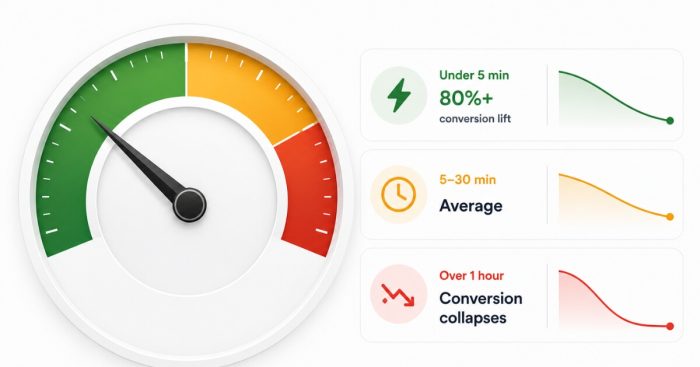
How Fast Should a Cash-Pay Medical Practice Respond to a New Website Lead?
Inside five minutes.
After five minutes, conversion probability drops noticeably. After thirty minutes, it collapses for cold paid traffic. After a few hours, the lead is mostly gone.
Importantly, the five-minute rule isn’t aspirational — it’s the empirical conversion-rate inflection point.
A lead worked inside five minutes of submitting a form converts at multiples of the rate of a lead worked the next day.
The mechanism is straightforward:
- the patient is sitting at their phone or laptop,
- the decision they just made (to fill out the form) is fresh,
- and the answer to their question (about cost, scheduling, what’s included) closes the loop while the intent is still hot.
If you wait too long, they move on to the next clinic, lose the impulse, or talk themselves out of it.
The right way to measure this in Go High Level (or any CRM) is to look at every lead’s creation timestamp and compare it to the timestamp of the first outbound response.
The gap is the response time.
For different traffic sources, the targets change slightly:
- For inbound paid-ad traffic (Facebook, Google, TikTok), the target is under 5 minutes.
- For organic SEO and referral traffic — generally more researched, more patient — under 30 minutes is acceptable.
- For LSA inbound calls, the call is the response, and the only question is whether the front desk picks up (see answer rate below).
The structural fix when response time keeps slipping is to assign one specific staffer to a daily lead-response time block.
An orthopedic regenerative clinic that booked patients at a 79.4% conversion rate from lead to appointment built that conversion rate primarily on response-time discipline — one named owner, one block of time, one set of follow-up cadences.
What Is “Answer Rate” and Why Should a Cash-Pay Clinic Bonus Staff on It?
Answer rate is the percentage of inbound calls the front desk picks up live (versus missed and called back later, or missed entirely).
Cash-pay clinics that hit 90%+ answer rate convert noticeably more inbound leads. In fact, many high-performing practices bonus their entire front-desk team on this single number.
The reason answer rate matters more than most cash-pay clinic owners realize is simple.
The patient who calls during business hours and gets voicemail is fundamentally a different patient than the one who calls and gets picked up.
The voicemail patient has now experienced a tiny failure in their decision-making — the clinic they were ready to call didn’t answer — and the impulse to dial the next clinic in their search is small but real.
Meanwhile, the picked-up patient is already in conversation. The conversation closes the loop.
Large orthodontic practices were the first cash-pay vertical to formalize this.
The Real ADvice nurture-activity training documents reference an orthodontic ops pattern where the entire front-desk team gets a bonus when answer rate exceeds 90% (some practices go higher — 95%).
The logic the founders give is simple:
“If we just do this one thing right, we can figure out everything else.”
As a result, the dollars produced by lifting answer rate from 70% to 92% — on the same lead volume, with no change to ad spend, conversion script, or pricing — typically dwarf the bonus pool by an order of magnitude.
When a call is missed, what happens next matters.
Track the callback time.
- Inbound calls returned within 10 minutes recover meaningful conversion.
- Inbound calls returned the next day might as well not have been returned at all.
Therefore, the answer-rate metric should be paired with a “missed-call callback time” sub-metric so the team can see both numbers and the bonus structure can reward both.

How Should a Cash-Pay Clinic Track Inbound Call Volume Month-Over-Month?
Pull total inbound calls per day from the CRM or phone system, aggregate weekly and monthly, and chart month-over-month.
The number itself isn’t a goal — it’s the denominator under your other nurture-activity metrics.
A cash-pay clinic running paid ads and organic SEO should see total inbound call volume grow month-over-month as the marketing flywheel turns.
If it isn’t growing, the marketing layer needs attention before the front desk gets any new asks.
On the other hand, if it is growing, the front desk should be staffed and trained to keep answer rate above 90% as the volume climbs — otherwise the additional marketing spend is buying calls that get sent to voicemail.
The right dashboard pulls four numbers into a single view:
- inbound call volume per day,
- answer rate per day,
- average response time on website leads,
- and outbound calls per day.
Charted weekly, the dashboard tells the team where to focus.
For example:
- Inbound volume climbing while answer rate dips? Hire or shift the front desk staffing pattern.
- Inbound volume flat while ad spend climbs? Audit the campaign.
- Outbound volume dropping? The lead-nurture cadence needs to be re-enforced.
A regenerative pain clinic we added $2,095,039 in revenue to in 10 months ran this exact dashboard discipline — every front-desk metric in one view, reviewed weekly.
The right time horizon for the volume trend is three months minimum.
One-week swings are noise.
Three-month moving averages tell the truth.
How Many Outbound Calls Per Day Should a Cash-Pay Clinic Make to Its Lead List?
It depends on lead volume.
More specifically, the rule is that outbound activity should be proportional to the active lead list, not a fixed number.
A reasonable starting target is 30–50 outbound touches per day for a clinic with 200–400 active leads in the nurture pipeline.
Outbound nurture activity is the second half of the response-time story.
The first inbound contact gets the lead into the system. Meanwhile, outbound nurture is what keeps the lead from going cold while they’re deciding.
Texts, emails, and outbound calls in a predictable cadence:
- Day 1,
- Day 3,
- Day 7,
- Day 14,
- Day 30,
help catch the leads who didn’t book on the first contact and need a second or third touch.
The bigger error than “not enough outbound activity” is “untracked outbound activity.”
If the front desk is calling, but the calls aren’t logged in the CRM, the clinic can’t tell whether 5 calls or 50 happened, and the conversation about “we need more outbound nurture” goes nowhere.
Instead, make outbound activity visible:
- every call logged,
- every text counted,
- every email tagged.
That way, the team’s actual activity becomes coachable.
The volume target should also factor in the ratio of inbound to outbound work.
For example:
- For a clinic with high inbound volume (paid ads + LSA + SEO all working), 20–30 outbound calls a day on top of inbound load is realistic.
- For a clinic with lower inbound volume, 50–70 outbound calls a day is needed to keep the lead list warm.
Ultimately, the right number is whatever keeps the lead list from going stale while still leaving the staffer time to handle inbound at 90%+ answer rate.
What’s the Right Cadence for Nurturing a Cold Lead at a Cash-Pay Medical Practice?
A 30-day nurture cadence with at least 5–7 touches across multiple channels — text, email, phone call — front-loaded in the first 72 hours and tapering after week 2.
The pattern that works for cash-pay nurture leads, regardless of vertical (HRT, GLP-1, functional medicine, regenerative pain), is roughly:
- Day 0 — immediate response (call or text within 5 minutes)
- Day 1 — follow-up call if no response
- Day 3 — text plus value-add (case study link, FAQ page, before-and-after photo)
- Day 7 — phone call
- Day 14 — text with a soft offer (“happy to answer any specific questions”)
- Day 21 — email with a deeper resource (video, longer write-up)
- Day 30 — final touch with a low-friction CTA (book a 15-minute call)
Every touch should be tracked in the CRM as an activity event.
As a result, the clinic can look at any individual lead and see exactly which touches they received, when, and how they responded.
When a lead converts after 28 days, the team can see what worked.
Likewise, when a lead goes silent, the team can see exactly where the cadence broke down and adjust.
The cadence is not a script.
It’s a structure.
Inside each touch, the front-desk staffer should respond to whatever specific thing the patient said on the prior contact — that’s the nurture part.
The cadence itself is just the frequency and the channel mix.
Most clinics under-touch their cold leads dramatically. Therefore, a 5–7 touch sequence over 30 days is the minimum, not the maximum.
What’s the Next Step?
If your cash-pay medical clinic is tracking booked appointments and not tracking the nurture-activity metrics upstream of that number — response time, answer rate, inbound volume, outbound volume — book a strategy call.
In 60 minutes we’ll:
- set up the four-metric nurture-activity dashboard,
- write the 30-day nurture cadence,
- and map the front-desk bonus structure so the team is paid to do the activity that actually produces the booked appointments.