
Why Does the Cash-Pay Medical Practice That Charges 3.6x More Win the Patient?
A True Story of Two Cash-Pay Clinics in the Same Metro — and Why the More Expensive One Won
A true story of two cash-pay clinics in the same metro, recommended to the same couple — $250 vs $900 for roughly the same labs and consult. The couple called the cheaper clinic first. Twenty minutes later they had booked $1,800 of services at the more expensive one. Here’s why — and how to make sure your clinic is the one winning.
A woman on our team, Victoria, needed bloodwork for herself and her partner Vinny.
We referred them to two existing clients of ours:
- One clinic priced at $250 for consult and labs
- Another priced at $900 for roughly the same services
Naturally, Victoria called the cheaper clinic first because it was:
- Closer
- Cheaper
- The rational choice
However, after being placed on hold and dropped twice, she called the $900 clinic on the third try.
Twenty minutes later:
- She had booked both herself and Vinny
- She committed to $1,800 of services
- She was already half-decided on membership
Meanwhile, the $250 clinic lost far more than a single consult.
They lost:
- Immediate revenue
- Future longevity spend
- Referral opportunities
- Long-term trust
That is the true cost of one mishandled phone call at a cash-pay clinic.
Below is exactly what the winning clinic did — and how to install it at yours.
Why does the cash-pay clinic charging 3.6x more often win the patient over the cheaper option?
Because cash-pay patients are not actually price-shopping.
Instead, they are hospitality-shopping.
By the time a longevity, HRT, functional medicine, or regenerative patient starts calling clinics, they have usually already decided:
“I’m spending money somewhere.”
The only remaining question becomes:
“Which clinic makes me feel like I matter?”
Victoria did not switch to the $900 clinic because $900 was objectively a better deal.
She switched because:
- The cheaper clinic placed her on hold repeatedly
- The more expensive clinic answered quickly
- The staff spent 20 minutes earning trust
Why This Changes the Economics
This is why cash-pay medical practice economics look completely different from insurance-based primary care.
The patient is making:
- An emotional decision
- Wrapped in rational justification
As a result, the clinic that delivers the stronger human experience often wins regardless of price.
Then, over time, that same patient frequently becomes:
- A recurring member
- A high-LTV patient
- A referral source
long after the original phone call.
What’s the true cost of a missed phone call at a cash-pay medical practice (when you add in word-of-mouth)?
The direct cost of one missed phone call is usually somewhere between:
$250 and $5,000 in immediate revenue.
However, the indirect cost becomes dramatically larger.
That missed experience can also create:
- Negative Google reviews
- Lost referrals
- Long-term reputation damage
- Higher future acquisition costs
In practical terms, one bad experience may cost:
- 5–15 future leads
- At $30+ CPL
- Over multiple years
Once you apply HRT or functional medicine LTV math — roughly $4,000–$12,000 per patient — a single mishandled call can realistically cost:
$40K–$120K over five years.
That includes:
- The patient
- Their spouse or partner
- Their referral network
Why Weak Hospitality Destroys Paid Ads
This is also why paid-ad economics become brutal when front-desk hospitality is weak.
For example:
- You spend $30 generating a lead
- The front desk mishandles the call
- The patient leaves with a negative impression
Effectively, you paid money to create distrust.
The HRT clinic we scaled from $1M to $4M in four years treats every inbound call like a $40K decision because, based on their LTV math, it actually is.
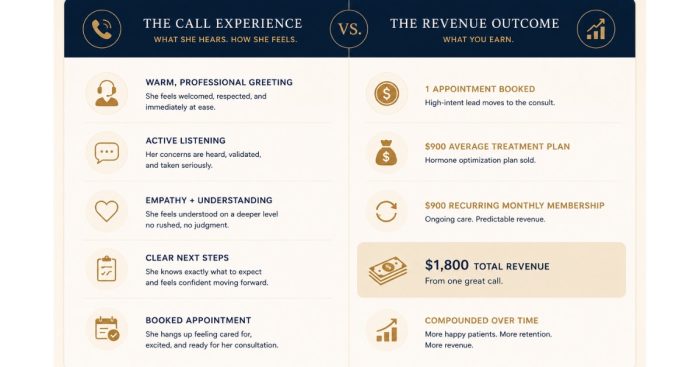
What does “excellent hospitality” actually look like on a cash-pay clinic phone call?
Excellent hospitality starts with simple operational details.
For example:
- The phone gets answered by the second ring
- The voice sounds warm and present
- The caller feels welcomed immediately
Then, during the first two minutes, the front desk:
- Asks the patient’s name
- Uses the patient’s name naturally
- Makes the caller feel important
Sometimes, the conversation lasts 15–20 minutes.
Importantly, the patient never feels rushed.
Instead, they feel like:
“Every question I asked mattered.”
Finally, the call ends with a booked appointment — not with:
“We’ll call you back.”
The Correct Hold Script
Occasionally, putting a patient on hold is unavoidable.
However, the wrong response is:
“Sorry for the wait.”
Instead, the better hospitality script is:
“Thank you so much for your patience — I wanted to be fully present with you on this call. How can I help you today, [first name]?”
That single sentence resets the patient’s emotional state.
Meanwhile, the $250 clinic in this story:
- Delivered an obligatory apology
- Then placed Victoria on hold a third time
Same situation.
Completely different hospitality experience.
How do I make my team prioritize hospitality over admin tasks?
First, make hospitality the explicit top-line responsibility in writing.
Then, make admin work secondary.
Most front-desk team members naturally default toward admin because:
- It feels measurable
- It feels productive
- It can be completed quickly
Meanwhile, hospitality work feels endless and less visible.
Therefore, the owner must clearly install the priority order:
“Every patient interaction comes first. Admin work happens between patient interactions — not the other way around.”
Reward Hospitality Publicly
The fastest way to change team behavior is rewarding the right behavior publicly.
For example:
- Share positive patient comments during huddles
- Post strong Google reviews in the break room
- Celebrate excellent calls in front of the team
If a front-desk team member helps close a $4,000 program through hospitality alone:
- Give them a bonus
- Explain why it mattered
Meanwhile:
- Coach admin mistakes privately
- Celebrate hospitality wins publicly
That asymmetry changes culture.
What CRM and phone-system patterns help front desk teams deliver personal touch at scale?
Three CRM patterns compound over time.
First: Use Caller Recognition
Every existing patient should appear by name when they call.
That allows the front desk to answer with:
“Hi Sarah, this is Maria — how can I help today?”
instead of a generic greeting.
Immediately, the call feels personal.
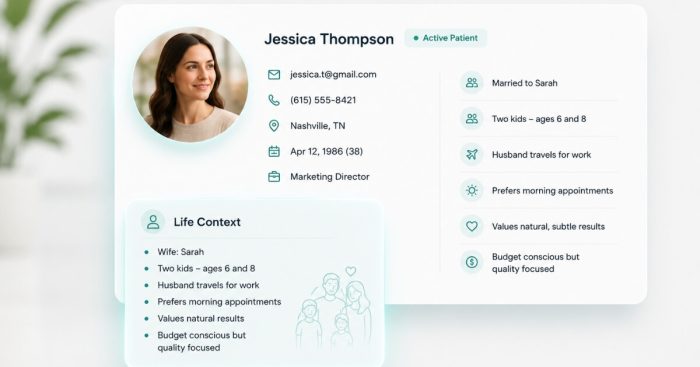
Second: Log Personal Details Inside the CRM
Whenever patients share personal details, save them.
Examples include:
- Spouse names
- Kids’ names
- Marathon training
- Family surgeries
- Travel plans
Then, during future calls, the front desk can naturally ask:
“How did your dad’s recovery go?”
That takes ten seconds.
However, emotionally, it transforms the relationship.
Third: Track Retention Before Churn Happens
The best membership clinics do not wait for patients to disappear.
Instead, they proactively flag patients who have not been seen in 60 days.
Then, the front desk reaches out before churn begins.
Often, the highest-ROI call sounds like:
“Hey, just thinking of you — how’s everything going?”
That one-minute check-in compounds retention dramatically.
What proactive outreach moves drive 30%+ annual revenue growth at a cash-pay membership clinic?
The single highest-leverage move is the unprompted personal check-in.
Every quarter, the front desk or NPC should personally:
- Call
- Text
—not email.
Email feels transactional.
The better outreach sounds like:
“Hey Sarah, this is Maria from Dr. Smith’s office — just wanted to check in. How are you feeling on the new protocol? Anything we should adjust?”
That interaction usually takes:
60–90 seconds.
However, emotionally, it renews the membership before the credit card ever processes.
Why This Compounds Growth
The clinics in our portfolio that execute this consistently often grow:
30–50% annually
without increasing ad spend.
Why?
Because every active member becomes a referral engine.
The functional medicine practice that added 100 new members without paid ads achieved much of that growth through referrals from patients who felt genuinely cared for.
Then, when clinics combine personal outreach with small physical touches such as:
- Birthday cards
- Holiday notes
- Water bottles
- Anniversary gifts
the retention compounding becomes even stronger.
How do I share these hospitality standards with my team without it sounding like another scripted policy?
Start with stories.
Specifically, gather the team into a short huddle and share the Victoria and Vinny story.
Then ask:
“Which clinic do we want to be?”
From there, walk through the specific behaviors:
- Answering by the second ring
- Using the warm hold script
- Logging CRM notes
- Running proactive check-ins
Afterward, invite the team to contribute their own ideas.
Why Stories Work Better Than Policies
Hospitality standards stick when the team helps build them.
Meanwhile, policies handed down from above usually disappear within 30 days.
Most importantly, stories create emotional memory.
Checklists fade.
Stories compound.
Over time, your team will begin telling their own hospitality stories internally.
That is usually the moment the culture becomes real.