
What’s the Funnel Stack That Converts Cold Traffic for a Cash-Pay Medical Practice?
Lead Form → Landing Page → Quiz → Scheduler With Credit-Card Hold
Most cash-pay clinics build one funnel and run every traffic source into it. As a result, their cost per acquired patient becomes unpredictable. Meanwhile, the front desk gets buried in leads that never show.
However, the fix is not a better landing page.
Instead, the fix is a four-step funnel where each step trades volume for quality. Then, a routing rule decides which step a given channel should point at.
At the top, lead forms create the most volume. On the other hand, a scheduler with a credit-card hold creates the highest-quality appointments.
Between those two steps sit:
- A landing page
- A quiz
After running every major patient-acquisition channel across 40 of the fastest-growing cash-pay medical clinics in the country, this is the FAQ on the funnel stack that actually converts cold traffic for a cash-pay medical practice.
What’s the funnel stack that converts cold traffic at a cash-pay medical practice — and why is it four steps instead of one?
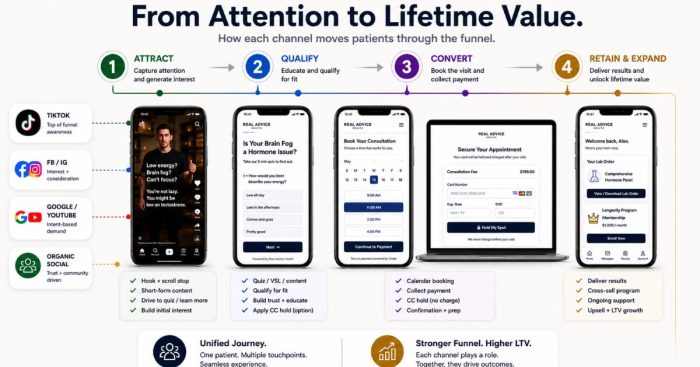
The funnel stack that converts cold traffic at a cash-pay medical practice is a four-step escalating-quality sequence:
- Lead form
- Landing page
- Quiz
- Scheduling page with a credit-card hold
Importantly, it’s four steps instead of one because each step deliberately trades volume for quality.
This is the core principle behind the funnel stack that converts cold traffic, allowing clinics to balance lead quantity, appointment quality, and operational capacity.
As a result, you pick the step that matches:
- The channel
- The goal this month
Step One: Native Lead Form
First, step one is a native lead form on the ad platform itself:
- Meta Lead Ads
- TikTok Lead Generation
- Google Lead Form Extensions
Because the user never leaves the app, friction stays minimal.
Consequently:
- Cost per lead is the lowest
- Volume is the highest
However, quality is also the lowest. In fact, half the people tapping “submit” forget they tapped within ninety seconds.
Step Two: Landing Page
Next, step two is a landing page.
Here, the user clicks the ad, leaves the platform, lands on a single-purpose page on your domain, and fills out a form.
Naturally, friction goes up one notch.
As a result:
- Cost per lead climbs
- Quality climbs even faster
That happens because the user actively chose to leave the feed.
Step Three: Quiz
After that, step three is a quiz.
Instead of showing a simple form, the page asks five to eight qualifying questions before requesting contact info.
As a result, the quiz does two jobs at once:
- It filters out tire-kickers
- It primes serious prospects by walking them through their own problem
Step Four: Scheduler With Credit-Card Hold
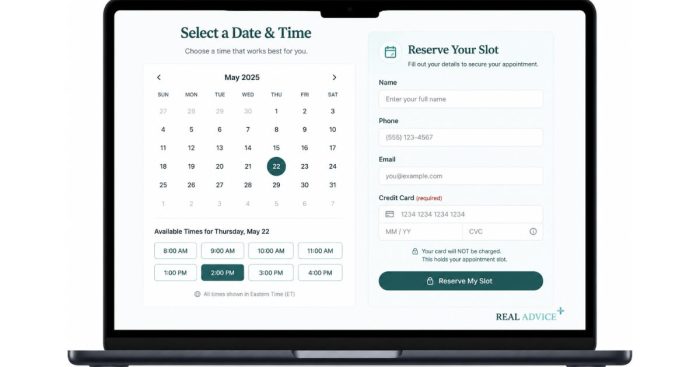
Finally, step four is a scheduling page with a credit-card field to hold the appointment.
At this stage, the user picks a slot and enters a credit card to reserve it.
Importantly, the card is not charged.
Nevertheless, this is the tightest top-of-funnel asset in the stack because attendance rates roughly double versus a free booking page.
When does a cash-pay medical clinic use a Facebook/Instagram lead form vs. a landing page?
A cash-pay medical clinic uses a Facebook/Instagram lead form when it needs raw lead volume from a low-CPL platform and has the sales team to call hundreds of leads same-day.
By contrast, it uses a landing page — or a VSL + quiz + scheduler — when:
- The offer is high-ticket
- The team is small
- Attendance rate matters more than lead count
Essentially, the lead-form question is really a sales-capacity question.
Meta Lead Ads are the cheapest top-of-funnel asset on the platform because:
- The user never leaves the app
- The form pre-fills name/email/phone
- CPL is a fraction of landing-page traffic
However, the user invested almost zero effort.
Therefore, the show rate becomes brutal unless someone calls within five minutes.
FB/IG ads “require very fast follow-up or the likelihood of success is low.”
In other words, that’s not a slogan. It’s the operational reality.
Without a sales rep dialing within five minutes, lead forms will bankrupt you on no-shows.
When the Landing Page Route Wins
Meanwhile, the landing-page route works best when:
- The offer is over the $3,000 front-end-cash threshold
- Your team can’t keep up with same-day dials
On FB/IG, Anton’s default for a meaningful-ticket offer is:
“a VSL and a quiz, with a calendar and a credit card to reserve the spot.”
As a result, three filters get stacked together:
- The VSL filters by attention span
- The quiz filters by clinical fit
- The credit-card hold filters by financial intent
Therefore, cost per scheduled appointment becomes the metric that matters most.
Not cost per lead.
Rule of Thumb
Use a lead form when:
- You have a hungry sales team
- The offer is under three grand
- The offer moves fast
On the other hand, use a landing page + quiz + credit-card hold when:
- The offer is $3K+ front-end
- The sales team is small
- You’re tired of paying for leads that never pick up the phone
What does a quiz funnel do that a landing page can’t for a cash-pay clinic — and which treatments need one?
A quiz funnel pre-qualifies cold traffic against your clinical criteria and walks prospects through their own problem before asking for contact info.
By comparison, a flat landing page can’t do that.
As a result, the treatments that need a quiz are:
- Treatments where the patient is problem-aware but not solution-aware
- Treatments where eligibility filtering happens before the consult
Landing Page vs. Quiz
A landing page is a pitch.
Meanwhile, a quiz is a diagnostic conversation.
On a landing page:
- You tell the prospect what the offer is
- You ask them to fill out a form
On a quiz:
- They answer five to eight questions
- They describe symptoms
- They explain goals
- They articulate current state and history
By the end, they’ve articulated their own problem in their own words.
Because of that, the self-articulation becomes the conversion event.
Consequently, the contact form at the end of the quiz feels like the next natural step instead of an interruption.
Which Treatments Need a Quiz?
Quiz funnels work especially well for treatments where the patient is problem-aware but not yet solution-aware.
For example, gut health is the textbook case.
“a gut health patient is Problem aware, they know they have a problem, and they imagine that solutions could exist, but they just don’t know where to start.”
Therefore, a flat landing page selling “gut health consult” doesn’t move that prospect.
By contrast, a quiz titled:
“Find out which gut issue is actually driving your symptoms”
walks them up the awareness ladder.
Similarly, the same pattern applies to:
- Functional medicine
- Hormone optimization for first-time TRT/HRT patients
- Neuropathy
- Joint pain
These are all problem-aware categories where a quiz outperforms a landing page on quality.
Real-World Proof
For a real-money proof point on multi-channel paid:
This is what we ran across NuLevel — a weight-loss and medspa clinic where we added $6.7M in revenue in one year across 3,727 new patients.
The funnel stack across TikTok, Meta, and Google rotated:
- Lead forms
- Landing pages
- Quizzes
- Scheduler-with-CC-hold pages
Moreover, the routing changed by:
- Channel
- Offer
Not one funnel for everything.
When Else Should You Use a Quiz?
Additionally, a quiz is the right call when eligibility filtering needs to happen before the consult.
Examples include:
- BMI for GLP-1
- Lab ranges for TRT
- Prior treatment history for regen
As a result, filtering inside the quiz ensures you only book consults for prospects who qualify.
Why does a credit-card hold on the scheduling page double the attendance rate at a cash-pay medical practice?
A credit-card hold on the scheduling page roughly doubles the attendance rate because it forces the prospect to demonstrate financial intent before they ever reach the consult.
Consequently, people who enter a credit card to reserve a slot show up at a far higher rate than people who only enter a phone number.
Importantly, the card isn’t charged.
Instead, the microcopy says exactly this:
“Your card will NOT be charged. This holds your appointment slot.”
The reason it works is psychological commitment, not financial.
For example, a prospect who enters:
- Name
- Phone
is curious.
Meanwhile, a prospect who enters:
- Name
- Phone
- A credit card
is committed.
That tiny “I am the kind of person who pays for medical care” decision predicts whether they show up.
Why This Matters Financially
This is why Anton’s tightest-quality funnel step is:
“a scheduling page with a credit card field to hold the appointment.”
Importantly, it’s not a payment gate.
Instead, it’s a filter against the most expensive event in a cash-pay clinic:
A no-show on a paid lead.
For example:
- Spend $100 per FB/IG lead
- Book 10 consults
- Only 4 show
As a result, cost per show becomes $250.
Now add the credit-card hold:
- You might only book 7
- However, 6 of those 7 attend
Consequently, cost per show drops to roughly $167.
At the same time, the consult team stops working empty calendars.
Why It Also Works for Organic Social
Additionally, the credit-card hold is also the cleanest filter for organic social.
Anton’s organic monetization pattern is:
“a free Discovery call page where they have to put a credit card into reserve their appointment — they don’t have to pay just put the credit card into reserve the slot.”
By this stage, the prospect already:
- Followed you on social
- Watched your content
- Decided to book
Therefore, the credit-card field separates real bookings from casual ghosts.
How does Anton route TikTok, Facebook/Instagram, Google, and organic-social traffic through different funnel stages?
Anton routes each channel through a different funnel stage based on what that channel is best at.
TikTok
Typically, TikTok defaults to a lead form for volume.
The audience skews female, while aesthetic and high-LTV offers perform especially well.
“The ways I have done it are to a lead form for more volume, if I want more quality I go to a landing page, if I want more quality I go to a scheduling page with a credit card field to hold the appointment.”
As a result, there are three settings on the same dial:
- Lead form to feed the team
- Landing page for better show rate
- Scheduler with CC hold when attendance matters
Facebook/Instagram
Meanwhile, FB/IG has a massive, diverse audience.
Therefore, almost any offer can work with:
- Fast follow-up
- An aggressive offer
Default routing is:
“to a VSL and a quiz, with a calendar and a credit card to reserve the spot.”
As a result, cost per schedule becomes the core metric.
Not cost per lead.
For most cash-pay clinics over the $3,000 front-end-cash threshold, Meta should be running:
- VSL
- Quiz
- CC-hold scheduler
Google traffic carries higher intent because the user typed the search term directly.
Therefore, a landing page becomes the default route.
“I pretty much always run them to a landing page because I want to be able to track conversions, I’ll do a quiz if I want to make them more quality and then after the quiz I really want to gauge intent I’ll go to a scheduling page with a credit card on it.”
Again, the same dial controls:
- Volume
- Quality
- Attendance
Organic Social
Finally, organic social is the slowest channel.
However, it also produces the highest-quality leads.
Because of that, send those prospects straight to:
“a free Discovery call page where they have to put a credit card into reserve their appointment — they don’t have to pay just put the credit card into reserve the slot.”
At that point, skip:
- The lead form
- The quiz
The audience already self-qualified.
When should a cash-pay medical practice use call-only ads instead of running traffic to a landing page?
A cash-pay medical practice should use call-only ads instead of a landing page when the intent on the keyword is extremely high.
At that point, the patient is:
- Most-aware
- Ready to buy
Therefore, the friction of a landing page or scheduler costs you the call.
What Makes Call-Only Ads Different?
Call-only ads sit outside the lead-form-to-scheduler sequence.
Instead, they’re the version of the funnel where the click-to-call button IS the funnel.
“For like really high intent I will do call only ads.”
Typically, the use case involves a prospect at the most-aware stage.
They already know:
- The problem
- The solution
- The product
Now they’re searching for someone to deliver it immediately.
Examples include:
- “Botox near me”
- “TRT clinic open today”
- “knee injection appointment”
In these searches, any extra step between the ad and the phone ringing costs you the patient.
Why This Works
This is also the play to copy from Local Service Ads, which run on the same ad-to-call model.
If you can navigate the LSA policies:
“this is a fantastic way to get business because most people can’t navigate the policies.”
In other words, the same mechanic applies.
The ad IS the funnel.
The Trade-Off
However, the trade-off is:
- Lower visibility into ROAS
- Less pixel-trackable conversion data
Call-only ads don’t drop a pixel-trackable conversion the way a landing-page submit does.
Therefore, you’ll need:
- Call tracking
- Call recording
As a result, you only run call-only ads when the keyword is genuinely high-intent.
Problem-aware or solution-aware traffic usually does not survive call-only.
Instead, those prospects still need:
- The landing page
- The quiz
- The scheduler
to walk them up the awareness ladder first.
What’s the next step?
The funnel stack is solvable.
First, build all four assets once:
- Lead form
- Landing page
- Quiz
- Scheduler with a credit-card hold
Then, route traffic into the right step for the channel and the goal.
That’s how you stop running every paid dollar into one landing page and wondering why TikTok and Facebook produce wildly different unit economics.
If your cash-pay medical practice is:
- Paying for leads that don’t show up
- Running every channel into one funnel because that’s the funnel you happened to build first
then the path forward is to map your current traffic to the four-step stack.
We did exactly this across a pain management and regenerative medicine clinic where we added $2,095,039 in revenue in 10 months.
Different offers.
Different channels.
Different funnel steps.
Yet the same underlying stack still applied.